









Artificial intelligence is becoming increasingly accessible across workplaces, yet its adoption alone is not guaranteeing meaningful productivity improvements. The challenge for organisations is translating individual experimentation into measurable business outcomes through redesigned workflows, stronger leadership and workforce development.
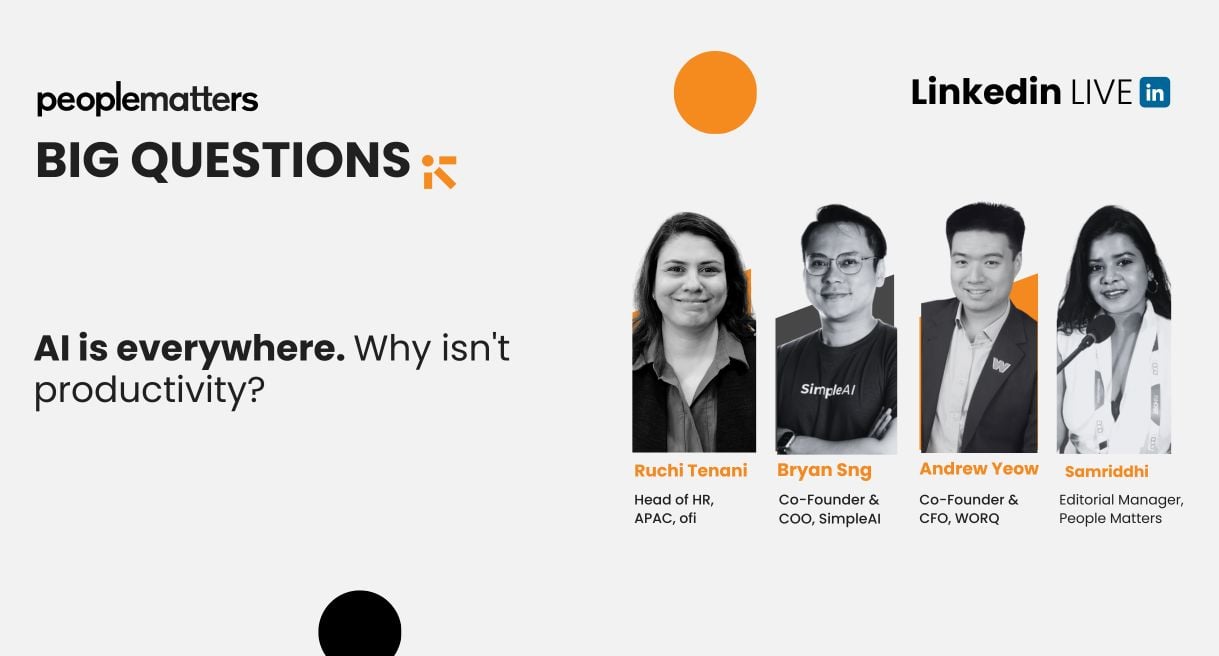
At the September edition of People Matters Big Questions Southeast Asia, three leaders examined why AI investments are not consistently translating into enterprise-wide gains. The LinkedIn Live discussion featured Ruchi Tenani, Head of HR, APAC, at ofi; Bryan Sng, Co-Founder and COO of SimpleAI; and Andrew Yeow, Co-Founder, CFO and Strategist at WORQ.
Their perspectives pointed towards a common distinction: using AI to accelerate individual tasks is different from changing how an organisation operates. The discussion examined the implications for business strategy, management practices, employee skills and the infrastructure needed for effective deployment.
Productivity depends on moving beyond individual adoption
For Bryan Sng, the gap between AI adoption and productivity gains reflects how organisations have progressed through different stages of implementation. He described four stages, beginning with leaders using AI for research, followed by employees using it to create presentations, documents and email responses.
The next stages involve AI becoming a teammate that supports operational processes, before eventually functioning as a system running automatically across an organisation.
Sng observed that much of the attention during the previous two years had centred on AI as an assistant. While these applications can accelerate work, faster execution does not necessarily establish improvements in quality or overall productivity.
He explained the distinction through software engineering, where the allocation of effort is changing as AI tools become more capable.
“In the past, software engineers used to spend 70% of the time coding, 30% of the time designing product.”
He continued: “But now they're spending 40% of the time understanding proprietary workflow, 30% of the time product design, the balance they do for coding.”
The example illustrates how productivity improvements can emerge when employees redirect their effort towards understanding business requirements and designing products, rather than concentrating primarily on code production.
Sng also highlighted the potential of generative AI in financial services, particularly accounting and financial administration. Traditional automation technologies such as robotic process automation and optical character recognition were more limited when handling information requiring conversion between unstructured and structured formats.
He noted that generative AI can handle unstructured information in ways that were previously difficult to automate, creating opportunities for productivity improvements in accounting.
Smaller organisations are moving faster
Andrew Yeow offered a complementary perspective, suggesting that productivity gains are already appearing across particular teams and businesses. However, scaling those gains across larger organisations presents a different challenge because established policies, procedures and processes take time to change.
Drawing on WORQ's experience as a coworking and office provider, Yeow observed that startups and smaller technology companies are among the early adopters. AI tools are enabling smaller teams to undertake work across functions without requiring the same breadth of specialist resources previously needed.
He described the changing possibilities for entrepreneurs and small businesses, saying: “But these days, actually, I do see that for a one man team, two man team, they can actually get much more done than they could in the past.”
He also pointed to the growing accessibility of software development, finance and legal-related tasks, although the discussion did not establish quantified productivity gains across these functions.
Yeow's central observation was that productivity improvements are already happening, but remain concentrated in particular functions and departments. Larger organisations need to examine their operating models and customer value propositions before expecting similar gains to scale across the enterprise.
Ruchi Tenani connected these observations to organisational change, emphasising the transition from individual adoption towards team collaboration and enterprise-wide implementation.
“Actually, that value will be created at an organisational level when teams are being productive in a more meaningful way,” she said.
At ofi, Tenani explained, the starting point is business-led rather than technology-led. Organisations must establish what they want to achieve before assessing how AI can enable those outcomes and where existing processes require changes.
“We know what we want, how do we want it. And then we are enabling and looking at our current workflows, our processes to say how AI can enable and where we need to change our processes internally to ensure AI is at the forefront of those.”
Her perspective places workflow redesign at the centre of AI adoption, rather than treating technology deployment as an independent transformation objective.
Leadership must address business problems, not technology enthusiasm
The discussion also examined how management decisions and organisational culture influence the outcomes of AI investments. Tenani stressed the importance of defining the underlying business problem before deciding which technology to deploy.
“At the end of it, if it is not a technology problem, it cannot be a technology solution,” she said.
For leaders, the distinction requires clarity about business objectives and an environment where employees can explore new tools without feeling discouraged from experimenting. Tenani identified psychological safety and openness to change as important leadership responsibilities.
Sng approached the same challenge through implementation, emphasising the need for a designated internal champion who can coordinate adoption and guide process changes. His recommendation reflects the importance of assigning responsibility rather than assuming employees will independently integrate AI into established workflows.
He explained the principle behind his approach: “AI is not here to replace human but it's here to actually replace processes or tasks.”
Sng also recommended identifying initial opportunities where AI can produce practical benefits before extending implementation further. Reviewing processes and integrating AI into them are necessary, he suggested, if organisations want to achieve its full effectiveness.
Yeow placed employee experience alongside process redesign, describing AI as a potential learning aid that can help people develop capabilities and undertake higher-value work. He cautioned against introducing sweeping changes before employees become comfortable with the technology.
For organisations, the implication is that change management, process redesign and employee confidence need to progress together. Deploying tools without preparing people and operating models risks limiting their contribution to business performance.
Workforce readiness requires more than enthusiasm for AI
Tenani said employees are interested in exploring AI, but organisations must provide opportunities to develop and apply new skills within their existing roles.
“We have to really practically merge our work experiences around the job as well as our learning experiences,” she said.
The challenge is integrating learning into daily work rather than expecting employees to develop new capabilities separately from their responsibilities. Tenani linked this approach to the ability to translate employee development into improved business performance.
She also cautioned against assuming that AI adoption should look identical across generations, roles and experience levels.
At ofi, she described teams working with large datasets and advanced analytics in areas including training and supply chain efficiency, alongside operational employees whose immediate technology requirements differ.
“AI does not mean one-size-fits-all kind of a thing,” she said.
The distinction matters for workforce planning because different jobs require different levels of adoption, training and technical proficiency. A uniform implementation strategy may not reflect the actual requirements of individual teams.
Sng highlighted another dimension through the accounting profession, where adoption patterns can differ by seniority. Partners may focus on opportunities to improve productivity and profitability, while junior employees may be more willing to experiment with AI tools.
Middle managers, however, must balance process improvements with maintaining output quality and ensuring junior colleagues develop foundational accounting knowledge.
He described the resulting organisational shift through a structural analogy: “But I think gradually it will become like a diamond shape because the corner part are actually augmented by AI.”
His observation raises questions about how entry-level responsibilities may evolve as AI takes on more routine tasks. It also highlights the importance of preserving opportunities for employees to acquire the technical knowledge traditionally developed through early-career experience.
Governance and accountability become critical as deployment expands
Yeow highlighted the risks associated with moving from early experimentation to more extensive AI deployment. He stressed the importance of establishing appropriate infrastructure, policies, safeguards and measures before integrating AI more deeply into business operations.
As AI agents begin working alongside employees, organisations must consider how responsibilities are divided and how systems interact without duplicating work or creating confusion.
Yeow explained: “But now actually we have AI agents and then we have people side by side. And actually they need different infrastructure to work well with each other yet not overlap their work.”
He also identified data protection and clarity over the respective responsibilities of people and AI systems as important considerations. The discussion did not specify particular governance frameworks, but highlighted the need to plan safeguards before scaling deployment.
Tenani returned to the importance of business priorities when addressing mistakes leaders make during implementation. She cautioned against adopting AI simply because the technology is attracting attention or organisations fear being left behind.
Instead, leaders should identify where AI can differentiate their businesses and remain open to ideas emerging across organisational levels.
Sng reinforced the need for targeted implementation, recommending that organisations identify the processes most suitable for automation, appoint internal champions and examine how data will be incorporated into AI systems.
These perspectives suggest that successful AI deployment requires clear ownership, appropriate safeguards and a defined connection between technology decisions and business objectives.
The next test is measurable business value
The discussion at People Matters Big Questions Southeast Asia highlighted a shift in the AI conversation, from widespread experimentation towards the more demanding question of enterprise-level value creation.
The leaders identified several priorities for organisations seeking to move beyond isolated productivity improvements:
Redesign workflows: Integrate AI into business processes rather than relying exclusively on individual productivity tools.
Define business outcomes: Identify the problems AI should solve before selecting technologies or expanding deployment.
Prepare employees: Combine practical learning with daily responsibilities, while adapting adoption strategies to different roles and experience levels.
Establish accountability: Assign implementation ownership and develop appropriate infrastructure, policies and data safeguards.
Preserve foundational skills: Ensure automation does not eliminate opportunities for employees to acquire the technical knowledge needed for future responsibilities.
The discussion did not establish a universal formula for measuring AI-driven productivity, nor did it quantify the financial returns organisations can expect. Instead, the speakers identified organisational design, workforce readiness and implementation discipline as factors influencing whether adoption produces meaningful results.
For businesses across Southeast Asia, the next phase of AI adoption will depend on how effectively leaders connect technological capability with the work their organisations need to accomplish. The central challenge is no longer simply making AI available, but determining where it changes performance, how employees contribute alongside it, and whether those changes create measurable business value.