









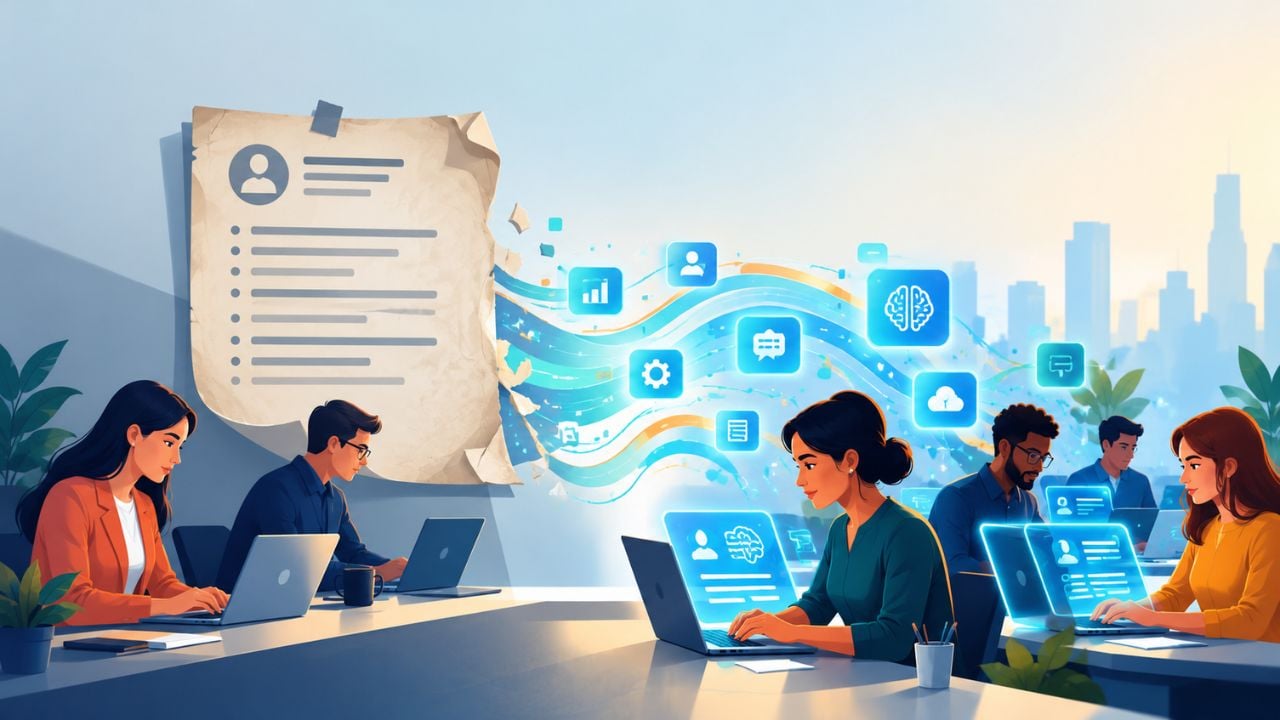
AI adoption across Southeast Asia is accelerating, but the conversation inside organisations is beginning to change. The question is no longer simply where AI can be deployed. Increasingly, leaders are asking how it can move beyond isolated use cases to reshape work, improve decisions and create measurable business value.
That transition is proving difficult. While organisations are experimenting rapidly, only 25% are currently at the stage of creating business impact or enterprise-wide transformation through AI and HR technology. Most remain at functional adoption, with recruitment and HR operations leading because they offer relatively visible and immediate gains. Employee experience, performance and learning remain less penetrated, in part because they depend more heavily on context and human judgment.
Against this backdrop, People Matters and HONO.ai brought together HR and business leaders in Bangkok for a roundtable on “The New Role of HR: Leading Business Change in the AI Era.” The session explored what it takes to move AI from experimentation to sustained enterprise impact, and how HR’s own mandate needs to change in the process.
The conversation included leaders from HONO.ai, including Boonchoo Malhotra, Southeast Asia Business Head and Country Director for Thailand and Malaysia, alongside transformation practitioners and senior people leaders from across industries. It was grounded in findings from People Matters’ SHRPA 2026 research, which identified scaling AI beyond pilots as one of the most significant challenges facing organisations today.
Start with the work, not the technology
One of the clearest messages from the room was that AI transformation cannot begin with a search for use cases simply because the technology is available.
Leaders instead pointed to a more fundamental starting point: What business problem are we trying to solve?
That could mean reducing hiring time, improving workforce productivity, strengthening customer experience, reducing operational waste or giving managers better information for decision-making. Once the objective is clear, organisations can determine which work should change, which roles need to evolve and where AI adds value.
Participants described organisations mapping AI opportunities across the employee journey, building roadmaps for HR and support functions, identifying initial “low-hanging fruit” and then testing adoption before scaling. Others shared examples ranging from HR policy intelligence and employee-service chatbots to engagement insights, workforce planning and manufacturing automation.
But the discussion also highlighted a risk: implementation can move faster than organisational learning. A technically successful pilot does not automatically translate into sustained adoption.
This is why enterprise AI maturity requires several foundations to develop together. SHRPA identifies six: strategic clarity, ownership, technology alignment, data readiness, workforce AI readiness and HR operating-model reinvention. In particular, ownership, data and workforce readiness need to be addressed early rather than added once implementation is underway.
For HR, this represents an important shift. Its role is increasingly not just to introduce another tool, but to help the organisation rethink work, roles, skills and the capabilities required to perform them.
AI can create speed. Human judgment still creates direction
As AI becomes embedded in everyday workflows, organisations are also discovering the limits of automation.
One observation during the discussion captured this distinction simply: AI can provide speed, but it cannot replace the responsibility to make a decision.
That distinction matters as AI moves from automating transactions towards supporting planning, analytics and increasingly complex recommendations. Faster access to information can help leaders identify workforce risks, analyse talent portfolios, anticipate turnover or respond to changing business conditions. But participants repeatedly stressed that these insights still require interpretation.
The human-in-the-loop therefore becomes more important, not less. This is particularly visible as employees themselves become more comfortable using generative AI. One participant described moving from an initial challenge of encouraging adoption to a new problem: employees accepting AI-generated output without adequately reviewing it. The capability requirement had shifted from simply knowing how to use AI to knowing when to question it.
Critical thinking, contextual judgment and accountability consequently become central components of AI readiness.
The same applies to governance. Participants discussed the need for guardrails around data access, privacy, model selection and usage. Yet governance cannot become so restrictive that it eliminates the agility AI is supposed to create. The challenge is to design controls around the risk and business value of the use case rather than applying the same restrictions everywhere.
The goal, then, is neither unchecked experimentation nor rigid control. It is an operating environment in which employees can use AI confidently while understanding where human accountability begins.
Productivity and employee experience should reinforce each other
Perhaps the most important reframing during the session concerned the perceived tension between productivity and people.
AI programmes are frequently justified through efficiency: less manual work, faster processes, lower costs and greater output. Employees, meanwhile, are often looking for flexibility, growth, wellbeing and meaningful work. Treating these as competing priorities can lead organisations into a false trade-off.
The discussion instead focused on their intersection. When AI removes repetitive work, simplifies access to information or helps managers respond more effectively, productivity gains can improve the employee experience at the same time. The opportunity is to use the capacity released by technology for higher-value work, stronger human interaction, learning and better decision-making.
As one discussion thread emphasised, employees also need psychological safety as jobs and skills evolve. They need visibility into how their roles are changing, what new skills matter and where they can continue to create value. An environment that allows people to experiment, learn and sometimes fail becomes an important part of workforce readiness.
This changes the way HR should think about experience. Employee experience is no longer only about human-to-human touchpoints. It also includes the employee's experience of technology itself: whether a tool makes work easier, whether self-service actually resolves problems and whether AI enables employees to spend more time on work that matters.
And that creates a broader measurement challenge. Adoption rates and cost savings remain useful, but they are only early indicators. Organisations increasingly need to examine productivity, service quality, business outcomes, employee experience, decision quality and how employees reinvest the time AI gives back to them.
HR’s mandate is getting bigger
If there was one underlying shift connecting the conversation, it was this: AI transformation is becoming a workforce transformation agenda.
The technology may sit across functions, but many of the questions it creates sit squarely within HR's mandate. Which work changes? Which skills become more valuable? How should roles be redesigned? How do leaders prepare people for that transition? And how do organisations preserve trust and judgment while increasing speed?
For HR, this means moving beyond its traditional role as an architect of policies and processes. The emerging mandate is broader: helping architect the relationship between talent, technology and transformation.
AI can automate a process. It can identify patterns and compress the time required to reach an answer. But turning those capabilities into enterprise value still depends on choices about people, work and organisational design.
That is where HR's next opportunity lies.