









Artificial intelligence is advancing rapidly, but the biggest question for organisations may no longer be what AI can do. It is what businesses, leaders and employees should ask it to do.
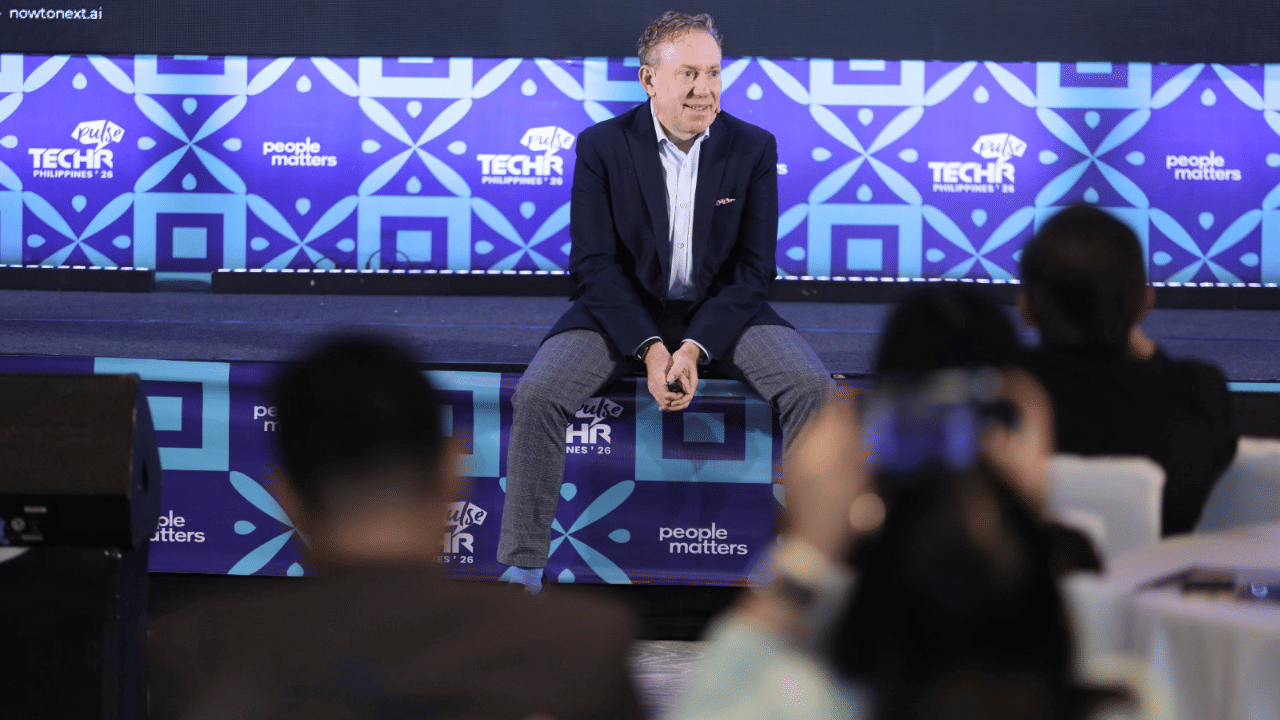
That was the central message from Jason Averbook, Co-Founder of Now to Next, during his keynote, “You Are the Variable: Turning AI Possibility into Philippine Growth.” Rather than framing AI purely as a technology or HR issue, Averbook positioned it within a broader “world of change”, where organisations must rethink how work is designed, how employees experience it and which tasks should remain distinctly human.
His argument was less about adopting another technology and more about redesigning work around outcomes.
From being connected to building connection
Averbook began by drawing a distinction between being connected and building meaningful connections – a distinction he believes is increasingly important in a technology-driven workplace.
Employees today have unprecedented access to digital tools, platforms and information. Yet greater connectivity does not necessarily translate into stronger human connection.
The same tension exists inside organisations. Employees are accustomed to seamless digital experiences in their personal lives, whether shopping online, consuming content or managing everyday tasks. At work, however, they can still encounter portals, intranets and processes that require them to navigate organisational structures rather than simply get something done.
The gap raises a fundamental question that if it is 2026 outside the workplace, what year does it feel like inside it?
For Averbook, modernising employee experience is therefore not simply about introducing newer technology. It is about understanding how people expect to interact with technology and bringing some of those expectations into the workplace.
The question is no longer only what AI can do
AI's growing ability to perform knowledge work is changing the nature of the debate. Averbook cited predictions made in 2025 and 2026 about AI's potential to automate increasingly large portions of software development and professional work. But rather than focusing on whether those predictions will materialise exactly as stated, he used them to make a broader point.
The critical question for organisations is not simply “Could AI do this?” but “Should AI do this?” That distinction has significant implications for HR, IT and business leaders.
The ability to automate a task does not automatically make automation desirable. Some activities may be faster and cheaper when performed by machines, while others depend on judgement, empathy, context and human relationships.
This creates an opportunity to rethink work rather than simply accelerate existing processes.
AI cannot fix a broken process
One of the strongest themes of the keynote was the risk of using AI to accelerate processes that are already ineffective.
Averbook argued that organisations can easily fall into the trap of placing AI on top of existing systems without questioning whether those systems should exist in their current form.
Performance management was one example. If a process is already poorly designed, introducing AI may simply allow the organisation to execute the same flawed process faster.
The implication is straightforward: automation should not be confused with transformation.
Averbook encouraged organisations to distinguish between iterative AI, which reduces friction within an existing process, and innovative AI, which enables organisations to rethink how the work itself should be designed.
The difference is significant. Making an existing process faster may create efficiency, but redesigning the process around a better outcome can create a more fundamental shift in performance and employee experience.
The future of work: hands, heads and hearts
Averbook offered a simple framework for thinking about which parts of work should be automated. Work, he suggested, can broadly be viewed through three dimensions: hands, heads and hearts.
- Hands represent repetitive, documented and auditable activities — such as data entry, scheduling and document processing. These are areas where AI can potentially take on a larger role.
- Heads involve judgement, decision-making and working alongside technology to interpret information and solve problems.
- Hearts represent the human dimensions of work, including empathy, relationships and moments of connection with employees.
The opportunity for HR is therefore not simply to remove work. It is to reduce the amount of time spent on repetitive activities so that people can devote more attention to judgement, problem-solving and human interaction.
This reframes automation as a way to redistribute human capacity, rather than simply reduce human involvement.
Four resets for an AI-enabled organisation
Averbook outlined four areas organisations need to reconsider as AI becomes more deeply embedded in work: mindset, heart set, skill set and tool set. The order matters.
Organisations often begin with the technology — purchasing AI tools, expanding licences or introducing new platforms. Averbook argued that this approach can miss the more fundamental questions around why the technology is being introduced and what the organisation is trying to achieve.
The mindset reset involves moving away from an excessive focus on controls and processes towards trust, outcomes and collective intelligence. It also requires organisations to view change as an ongoing part of strategy rather than an occasional disruption requiring a traditional change-management programme.
The heart-set reset focuses on the human concerns that accompany technological change. Employees may worry that AI will take their jobs, question what they will do if machines take over tasks they have mastered, wonder whether they can trust the technology or ask whether their own contribution will remain relevant.
These concerns cannot simply be addressed through communication campaigns or training programmes. They need to be acknowledged as part of the redesign of work.
Skills will matter — but not necessarily the ones people expect
The rise of generative AI is also changing how organisations think about skills. Averbook challenged the idea that becoming an AI expert necessarily means mastering prompt engineering or learning a particular AI tool.
Instead, he highlighted capabilities such as curiosity, judgement, storytelling, process fluency and the ability to understand how different parts of an organisation connect.
This represents a shift from narrow functional expertise towards broader organisational understanding.
Employees will increasingly need to work across traditional boundaries rather than remain confined to vertical organisational structures. For HR professionals in particular, this means understanding how technology, business strategy, employee experience and organisational processes intersect.
Storytelling also becomes more important. As AI generates increasing amounts of information, the ability to explain what that information means, why it matters and what should happen next can become a differentiating human capability.
From AI adoption to AI embodiment
Perhaps the sharpest challenge Averbook posed to organisations was around how they measure AI success. He questioned the value of celebrating adoption rates simply because employees have logged into or used an AI tool.
Usage alone does not demonstrate transformation. Instead, organisations should ask whether AI has changed how work is done, whether the quality of work has improved and whether employees are completing tasks with less rework. This represents a shift from adoption to embodiment.
Under an adoption model, success can be measured through licences, log-ins or usage statistics. Under an embodiment model, the focus moves towards outcomes: Is the work better? Is it faster where it needs to be? Is there less rework? Has employee capacity been redirected towards higher-value activities? The latter is harder to measure, but potentially more meaningful.
The human role in the AI workflow
Averbook also offered a practical way of thinking about the division of labour between people and AI. He described the process as 10% human, 80% AI-assisted and 10% human.
- The first 10% is about defining the purpose: What are we trying to achieve and why?
- The middle 80% is where AI can assist with generating, processing or developing the work.
- The final 10% returns to the human: validating the output, applying judgement, considering context and communicating the result effectively.
The model reinforces the idea that AI should support human thinking rather than eliminate it. The human role becomes particularly important at the beginning and end of the process, defining the problem and deciding whether the answer is actually good enough.
For organisations unsure where to begin, Averbook suggested starting with one outcome rather than one process.
Instead of deciding to “transform onboarding”, for example, an organisation could define a specific outcome it wants to achieve, such as enabling a new salesperson to become productive more quickly. That distinction changes the starting point.
Once the outcome is clear, HR, IT and business teams can work together to redesign the experience around it, rather than attempting to automate an existing process simply because it already exists.
This also challenges the traditional separation between HR and IT. As technology becomes embedded across every function, the boundaries between technology work and people work become increasingly difficult to maintain.
Ultimately, AI may dramatically change how work gets done, but people remain responsible for deciding what work is worth doing and what good looks like. The technology may eventually allow employees to move away from navigating individual applications and instead communicate the outcome they want to achieve. But that does not remove the need for human judgement.
For organisations in the Philippines and elsewhere, the opportunity is therefore larger than AI adoption. It is about using AI to rethink productivity, skills, employee experience and organisational design.
The organisations that benefit most may not necessarily be those that deploy the greatest number of AI tools. They may be the ones willing to question their existing processes, redesign work around outcomes and deliberately decide where machines should contribute — and where humans should remain at the centre.