









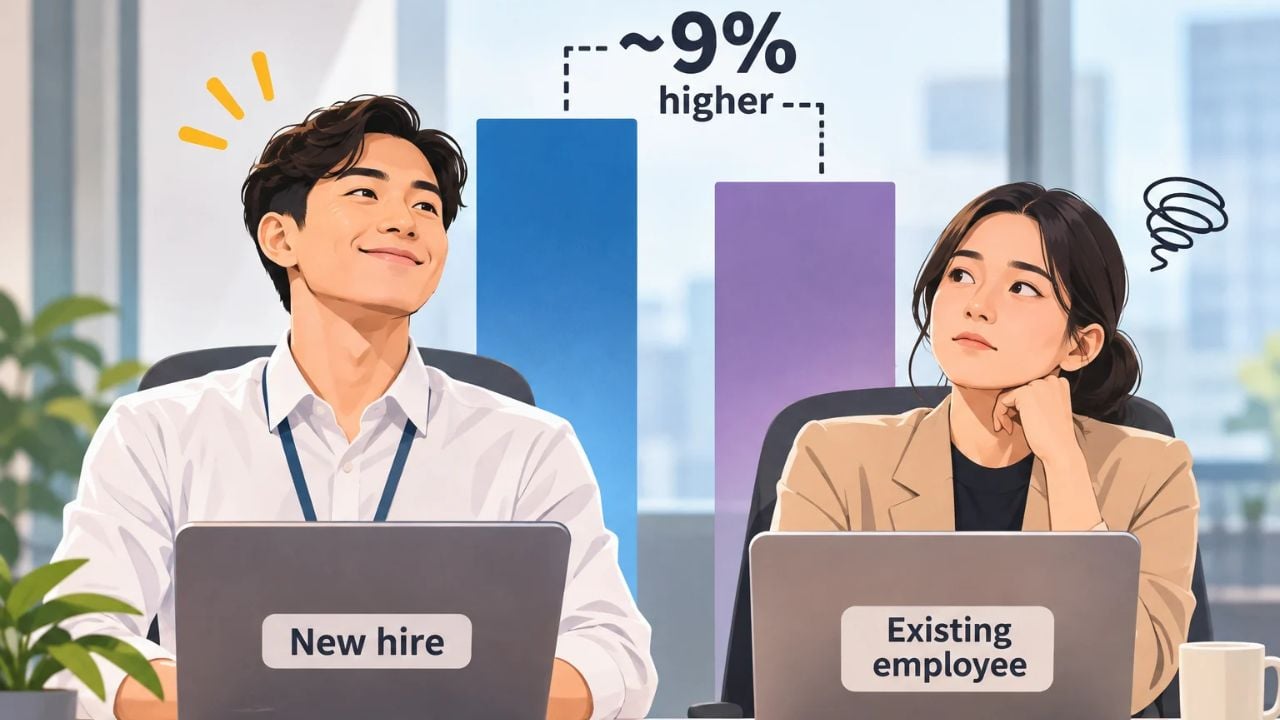
An employee spends years with an organisation, develops new skills and earns a promotion. Yet, despite taking on greater responsibilities, the employee may still earn less than someone hired externally for the same position.
This highlights a growing compensation challenge known as salary compression, where the difference in pay between employees with varying levels of experience or tenure becomes smaller than expected. In some cases, new hires may even earn more than existing employees performing comparable roles.
The issue is becoming increasingly relevant for employers in Singapore, where companies are competing for talent while trying to retain experienced employees.
Singapore's wage system adds another dimension to this challenge. The country does not have a universal statutory minimum wage. Instead, salaries are largely determined through negotiations between employers and employees, with market demand, skills and productivity influencing pay.
While this gives employers flexibility in setting salaries, it also raises questions about whether existing employees' pay is keeping pace with the salaries offered to new hires.
Why Singapore does not have a universal minimum wage:
Singapore believes wages should reflect employees’ skills, productivity and prevailing market conditions rather than follow a single rate across industries.
The Ministry of Manpower (MOM) maintains that a universal minimum wage may not account for variations in productivity, business conditions and industry requirements.
Instead of a blanket minimum wage, Singapore uses the Progressive Wage Model (PWM) to set wage levels and career progression requirements for eligible workers in specific sectors and occupations.
The National Wages Council (NWC) issues non-binding recommendations to guide employers on wage increases.
For professionals outside these targeted wage requirements, salaries are largely determined by employer policies, market rates and individual negotiations.
New hires vs existing employees
Recent salary studies point to differences in how employers approach pay for new hires and existing employees.
According to Robert Walters' Salary Survey 2026, 69% of employers in Singapore planned to give existing employees salary increases of at least 3% in 2026. In comparison, 56% expected to offer new hires increases of at least 6%, while 27% anticipated increases exceeding 10%.
The survey also found that 83% of jobseekers expected salary increases of more than 10% when changing employers.
A similar concern emerges from the Singapore and Malaysia Salary Guide 2027, published by Omni HR in partnership with PAYGAP Asia. The report found that employees promoted internally in Singapore earn approximately 9% less than external hires entering comparable roles.
It also found that the median salary increase for an internal promotion was 12.1%, compared with 5.1% for a regular salary revision.
One reason is the way companies calculate salary increases. Internal promotions are often based on an employee's existing salary, while new hires are offered packages based on current market rates.
As a result, even employees receiving a promotion and a substantial salary increase may continue to earn less than someone joining the company from outside.
When staying with a company does not guarantee better pay
The difference in salary growth also raises questions about whether changing employers has become a better way to earn more.
According to Hays' 2026 Asia Salary Guide, 43% of Singapore professionals who changed employers secured salary increases exceeding 10% in 2025. Meanwhile, 39% were dissatisfied with their salaries, while 36% did not receive an increment in the previous year.
The Omni HR and PAYGAP Asia research also found that 22% of Singapore employees had gone at least 12 months without a salary change. Among employees with more than one year of tenure, this figure increased to 29%.
Employees in the latter group were reportedly 3.9 times more likely to resign.
The findings point to a concern for employers. When employees do not see their salaries increasing alongside their responsibilities and experience, they may look for better-paying opportunities elsewhere.
Losing experienced employees can also mean additional recruitment costs, time spent training replacements and the loss of valuable knowledge about the business.
Employers face pressure to balance hiring and retention
While companies may offer higher salaries to attract skilled professionals, they are also dealing with rising employment costs.
MOM's Report on Wage Practices 2025 found that 72.4% of establishments increased wages in 2025, compared with 78.3% in 2024. The proportion keeping wages unchanged rose from 18.5% to 24.5%.
Among establishments that increased wages, the average increment was 5.8%. Employee retention remained the most commonly cited reason for giving higher increases.
The findings show that salary increases continue to play an important role in retaining employees, although more employers are choosing to keep salaries unchanged.
For HR teams, this creates a difficult balance: offering competitive salaries to attract new employees without overlooking those who have already contributed to the organisation.
Reviewing how existing employees are paid
Addressing salary compression requires companies to look beyond annual salary increases and review how they reward employees when they move into higher positions.
One way is to compare the salary of an internally promoted employee with the current market rate for the new role, rather than calculating the increase only on the basis of their previous salary.
Regular salary reviews can also help companies identify employees whose pay has fallen behind market rates.
Employers may need to review how much they set aside for internal promotions, particularly in roles where finding skilled professionals is difficult. Clear salary structures can also help employees understand how their responsibilities, skills and performance influence their earnings.
Recruitment and retention should not be treated as separate priorities. Offering higher salaries to new hires while overlooking existing employees can make it harder for companies to retain experienced talent.
The changing equation between hiring and retention
Singapore's wage system gives employers flexibility to set salaries according to market conditions and business needs. However, the growing difference between external hiring offers and internal salary increases raises questions about how companies value their existing workforce.
The absence of a universal statutory minimum wage does not directly cause salary compression. However, in a system where market negotiations play a significant role in determining pay, employers need to ensure that their internal salary structures keep pace with changing market rates.
As competition for skilled employees continues, the challenge for employers is not just to offer attractive salaries to new hires. It is also to ensure that employees who have stayed, developed their skills and contributed to the business are rewarded fairly.