









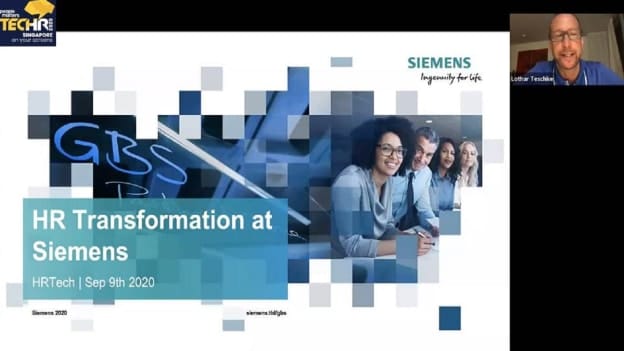
“Siemens is working on a vision 2020+ which is the most dramatic transformation in the company’s history,” shared Lothar Teschke, Global Head of HR Projects - Siemens, in his masterclass at People Matters TechHR 2020 . The board came together in April 2019 to create a portfolio of operating companies and strategic companies, with underlying corporate functions, different ownerships and structures required, and a different approach to provide services. What was the next step?
In this masterclass at People Matters TechHR 2020, Lothar Teschke, and Shaswat Kumar, Vice President - Advisory & Cloud Solutions at Alight Solutions, discuss the various facets of Siemens vision2020+, initiating HR transformation at a global scale, and Teschke’s take on a receipt for a successful HR transformation.
Read on to find out what went into shaping Siemens HR transformation.
The 3 pillars of Siemens HR transformation
“HR transformation delivers benefits to the businesses and to our employees. If done right, it can ensure flexibility, and quality and efficiency across all platforms,” shared Teschke. With these three as the underlying pillars of Siemens HR transformation journey, Teschke delved into how they enhance organizational capabilities:
- Flexibility: Flexibility is core not just to employee experience, but in essence the flexibility provided by automation, helps organizations focus on scalability, while minimizing or avoiding remnant costs.
- Quality: Increase quality through simple global processes, policies and guidelines, drive empowerment by providing on-demand services, and especially more and more for managers in the company.
- Efficiency: “Increase efficiency by automation, which is one enabler for bundling services in the delivery centre, which is also one component of Siemens way forward,” said Teschke.
Through digitization, organizations can enhance efficiency by creating an ecosystem that enables the workforce to work anytime, anywhere, on any device.
Product parameters for HR transformation
“When I am talking about HR transformation, I am talking about HR hire-to-retire transformation. It is not only the HR governance part, it’s the entire HR that we are transforming,” emphasized Teschke as he stated the product parameters that guided Siemens decision-making on digitization:
- HR Cloud: Under HR cloud, Siemens strived to shift to standard, cloud-based technologies globally, facilitating the creation of a global digitalization platform. One such product that Siemens focused on to transform HR admin processes was Workday.
- Global payroll outsourcing: Siemens onboarded two global payroll providers for “gross to net” services based on flexible contractual agreements, with the focus on simplifying complex payroll processes.
- Footprint optimization: To optimize its footprint, Siemens built a network of cross-country delivery centers along with a few selected front offices in selected geographies.
- Evolution to new AskHR based on CARL: Siemens collaborated with IBM to create an HR chatbot called CARL, which stands for Cognitive Assistant for Interactive User Relationship and Continuous Learning. CARL was Siemens new interaction model of HR with employees.
- Local for local: This aspect of transformation helps contain costs to a minimum by staying within geographical boundaries, and at the same time leveraging and promoting expertise from the best players available locally.
An important aspect to factor in said Teschke is the cost and compliance risk.
Developing systems internally helps save on costs, however onboarding external vendors helps minimize compliance risk.
There is a need to strike a balance as organizations identify vendors and explore internal capabilities to transform their operations and way of working.
Tangible benefits of transformation
Teschke highlighted some key benefits as a direct outcome of HR transformation. He segments these benefits into three buckets:
- Process harmonization, simplification and automation: Enable bundling of service delivery and automation, reduce maintenance and support costs.
- User centricity - Accessibility and user experience: Ease of use through intuitive user guidance, leverage usage across any device and mobile, access anywhere anytime, access for all employees and managers to on-demand services, increase data visibility, drives ownership culture.
- Acceleration and transparency: Support different ownership models, (scalability, flexible cost structure, reduced time to implementation, enhanced reporting and predictive analytics, faster access to global data or decision making
The receipt for success
Sharing how this transformation has been successful for the organization Teschke first shared some context on the complexity and volume of transactions needed to transform HR processes:
While several organizations continue to contemplate the need for transformation, many others turned out to be early adopters. Irrespective of where an organization stands today in its transformation journey, there are some hygiene factors which if adhered to, can become as Teschke calls it, a ‘receipt for success’. These guidelines include:
- Ensure your senior leaders/ steering committee are onboard and remain supportive throughout the implementation.
A clear mandate supported by the senior management goes a long way in successful organization-wide adoption of HR transformation.
- Professional end to end project management. This is key. Lothar shared that this is the foundation of the entire project. It pays off to have a highly experienced leader at the front, guiding the team through such transformation.
- Strong dedicated global team with local partnership to share knowledge across the globe. With a distributed workforce, it becomes even more crucial to have dedicated teams that collaborate on successful implementation of the project on a global scale.
- Establish a close trusted partnership with your vendors as collaboration is so critical. This aspect cannot be emphasized enough. Organizations must ensure a frequent and open line of communication on objectives and expected outcomes, while also creating scope to highlight red flags in time. Trust here goes a long way, contributing to enhancement of quality.
- Identify all impacted stakeholders and solicit their buy-in and input before, during and after implementation. This will help strengthen the support and drive needed to accelerate implementation.
- Establish guiding (design) principles and strictly adhere to them. Adhering to established design principles is critical to the success of the building blocks of transformation.
When looking at transformation, Shashwat shared that the first mistake many people make is to look at change as a launch vehicle.
“Change is integrated and a large part of change happens when you get onto the business case and stakeholder buy-in, a lot of change happens during the design phase.”
The complexities and priorities in HR Transformation are bound to differ from organization to organization. However, how leaders shape the transformation vision and cater to the key components in the transition will determine the success of transformation for that organization.