









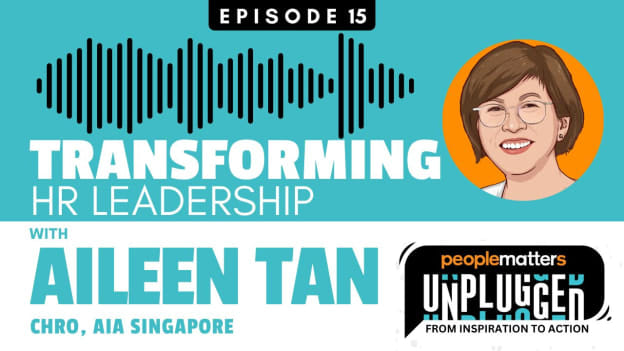
When most organisations talk about capability building, they typically point to courses, content, and compliance. But at AIA Singapore, HR is doing more than ticking boxes. Under the leadership of CHRO Aileen Tan, the insurer has turned HR into the beating heart of business transformation.
Tan’s approach is less about traditional top-down training and more about cultivating a culture where people feel safe to stretch, stumble, and speak up. Her belief is that real capability starts where comfort ends.
“If you’re not uncomfortable, you’re actually not really learning,” she said in the latest episode of the podcast People Matters Unplugged.
“In learning, you need to be uncomfortable, and it’s OK. We’re telling them it’s OK to be there.”
Capability is more than skills
At the core of AIA Singapore’s HR strategy is a broader understanding of capability. For Tan, it’s not just about ticking off a list of competencies.
“Capability building cannot stand in isolation. It really must align with the organisation, with long-term business goals,” she explained. “It is not something good to have. It is really a strategic imperative.”
This entails looking beyond technical proficiency. “When we talk about it, it cannot be just about skills. It is skills and more,” Tan said.
It’s really about building that resilience, the future readiness, the long-term sustainability of both the organisation and for the employees themselves.”
To bring that to life, AIA focuses on what Tan calls core critical skills, which fall into three dimensions:
- Communication
- Thinking
- Personal mastery
Upskilling from within
Rather than leaning on external hires to plug capability gaps, AIA prioritises internal mobility and continuous upskilling.
“It is very expensive at the end of the day to just keep hiring from the outside,” Tan notes. “We have a moral obligation to our employees to say, how do we help them develop?”
One example involved over 100 customer service staff who were trained to integrate AI into their daily work – not as a replacement for their roles, but to elevate them.
“It’s more of upskilling them in terms of how they use AI in their jobs on a daily basis,” she said.
From silos to squads
Capability building isn’t just about the individual either – it must also happen at the team and organisational levels. Since 2020, AIA has leaned into agile ways of working to break down silos and foster collaboration.
“We launched across the group this initiative called organisation of the future,” Tan shares. “It helped us focus our transformation on how we get teams to work together, be more agile – and it was very employee-focused.”
At the heart of this initiative is an emphasis on shared strengths.
“We have emphasised [building] on people’s collective strengths. How do we bring teams together that there is this culture of sharing and culture of cross-learning?”
That means recognising the diversity of style and approach. She said:
We all have different styles, different mentalities, and we bring different things to the table.”
Learning in the flow of work
Instead of limiting capability building to the classroom, Tan believes learning must be timely, contextual, and embedded into daily tasks.
“For learning to stick, it has to be just in time ... people learn best when they are at work. It is something that they are doing at the moment,” she said.
To that end, she’s reimagining how development happens across the organisation.
“I’m trying to change a little bit of the classroom training to do a lot more case studies. [Talent development] needs more dialogue, [like] focus group type of sessions.”
Leadership sets the tone
For Tan, the success of capability building hinges on leaders walking the talk. At AIA, managers are expected to go first.
“We expect leaders to also share their experience, be vulnerable a little bit and say, ‘Yeah, I’m a bit uncomfortable with this. I don’t quite understand this.’”
After all, when leaders admit they don’t have all the answers, it creates permission for their teams to learn.
“We want them to actually go first, bring that experience, share it with their team, so that the teams feel that it is OK also to say, ‘I’m really uncomfortable about this.’”
Creating psychological safety
Tan underscores that learning and innovation only happen when employees feel safe to speak their minds.
We’ve worked very intentionally to create a culture where it is alright, it is safe to ask for help. It is safe also to share.”
That openness starts at the top. “Our CEO has been the prime example of this. She has shared very openly her own personal and professional challenges.”
In the workplace, therefore, people aren’t afraid to ask tough questions.
Metrics that matter
“There’s been an uptick in terms of our employee engagement. It’s also, I think, manifested itself in the sense that our business results, our business growth, has been good,” Tan said.
She believes the organisation’s commitment to learning is helping build a more agile and more adaptable workforce.
“This is creating a psychologically safe environment to say, ‘I need help’. For them, [they] also recognise that the company provides a lot of help.”
The ideal scenario
If budget were no constraint, Tan would invest in grassroots learning and experimentation.
“I would really love to see employees also be the CEO. I use this word with them, ‘You’re the CEO of your learning.’”
That includes giving people space to test, try, and sometimes fail.
The ultimate leadership lesson
After years of leading HR transformation, Tan says the most powerful insight is the need to cultivate dissent – and listen to it.
People should be free … to voice what is really of concern for them, even if it’s a dissenting voice.”
But dissent must come with responsibility.
“You don’t disagree for the sake of disagreeing … you need to have also a solution or alternative view,” Tan said.
As for leaders, humility is everything. And this is seen in their openness to feedback and insight.
Leaders, according to Tan, should be able to say: “‘You know what, I may be wrong. You know what, the idea you put forth actually makes a better idea and maybe you’re right.”
In the end, Tan believes building organisational capability isn’t just about skill sets but, more importantly, about mindsets – and cultures – one where people can stretch beyond what they thought possible.
Listen to Aileen Tan of AIA Singapore on the latest episode of the podcast People Matters Unplugged.

Season 3, Episode 15: Transforming HR Leadership
What if HR wasn’t just a support function – but the architect of future-ready business success? In the latest episode of People Matters Unplugged, AIA Singapore’s CHRO, Aileen Tan, takes us behind the scenes of a transformation that starts not with technology, but with trust. Catch this insightful interview hosted by Cheshta Dora, Head of Research & Community at People Matters.
Guest: Aileen Tan, CHRO, AIA Singapore
Key Takeaways
1) Capability Building is a Strategic Imperative
It’s not just about skill development — it's about building resilience and future-readiness. Core critical skills include:
- Communication & Collaboration
- Critical Thinking & Problem Solving
- Personal Mastery & Mental Resilience
2) Upskilling at Scale
AIA avoids overreliance on external hiring by focusing on internal talent development.
3) From Individual to Team-Level Learning
- Shift from siloed development to cross-functional learning using agile squads
- Introduce CliftonStrengths assessments to promote awareness of team dynamics and collective learning
- Learning is both individual and social
4) Leadership Accountability
Leaders are expected to:
- Walk the talk by attending training first
- Demonstrate vulnerability and a growth mindset
- AIA’s brand promise: healthier, longer, better lives in both professional and personal realms
- Emphasis on clarity, courage, and humanity as leadership essentials
5) Culture of Psychological Safety
- Employees are encouraged to speak up, raise concerns, and share ideas – even dissenting ones
- CEO and leadership lead by example in sharing personal stories to create openness
- Psychological safety is seen as a catalyst for innovation and better decision-making
6) Learning in the Flow of Work
- Shift from traditional classroom training to case-based learning and just-in-time upskilling
- Learning is more effective when it connects directly to daily tasks and real challenges
7) If Resources Were Unlimited …
Aileen’s dream capability-building programme would:
- Be employee-led and community-driven (e.g., knowledge-sharing groups like data communities)
- Encourage experimentation and safe-to-fail learning environments
- Empower managers to be full-time coaches and mentors.
“If you’re not uncomfortable, you’re not learning.” - Aileen Tan
For AIA Singapore, building capability is not just about career mobility – it’s about creating an ecosystem where people feel safe, supported, and ready for change.