









'Can a man still be brave if he's afraid?'
'That is the only time a man can be brave.'
- George R.R. Martin
Did you know that legendary leaders like Martin Luther King, Winston Churchill, and Abraham Lincoln, among others, suffered from mental health conditions? Did that mean they were weak or did not deserve to hold a leadership position? No. The fact that they embraced their health condition, took care of it and leveraged it for the betterment of themselves and the society proved how having a mental health condition, while it requires its due course of treatment, isn't an indication of a weakness or disability. In fact, as brought out by Nassir Ghaemi in his research, it enabled them to become better leaders. Ghaemi believes, “Mania enhances creativity and resilience to trauma, while depression increases realism and empathy.”
There is a significant emotional cost attached to being a leader, which if not taken care of, can have dramatic consequences not just on the workforce, but on the very mental wellbeing of leaders themselves. Global leaders are firefighting the crisis day and night, as expected of them by their superiors, their employees and their families. Did we really think that their mental health was immune to the current circumstances and the mountain of diverse challenges it brings along?
If leadership was a 24*7 job before the global pandemic came rushing in, what do you think it looks like now?
In the words of THNK School of Creative Leadership, “The economic impact is immense, and the human costs are devastating.”
Emphasizing mental health they say, “Mental health issues are happening at every socioeconomic and professional level, from low wage workers to CEOs.”
It’s appalling to see how mental health continues to be looked upon as a weakness and not as something that needs to be looked into and looked after. And it’s this very perception that continues to keep people, especially those in leadership positions from accepting how they are feeling and from seeking the required support. However, unprecedented times like the present have accelerated the need to not only understand and accept the existence of mental health issues, but also fastrack getting systems, accessibility and better mental health in place.
With May being the Mental Health Awareness Month, let’s find out what the impending mental health crisis, rather the impending global psychological pandemic has in store for leaders, what are their biggest stressors at the moment and how can they manage their mental wellbeing as they continue to put out fires, protect their people and stabilize business amid COVID-19.
Why do we need to talk about mental health of leaders
The World Health Organization (WHO), defines mental health as “a state of well-being in which the individual realizes his or her own abilities, can cope with the normal stresses of life, can work productively and fruitfully, and is able to make a contribution to his or her community.”
Your workplace is bound to have an impact on your abilities that WHO talks about. Being able to produce meaningful work and make an impact is bound to boost your mental health, however, stress, negative emotions, fear and insecurity, during challenging times can bring down your mental wellbeing. If you take a look around, it is very rare that leaders take a leave when sick. Why? Just as Sun Tzu says in his book ‘The Art of War’, “If the mind is willing, the flesh could go on and on without many things.” The mind that does not even allow the possibility of being mentally unwell to crawl in. Additionally, the social expectation and need for leaders to be strong, which has been drilled into their minds so deeply, that they do not even realize the need to take that occasional off, other than ofcourse when their families might insist on a vacation. In the current context, there are too many issues to be addressed and taking a sick day feels impossible and more stressful. So what are the odds that leaders would be able to attend to their mental health, or better yet, what are the odds that they would as much as think that they need to prioritize, manage and improve their mental health?
“We did a recent check-in with our senior leaders, asked them how they were feeling, and many of them said: "I'm feeling a bit helpless right now, because these things are happening around me and I can't control them. I'm feeling overwhelmed by what I'm seeing on the news,” shared Deborah Woollard, Cisco's VP of Human Resources for Asia Pacific, Japan, and China, in an interaction with People Matters.
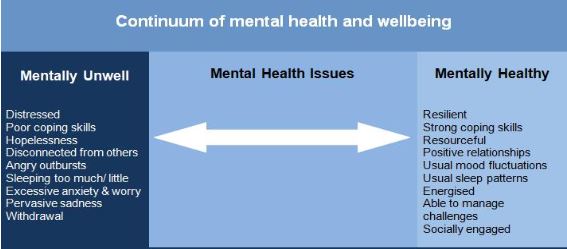
Image source: Blooming Minds WA Pty Ltd
The focus for leaders today is very diverse. While some are struggling with making remote working more seamless through investment in infrastructure and ergonomics, there are others dealing with furloughs and layoffs, some making remote working a permanent working model, while others focus on resuming work from office.
In a recent story, we discussed in detail about the global psychological pandemic that is on its way. With that in mind, there is a greater need for leaders to look after their mental wellbeing and be able to set a precedence for the workforce to do the same before it’s too late. However, given the scale of the impending mental health crisis, it isn’t only about leaders encouraging employees to be more cognizant of their mental health, but in effect, the need for each one to understand the gravity of the situation, prioritize their mental wellbeing, and be able to build a strong community that can be there for each other, given the vast gap in impacted population and availability of mental health professionals and services.
“Mental health issues have always been somewhat invisible and poorly understood, and governments and populations are ill-prepared to address the on-coming impact of this type of disaster,” said Shekhar Saxena, Professor of the Practice of Global Mental Health at the Harvard TH Chan School of Public Health and the former Director of the Department of Mental Health and Substance Abuse at WHO (2010-18), in an interview. “With a small amount of guidance, people can look after themselves and each other much better because of the mutual support they can provide and receive. Access to psychosocial resources has to be increased especially for vulnerable populations. Steps have to be taken to curb the ‘infodemic’ because misinformation only increases anxiety everywhere,” added Saxena.
Sharing his thoughts with People Matters, John Gaunt, Chief Human Resources Officer, Synechron said, “As a leader, I feel responsible. I feel responsible for the health and safety of my employees and their families. I had to look after employees who had switched to the telecommuting mode, to employees stuck in a different geography during travel, and even those who were required to be in office despite lockdowns to ensure essential services. Though there is an incessant line of thought that persists about what we can do better for our employees, I am not at stress. It’s because of a committed, compassionate and highly motivated support team that Synechron has.”
“I have been observing leaders across both sectors and nations, and I recognize that it is emotionally and cognitively challenging to make decisions that affect the lives of thousands of people,” shared Amy C. Edmondson, the Novartis Professor of Leadership and Management at the Harvard Business School.
Leaders shouldn’t have to do it all alone. It needs to be one for all, and all for one.
Why leaders need to prioritize their mental health
The Centre for Mental Health in the Workplace states that dealing with negative emotions in the workplace can be one of a manager’s greatest challenges. “Not only are interactions with distressed workers complex and delicate, managers may face personal barriers and emotional triggers that make it especially difficult for them to engage in emotionally charged situations. Understanding these barriers can be an important first step toward being comfortable and effective when dealing with negative emotions in the workplace.”
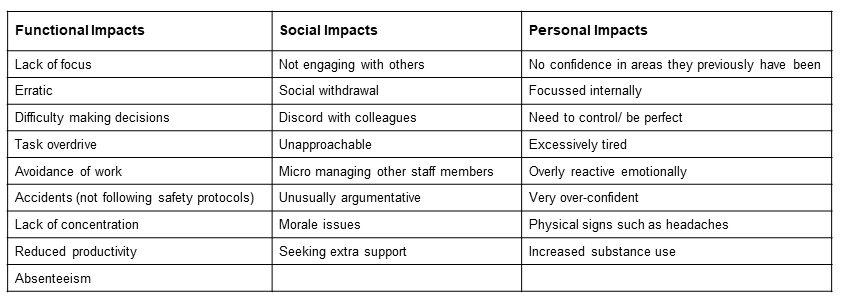
Image source: Blooming Minds WA Pty Ltd
In trying uncertain times like the present, you are the guiding light for your workforce, and to a great extent your family. That is bound to over a period of time get stressful and tiring, not just having to live up to those expectations but at the same time being entrusted with the sole responsibility of the wellbeing of your loved ones and your workforce.
“As a leader the foremost feeling in my head is a sense of responsibility towards the wellbeing of all our employees and ensuring that they and everyone in their family network is safe and healthy. The second one is to ensure that the decisions we take on the basis of evolving situations are in favor of our employees and true to the values of Capgemini,” shared Pallavi Tyagi, EVP and CHRO India, Capgemini with People Matters.
You have been stretching work hours and stressing yourself out, taking on more than you can, because the situation demands it. All the more reason, you need to prioritize your mental wellbeing to be able to stay alert, perceptive, empathetic, and not become an absent leader consumed in his/her/their own downward spiral.
“When we proceeded towards the lockdown our topmost priority at Capgemini was to make sure that employees were safe, working from home and were able to deliver to clients in a seamless way. While ensuring client delivery, we also had to help employees settle, make them feel engaged and support leaders to manage through the reality of virtual working. Throughout these times; we also lifted and quickly shifted some policies as well as enabled some like medical insurance or benevolent fund to help the employees through these unprecedented times,” added Pallavi. She further said that moving towards opening up offices post the lockdown , the immediate concern is to ensure that offices and work environments are safe for employees to come in while maintaining all regulatory and safety protocols.
The concern for leaders is not just a to-do list where tasks need to be marked complete, but rather a never-ending process of employee and business decisions. Which is why one must keep track of their wellbeing, take a break when needed, to be able to reset and accomplish all goals effectively and holistically, without compromising on health.
How can you manage and improve your mental health
According to a 1961 Reader’s Digest article by Edison’s son Charles, Edison calmly walked over to him as he watched the fire destroy his dad’s work. In a childlike voice, Edison told his 24-year-old son, “Go get your mother and all her friends. They will never see a fire like this again.” When Charles objected, Edison said, “It’s all right. We’ve just got rid of a lot of rubbish.” Only when leaders actively prioritize and maintain their mental wellbeing, can they develop an outlook similar to that of Edison’s, which is considered the epitome of mental strength - ‘seeing opportunity and taking action when things look bleak’.
It’s a myth that you need to take care of your mental wellbeing only when you notice symptoms. That in fact is a reactive approach. In order to tactfully navigate through the challenging situations that leaders face today, it makes much more sense to proactively foster a habit of preserving and enhancing mental health, for the uncertainties that lie ahead. Here are some steps to build and follow a mentally healthy routine:
- You don’t have to say everything is ok: It is time to give up the enforced smile you carry around to not pass on your worries to your team and employees.
Everyone seeks honest, transparent and clear communication. Trust your employees to face the facts and give them an opportunity to step up.
Discuss the reality and together come up with innovative ideas to ride the rough tide.
- Limit and consume reliable content: With the endless channels of communication, one is bound to be overwhelmed by the variety and depth of content available to consume - work, personal, world news. Specific to COVID-19, the credibility and sources of such content could be questionable. To be able to declutter your mind from overflowing information, you need to not only limit the intake of COVID-19 related communication but also identify reliable sources of information to clear out noise, and be able to distinguish noise from facts.
- Draw clear boundaries between work and personal time: Whether prolonged remote working or initiating and resuming work from office, work has doubled. You are managing work, you are living amid a global crisis, caring for your family, and likely also helping with house chores (or doing it all by yourself). You are doing all of that together, and often not as individual tasks but multitasking all the way. That is bound to spread-over your personal and family time. That needs to be rectified, given this lifestyle is here to stay for time unknown. It is essential to have a routine, break down tasks over the 24hours with dedicated time slots, and not let one compromise for the other, which also requires you to take up only what you can afford to accomplish so as not to get stressed by over-promising and under-delivering. “I don’t feel stressed; but the changed scenario was coped by creating a schedule that helps through delivering at work; and having quality and fun times with the family. If all my employees and their loved ones come out at the other end safe and healthy; there would be no better sense of satisfaction,” shared Pallavi Tyagi.
- Allow yourself to be vulnerable and share what you feel: Have a support group, a safe space with open-minded people. Allow honest conversations in a trusted group, share what’s not letting you sleep, what’s keeping you on your toes and what’s keeping you from feeling mentally at peace. You might not always get a solution, but just letting those worries out of your system, releasing the piled up tension will help create space to receive clarity, think and approach situations with an open mind. It is alright to not have all the answers. No one was prepared to lead this crisis, including you. What you must embrace is knowing that you don’t have to lead alone, you need to move forward together.
“Vulnerability is at the core, the center of meaningful human experiences,” shares Brene Brown, a professor, lecturer, author, and podcast host, “further adding, “Vulnerability sounds like truth and feels courage. Truth and courage aren’t always comfortable, but they’re never weaknesses.”
- Be open to learning: Processing your emotions and hearing others share their lows can be emotionally exhausting. This is where emotional intelligence (EI) comes in. EI is not just a survival skill for leaders in the workplace, but given the warnings about an impending health crisis and the need to educate and build more helpful resources to be able to tackle the scale of the crisis, EI comes as a tool to bridge the gap, and create space for better understanding and communication, thereby better meaningful connections. It is bound to enable you to understand where the other person is coming from, and be present in the moment without letting it trigger any irritation, agitation or restlessness in you.
- Take a break at regular intervals: Step away from your work desk for a few minutes at regular intervals. During this time, take a round or two of the house, get some fresh air standing near the window, snack on something healthy, ideally fruits, indulge in stretching exercises, and avoid screen time. Allow yourself those few minutes of no-screen and quiet time at regular intervals as you work.
- Leverage technology for wellbeing - physical and mental: A common issue for leaders is being unable to get a proper sleep. It’s time to accelerate tech adoption not just at work but in personal lives as well. With the availability of video conferencing tools, you can get access to several mental wellness applications that provide you with multiple mental health services, along with the option of talking to a counsellor/ psychologist through a video call if need be, for a more seamless and authentic conversation and experience.
Additionally, several fitness apps today enable you to access ongoing sessions where you can exercise following the instructor. For the same price of your gym membership and some even free, you get a personal instructor at your time and availability, and for exercises that you get to choose. Yes exercising could be more fun in a group, but the intent is not just fun, the intent is your wellbeing, let that motivate you to be regular with physical exercises to keep both your body and mind healthy and fit.
- Take a mental health day-off and implement it in the policies: There is no time better than now to implement a mental health day(s)-off. There has been a lot of conversation around the need to focus on mental wellbeing. While conversations help, sometimes people could just do with some quiet time to themselves.
With lesser people applying for leaves off-late, given the question where would they go, it is essential to realize that they could take a day-off just to take a break from the endless chores and work, a day for mental peace and relaxation.
If you encourage this and role model the need to normalize and accept this mindset, it won’t just help your mental and emotional wellbeing, but will empower employees and will help break the stigma, with every availed mental health day-off.
- Find a stress-buster: In this activity you get to decide the frequency and timeline. Whether you choose to engage in any such activity that interests you every evening, alternate days, thrice a week or weekends, reignite the enthusiastic and creative side of yours and build on it. Synechron’s John Gaunt shares, “To maintain my work-life balance in this ‘new normal’ of life, I do try my culinary skills and cook often for my family and friends. I also bake sometimes or play pool during work breaks. But most importantly, I really like to pick up my mobile phone and capture some of the natural beauty of landscapes and surroundings through the camera in my own way.”
Breaking the stigma requires leaders to stop pretending that they have it together all the time, it requires them to normalize and embrace the feeling of vulnerability, fear, and confusion and empower themselves as well as their workforce to seek timely help without the fear of judgement and without associating the tag of weakness with needing help for maintaining and improving mental health.
Leaders have the power to set the tone for a mentally healthy workplace, and that’s much more effective when they begin with themselves. If leaders don’t look after their own mental wellbeing, the restlessness, anxiety and outbreaks are bound to cascade to their teams and impact the culture, team vibe and eventually productivity levels.
Rightly said by THNK School of Creative Leadership on leaders who are able to care for their mental health, “By being courageous enough to open up about their own ordeals, they are making it safer for others to share their stories.”