









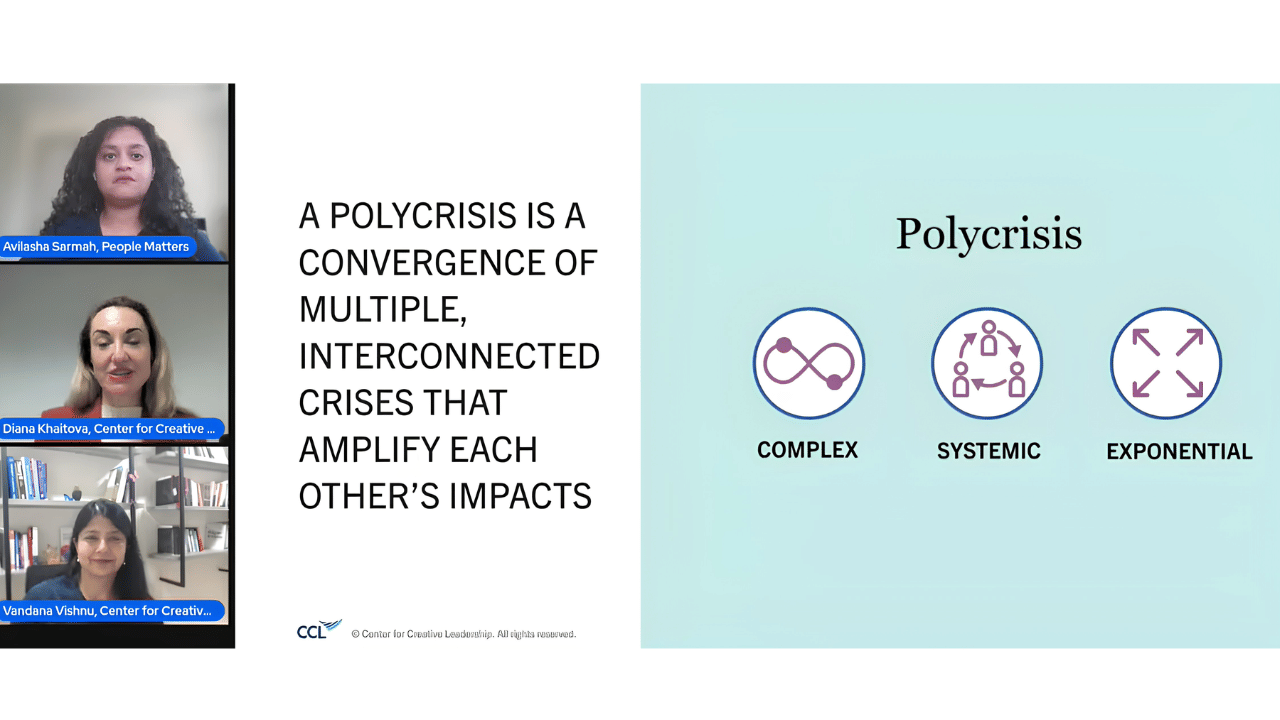
Polycrisis has become the defining context for leadership. AI is fundamentally changing how organisations make decisions and collaborate across human and machine systems, while economic uncertainty, geopolitical shifts and changing Instead, organisations are increasingly embedding executive coaching into succession planning workforce expectations are adding new layers of complexity. Leaders today are expected to make high-stakes decisions amid multiple, interconnected disruptions while preparing their organisations for what's next.
The leadership challenge extends beyond technology. Research shows that while 92% of organisations plan to increase AI investments over the next three years, only 1% consider themselves mature in AI adoption. The gap points to a broader challenge: technology is advancing faster than organisations' leadership capability and readiness to harness it effectively. As organisations rethink AI leadership, the focus is shifting from technology alone to developing leaders who can make better decisions amid complexity and drive transformation.
It was this evolving leadership landscape that shaped the recent People Matters webinar, Leading Through Polycrisis: Driving Organisational Impact Through Executive Coaching, held in collaboration with the Centre for Creative Leadership (CCL). Diana Khaitova, Head of Client Development, APAC, and Vandana Vishnu, Faculty and Director of Coaching, APAC, discussed why executive coaching is increasingly being embedded into leadership strategy to help organisations build leaders who can navigate uncertainty, strengthen leadership effectiveness, accelerate organisational transformation and lead with confidence.
From managing disruption to building transformational leaders
Setting the context, Diana said today's business environment demands leadership capabilities that extend far beyond operational excellence. As challenges become increasingly interconnected, leaders can no longer rely solely on experience or proven playbooks.
"I would bet that it has never been more difficult to be an effective leader than it is now," she said.
According to Diana, today's business and societal challenges are systemic, requiring leaders to navigate uncertainty rather than search for definitive answers. "Many business issues or societal issues that we are dealing with today are so complex that they simply do not have one correct solution. It's all about trade-offs, understanding and navigating complexity, and very often navigating in emerging situations that are unclear and might change at any point."
Drawing on CCL's latest research on the future of leadership, Diana highlighted that AI has accelerated the need for leaders who can think systemically, inspire purpose and collaborate effectively across increasingly complex ecosystems of people and technology.
Rather than simply managing execution, leaders are expected to anticipate change, connect seemingly unrelated challenges and guide organisations through continuous transformation. Executive coaching, she explained, creates space for leaders to develop a transformational mindset and supports broader organisational transformation when embedded strategically across leadership teams.
Leadership development requires a transformational mindset
Executive coaching, however, is about far more than strengthening existing competencies. "It is not about adding more to the glass. It is about expanding the glass or expanding the vessel," said Vandana.
CCL describes this as vertical leadership development, helping leaders shift their perspectives as they prepare for greater organisational responsibility.
Illustrating this, Vandana shared the example of a Chief Operating Officer preparing to transition into the Chief Executive Officer role. Coaching helped the leader move beyond operational execution to shaping long-term strategy and influencing organisational direction. She also described how a regional leadership team reflected on whether they were operating with the mindset needed to drive transformation rather than simply deliver short-term results. The examples illustrated how coaching helps leaders shift from operational execution to enterprise thinking and long-term strategic leadership.
Executive coaching delivers greater impact when linked to business outcomes
Diana noted that many organisations have historically viewed coaching as a corrective intervention. "The leader gets a coach. Will it be impactful? Yes... Is that strategic use of coaching? No."
Instead, she explained that organisations are increasingly embedding executive coaching into succession planning, leadership development and organisational transformation initiatives to build future leadership pipelines at scale.
Vandana shared examples of organisations integrating coaching into high-potential leadership programmes and global leadership initiatives, with clearly defined business outcomes guiding every coaching journey. Rather than measuring success by participation or coaching hours, organisations are increasingly evaluating coaching through outcomes such as leadership effectiveness, succession readiness and business transformation.
Building positive psychological capital during uncertainty
Beyond individual leadership development, the discussion highlighted coaching's broader impact on organisational culture.
Drawing on CCL research, Vandana explained that executive coaching strengthens leaders' positive psychological capital by building hope, resilience, optimism and confidence. These qualities not only improve individual performance but also strengthen organisational commitment, employee wellbeing and adaptability while reducing burnout.
Diana said, "Leaders need to move everybody from fear to hope and optimism, and give people a sense of agency.”
The discussion also underscored that future-ready leaders balance AI innovation with risk, remain curious, and coach rather than direct, empowering their teams to navigate uncertainty with confidence.
Scaling coaching beyond the executive suite
As organisations seek broader leadership impact, the discussion explored how coaching can extend beyond senior executives and become part of everyday leadership.
Vandana shared examples of organisations introducing coaching cafés, peer coaching and structured coaching conversations to make coaching more accessible for managers and emerging leaders. Reflecting on one organisation's experience, she said, "When your top leaders put skin in the game, a completely different experience is created."
Diana emphasised that the most sustainable way to scale coaching is by building leaders' coaching capabilities rather than relying solely on executive coaching.
Building leadership for an uncertain future
The discussion underscored that leadership development must move beyond preparing leaders for today's challenges.
In a polycrisis, organisations need leaders who can think systemically, lead through ambiguity and continuously adapt to change.
The leaders reinforced that executive coaching is no longer simply an individual development intervention. When aligned with business priorities and embedded into leadership strategy, it becomes a strategic capability that strengthens leadership effectiveness, builds a coaching culture and enables lasting organisational transformation.