









When the winds of change blow, most of us clutch at what we know. In the endless sun-drenched stretch of rice fields, growth is never an accident. Leadership, too, mirrors this field. It does not resist the wind, but senses, guides, and adapts, shaping the next evolution of people and organisations. In this space between intention and nature, the next evolution of work emerges, where strategy and empathy, technology and human insight, converge to shape growth that is both sustainable and profound.
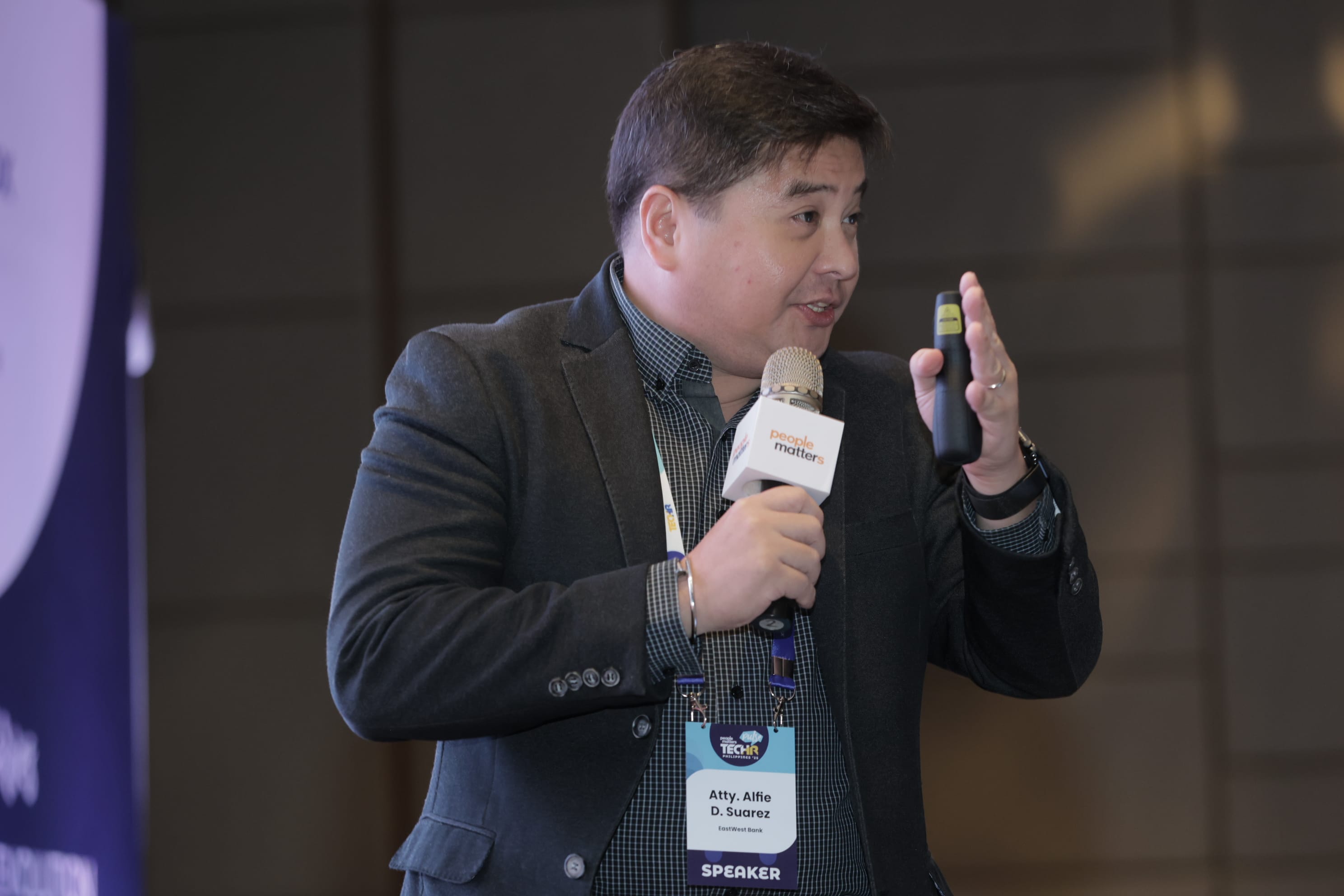
At People Matters TechHR Pulse Philippines 2025, Atty. Alfie D. Suarez, Executive Vice President & Chief People, Corporate Services and Sustainability Officer at EastWest Bank, took the stage to share his insights through a breakthrough story on Redefining Leadership: navigating uncertainty and inspiring change.
With a career marked by personal transformations and organisational turnarounds, Suarez framed leadership as less about control and more about conviction, resilience, and empathy.
Paradox of change
Suarez began with a deceptively simple question: Who really wants change?
“I’m very sure that when people are asked, ‘Do you want change?’ people will say, we want change,” he said. “But when you’re asked the question, do you want to change? Perhaps there will be fewer hands raised. More importantly, if you’re asked the question, do you want to lead change, more likely there will even be fewer hands that will be raised.”
The distinction is clear. We celebrate change in the abstract but resist it in the personal. True leadership lies in bridging that gap.
To illustrate, Suarez pointed to an image of two contradictory signposts: one saying no loading and unloading, the other permitting it. “Change can be confusing,” he said. “But more importantly, a lot of us got burned in the change and in the process. Because of that, when there is a change that’s happening, we try to avoid it so that we don’t get burned.”
His insight? Learn the game of change, don’t fear it. “When you understand the game of change, you don’t panic. Fear does not come from not knowing how to do things. Fear comes because you have not experienced it.”
Humour and humility
Suarez made the abstract deeply personal, tracing his own journey. “We’ve been married for 26 years,” he said, sharing family photographs. Showcasing a photograph from his 25th wedding celebration, Suarez pointed out that while his wife looks the same, he doesn't anymore.”
With humour and humility, he added: “If you can manage your mother-in-law, you can manage any kind of change.”
From family to professional milestones, his story was one of constant reinvention. He had witnessed proud conglomerates humbled by crisis, legacy companies broken apart, and global giants split to survive. “All of us have experienced change at the personal level or at a professional level,” he reflected. “We know the thing.”
From VUCA to BANI: A new landscape
Much of leadership literature has long referenced VUCA — volatility, uncertainty, complexity, ambiguity. But Suarez argued that the world has shifted to BANI — brittle, anxious, nonlinear, incomprehensible.
“Things are not just simply volatile. It can break, and that’s why it is brittle,” he said. “People are not just uncertain. It is because of that uncertainty that anxiety builds up.”
In this environment, leaders cannot default to old models. “During times of change, you don’t aim for certainty, you aim for clarity,” Suarez noted. “You’re clear as to why you need to change, clear in terms of the reasons, and how perhaps you can manage the change.”
Leading in BANI times
What does leadership look like in this fragile and anxious environment? Suarez was firm: “The worst thing for a leader to do at a time of great change is to stand still.” Instead, leaders must remain decisive, data-driven, and human-centred.
“We now have data. We now have AI to be able to help us make decisions,” he said, adding that information must be paired with empathy. “People are just so tired of change. There is fatigue. There is a need for leaders to acknowledge that, build optimism in their thinking, and practice radical transparency. People need to know why we need to change, where we are heading, and how we plan to execute it.”
He emphasised psychological safety as the foundation. “They say that if people don’t want to speak, there’s something wrong with the culture,” Suarez said. “Nobody has a monopoly on good ideas. Putting everybody together makes the team smart.”
Lessons in resilience and risk
Leadership also demands courage in the face of uncertainty. “Overthinking is the one that will kill you,” Suarez warned. “There’s more loss because of not deciding on making a wrong decision.”
He reframed mistakes not as failures but as learning. Quoting Churchill, he said: “Success is walking from failure to failure with no loss of enthusiasm. That is resilience.” In his view, resilience grows not from theory but from practice: “Learning is the way by which you build resiliency. Seventy per cent of learning comes from experience.”
The takeaway
For Suarez, the true test of leadership in today’s brittle and anxious world is not survival, but the ability to create spaces where people can thrive. “The measure of intelligence is your ability to change,” he reminded. “Kung gusto mong magmukhang matalino sa panahon na ito, e ‘dapat marunong kang magbago.’” Resilience, empathy, and decisiveness are no longer optional—they are the very fabric of leadership.
And while results will always matter, Suarez urged leaders to focus on the deeper work of transformation.
“If you focus on results, you will never change. If you focus on change, you will get results.”In a landscape defined by disruption, leaders who embrace change not as an obligation but as an opportunity will be the ones to chart braver paths forward. It is the result of the stalk bending to the rhythm of water flowing with precision, seeds chosen with care, and hands that know when to nurture and when to wait. Because in the end, leadership is not about avoiding the storm, but about teaching others how to dance with the wind