









Economic uncertainty is increasingly shaping how organisations think about talent, work and workforce strategy. While inflation may be easing in some markets, organisations and workers continue to navigate cost pressures, uneven growth, geopolitical disruption, technological change and shifting employee expectations.
For HR leaders, this creates a challenge that extends beyond managing workforce costs. It calls for a closer look at how people, business needs and changing market conditions intersect — and how organisations can build the capabilities and confidence needed to navigate an unpredictable environment.
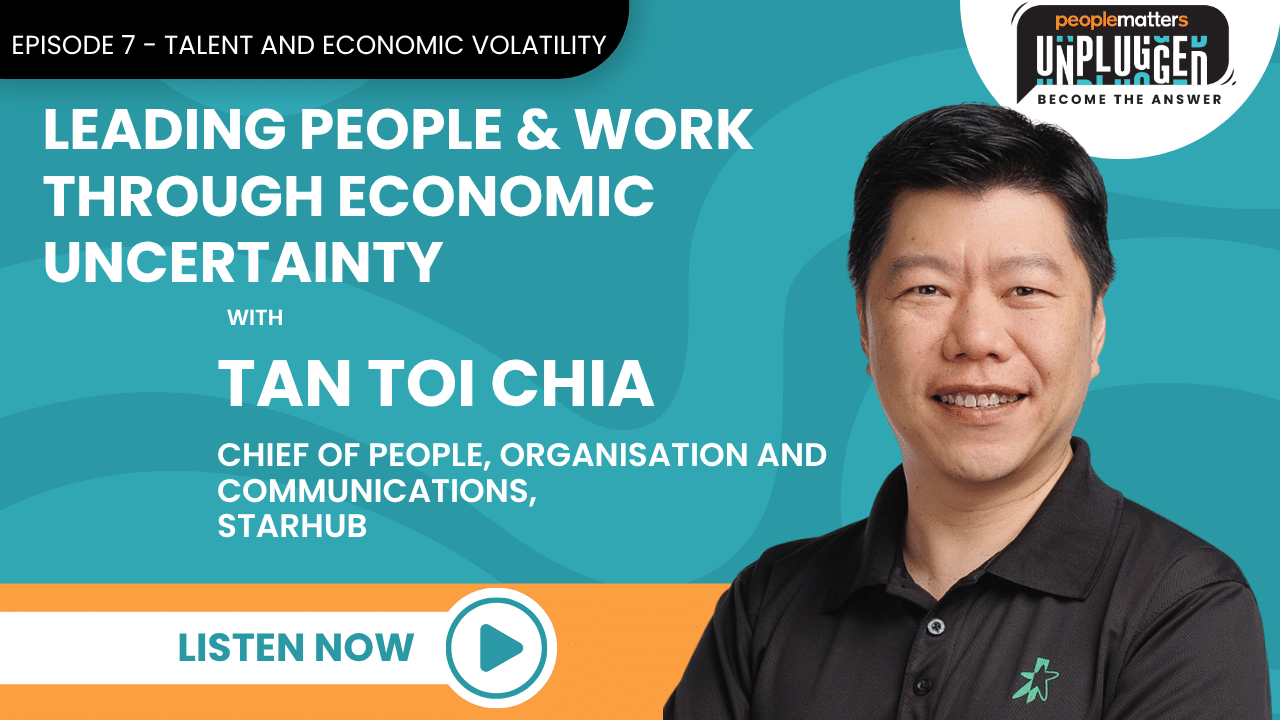
In a recent episode of the People Matters Unplugged podcast, Cheshta Dora, Head of Content, Research and Community at People Matters, spoke with Tan Toi Chia, Chief of People, Organisations and Communications at StarHub, about how organisations can rethink talent and work strategies amid economic disruption. His perspective centred on understanding the organisation, listening to customers and employees, building a culture of learning, enabling talent mobility, and finding the right balance between people and technology.
Understanding what the organisation is made of
In a world that Toi Chia describes as a “poly-crisis” environment, organisations can easily become consumed by the uncertainty around them. His starting point is to return to the fundamentals: understanding why the organisation exists, who it serves and what kind of people it needs to create value.
People, he noted, are ultimately the resource that turns other organisational resources into value for customers. As markets change, customer needs can change too, including not only what customers want, but how they want to receive it.
This makes listening to customers an important part of responding to disruption. At the same time, organisations need to understand the changing environment in which employees are expected to deliver.
For HR, this means understanding the external environment, understanding people and understanding technology, and bringing these elements together to identify opportunities and solutions.
Compensation is a baseline, not the entire employee proposition
Economic uncertainty and rising living costs naturally bring compensation into sharper focus. But Toi Chia distinguishes between fair pay as a basic requirement and compensation as the sole reason people stay.
For him, employees should be compensated fairly for their contribution and in relation to the market. If people leave because they are not being paid fairly, that is an issue organisations need to address.
However, if employees continue to cite compensation after they are being paid fairly, organisations may need to look deeper into what is driving their decision.
One possibility is uncertainty about the future of their role. Employees may be concerned that their current work could eventually become redundant as technology changes. In such situations, the conversation shifts from compensation to the broader employment partnership.
Toi Chia argues that organisations should think of employees as partners in delivering future impact. That partnership is built not only around pay, but also around care, concern, respect and the feeling of being heard.
When these elements are present, compensation becomes part of a broader relationship rather than the entire relationship.
Building skills around capabilities, not just jobs
Upskilling also takes on a different meaning in an environment where technology and roles are changing rapidly.
Toi Chia distinguishes between developing personal leadership and contribution, and building technical or vocational skills. But before either, he places emphasis on curiosity, humility and a growth mindset.
Employees can be confident and capable in their current roles while remaining humble about the ways they can continue to improve. For organisations, creating this learning mindset can provide the foundation for more targeted development.
At StarHub, learning is encouraged through formal programmes as well as opportunities to explore areas outside an employee's immediate role. The organisation also uses reflection as part of its approach to projects, asking what went well and what could have been better, with the focus on learning rather than assigning blame.
Another part of the approach is to avoid restricting learning to specific career paths or job families.
Rather than preparing people only for a particular job, the focus is on building collections of competencies that can be combined in different ways. This can allow employees to move into emerging roles or project teams by building on skills they already possess.
The approach also creates greater scope for talent redeployment when roles change. While a particular job may become redundant, the broader combination of competencies, experience and institutional knowledge within the workforce can continue to create value in new ways.
Moving from talent ownership to talent sharing
This approach requires a shift in leadership thinking. Instead of leaders viewing their teams primarily as resources for their own functions, Toi Chia argues that people should be viewed as organisational assets who can contribute to broader outcomes.
A leader working on a project, for example, could look across the organisation for the capabilities required rather than immediately assuming that new hires are needed. Other leaders, in turn, need to be willing to share people who have the relevant skills.
This requires managers to avoid planning their teams around 100% utilisation for existing responsibilities. Leaving capacity for projects and broader organisational work can create opportunities for people to contribute beyond their immediate roles.
For employees, the expectation is similarly broader than simply following a job description. Alongside their defined responsibilities, Toi Chia emphasises initiative, collaboration and the willingness to contribute to enterprise-level outcomes.
At StarHub, these expectations are reflected in performance criteria and in the organisation's behavioural framework, the StarHub Way, which includes collaboration and reflection.
Another capability Toi Chia highlights is agency — the willingness to act rather than simply identify problems. In his view, employees should be willing to step in, contribute and help make a difference when they see an issue.
Designing flexibility around trust
The idea of flexibility also features strongly in StarHub's approach to workplace design. Rather than treating employees primarily through demographic categories or generational labels, Toi Chia emphasises listening to individual needs and designing workplace expectations accordingly.
Flexibility, however, is linked to trust and accountability. When employees understand the organisation's purpose and outcomes, demonstrate curiosity and agency, collaborate effectively and remain focused on customers, there is greater scope to provide flexibility around how work is done.
At StarHub, this includes flexibility around where people work and, where the nature of the role permits it, flexibility around time. Roles requiring hard rostering are treated differently because of their operational requirements.
The principle extends even to areas such as workplace dress. Rather than relying heavily on prescriptive rules, Toi Chia describes the underlying expectation as simply dressing appropriately.
The broader idea is to create an environment where employees are given respect and flexibility while retaining a clear understanding of how they are expected to behave and contribute.
New employment models require thoughtful trade-offs
Economic and technological changes are also influencing how organisations think about employment models. StarHub does not have a rigid preference for full-time employment over part-time, fractional or other models. Instead, the organisation considers what the work requires and what implications a particular model may create.
For example, a fractional or remote arrangement may make sense when the work has clearly defined deliverables and does not require significant collaboration. But HR and people leaders also need to consider questions around bonuses, collaboration, team dynamics and how the arrangement affects other employees.
The focus, therefore, is less on creating hard rules for every scenario and more on considering the consequences of different models and ensuring consistency in how they are applied.
StarHub's workforce includes full-time employees, people working across satellite offices, RPO arrangements and project-based models where employees may work at client locations while remaining employed by StarHub.
Moving from AI awareness to AI-enabled work
AI represents another major dimension of the changing relationship between people and work. According to Toi Chia, most employees at StarHub have already had some exposure to AI. The conversation is now moving beyond awareness towards understanding how AI can augment work and how humans and AI can be organised to work together effectively.
One element of this is giving employees access to personal AI tools so they can experiment and identify use cases relevant to their own roles.
The organisation is also working on ensuring its information is appropriately digitised and accessible to AI in a secure way.
The next step is more fundamental: reimagining functions as though they were being designed from scratch.
Rather than simply adding AI to existing processes, the question becomes what a function would look like if AI were considered from the beginning, what processes should be redesigned, what work should technology support and what roles must humans continue to play.
For Toi Chia, the distinction is important because AI's ability to perform a task does not automatically mean it should perform it. Ultimately, humans remain accountable and responsible for the outputs.
The broader opportunity lies in combining AI with the existing competencies, experiences and institutional knowledge of employees to address new and more complex organisational challenges.
Design thinking as a decision-making discipline
For StarHub, design thinking also provides a framework for keeping users at the centre of decisions.
As a consumer business, understanding what customers actually want is critical. Toi Chia points to the company's “We Got You” campaign as an example of focusing on customers' everyday needs rather than simply communicating products, features and prices.
The same principle applies internally. When organisations design processes or solve problems, the experience of employees using those processes matters.
This becomes particularly important during periods of pressure, when organisations may be focused on reducing costs, increasing speed or meeting deadlines.
Toi Chia acknowledges that these pressures sometimes require difficult trade-offs. But keeping the user journey in view can prevent immediate solutions from simply shifting dissatisfaction or friction elsewhere.
Design thinking, in this context, becomes a framework for keeping those considerations visible during decision-making.
The case for a more dynamic talent ecosystem
Across the conversation, a common thread emerges: economic disruption cannot be addressed through isolated talent interventions.
The organisation needs to understand its customers and employees, develop a culture of curiosity and learning, create flexibility where appropriate, enable people to move across projects and capabilities, and explore how technology can augment work.
For Toi Chia, the immediate priority for HR leaders is not necessarily a single new policy or metric. His boldest bet is simpler: build teams that collaborate well and stay together.
His next experiment is equally focused on participation, putting more AI tools into the hands of more people and encouraging them not only to experiment, but also to share what they learn and how it has made a difference.
As economic conditions, technology and work continue to change, the conversation suggests that the ability to adapt may depend less on predicting the next disruption and more on creating the organisational conditions in which people can respond to it together.