










COVID has disrupted every part of our lives, the way we live, work and operate. I think by now it has sunk in that we have to deal and learn to live with the uncertainty around us. For how long? Well, no one has an exact answer. As organizations, we have learnt that this new way of working could be a design for the long term. That’s what leaders of many companies I have spoken with are finding as they respond to the COVID-19 crisis.
In addition to this organizations have also been trying to identify in which phase of the 4Rs are they in - Reaction, Resilience, Recovery or New Reality. In a recent webinar I had posed this question to around 120 odd HR and business folks and the response was quite encouraging. I found around 20% of them responding to “New Reality” and 30% of them to “Recovery”. So, organizations are slowly but eventually moving out of Resilience to Recovery and some to the new Reality. Thus, what is the 'new Reality'?
As I hear more and more leaders speak, two key business imperatives emerge strong:
- Cost
- Safety
We will focus on cost in this piece.
Controlling workforce and workplace costs
Due to the slowdown and uncertainty in business there is a clear focus on conserving cash and reducing outflow as much as possible till things start stabilizing.
One of the easiest ways to bring in a cost impact for the organization is through reimagining your workforce.
This aspect is giving sleepless nights to various HR leaders who are trying to work out the right mix/ratio of onsite to remote working.
I know of an organization in the financial sector who is experimenting with remote working and is trying to see if 70% of its workforce could operate remotely. With containment decreasing, this may slowly fade away, however there are path finding organizations who are seriously considering moving some “work profiles” or “roles” to permanent remote working.
So how does this save costs? It’s a no brainer you save on the workplace costs. You need to pay lesser rents and/or can do away with excess space you don’t need plus the admin costs as well. For most HR leaders the cost story ends here. This is where the pathfinding HR leaders take off to actually skim the horizons of a new reality to build a new future. They try to work on two areas - workforce and workplace costs. This is achieved through workforce optimization by reimagining new ways of working - Solid vs Liquid. Yes, that’s the game changer.
Reimagining workforce composition
Leaders are looking beyond the obvious and asking questions around - What could a reimagined workforce be? Can there be a hybrid operating structure? Can there be a family of roles? - The illustrative shown below will give you more clarity.
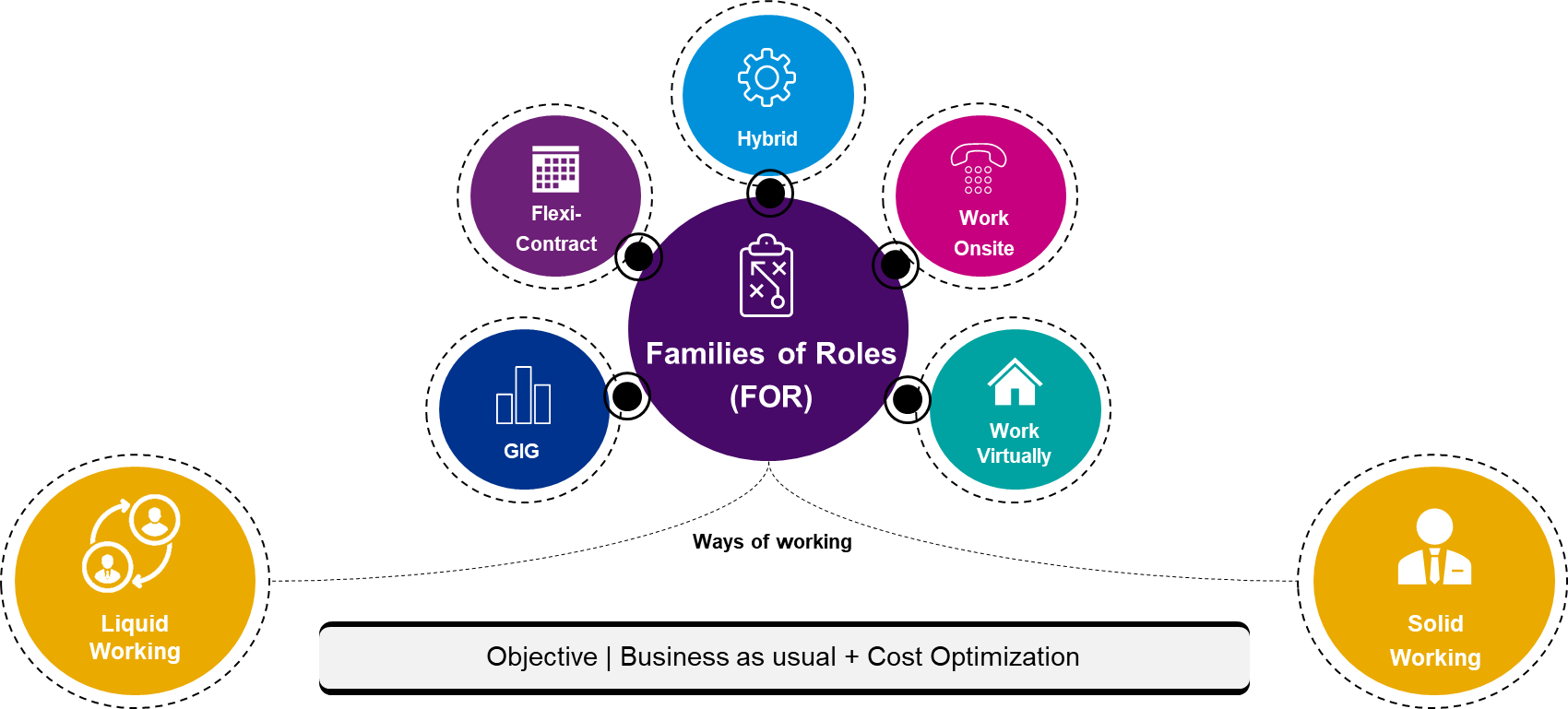
A new family of roles model can help you plot all your existing (mostly) fixed roles into: On-Site, Virtual, Flexi, Gig, Neo-Gig and Hybrid roles.
- Onsite roles are roles that can’t operate in a virtual format ever eg. A plant head
- Virtual as the name suggests are roles that can be moved to remote working permanently. Eg - An MIS executive or Programmer or Finance Executive
- Gig roles are roles that you can onboard for a specific period of time as required to complete your project, not on roles of your company and who can work on multiple projects, eg - Geologist or a Process Advisor etc.
- We also have Neo Gig roles who are contracted exclusive to your company for a longer period for a specific project but are not on roles of the company eg. Engineering Draftsman, Process Engineer.
- Hybrid are roles that need to work partly onsite and partly offsite - HRBP, Project Director, Procurement roles etc could be some such roles.
- Flexi roles are on your payrolls but need to work specified time - few hours per day, or few days per week, roles like a legal manager could move to this model
The other model that leaders could look at to save costs is that of a managed services model.
The thoughts and concepts above help you save workforce and workplace costs, needless to say as HR leaders you will need to work on many other areas with the FOR model – viz- compensation, variable pay, incentives, SOPs, all this is workforce design. There is so much that we can contribute as Human Resource Leaders today, let’s not limit ourselves and let our minds explore different models and things we have not tried, not experienced. This situation calls for such out of the normal thinking, doesn’t it?
Liquid Working: The uber model of workforce design
Till now we have only heard of solid working, i.e the fixed pay. A role-based model, but what if I possess the basic qualifications to execute another role which is in the same or allied job family. Eg. An HR head also operating as a Marketing Head or a Sales Lead operating as an Operations Lead and so on.
This model of working is termed as Liquid Working and allows the organization to utilize existing talent in a flexible way.
Thus, you not only save on manpower cost you could also land up improving your career engagement framework for such high potential talent.
For large voluminous tasks you can have teams coming together with specific or allied/similar skill sets to get things executed. Eg. In a financial industry lets say credit cards (ABC Cards) you can have an employee who does new customer entry, also do the same tasks for the parent bank (ABC Bank) and loan sales entry for the same financial company loan division. Imagine all this working in a Uber like platform. Technology matches your skill set and displays your availability, the project team is put together in a Uber way by the project manager. Welcome to the liquid workforce the uber model of workforce design powered by technology.
It’s all about working collectively with the business and reimagining the way we work and the way work gets done. Coupled with strong digital tech and infrastructure support, you will surely be gaining more momentum than your competitors. The next couple of years is all about tough competition.
Those who plan today will not only survive tomorrow but will build a new avenue to elevate themselves in the future.
COVID if looked at differently for business, is also an opportunity. We are all on a level playing field, it's about how we as leaders share our future, that will matter in the end.