









Today’s employees seek continuous learning, growth, and a clear sense of purpose in their careers.
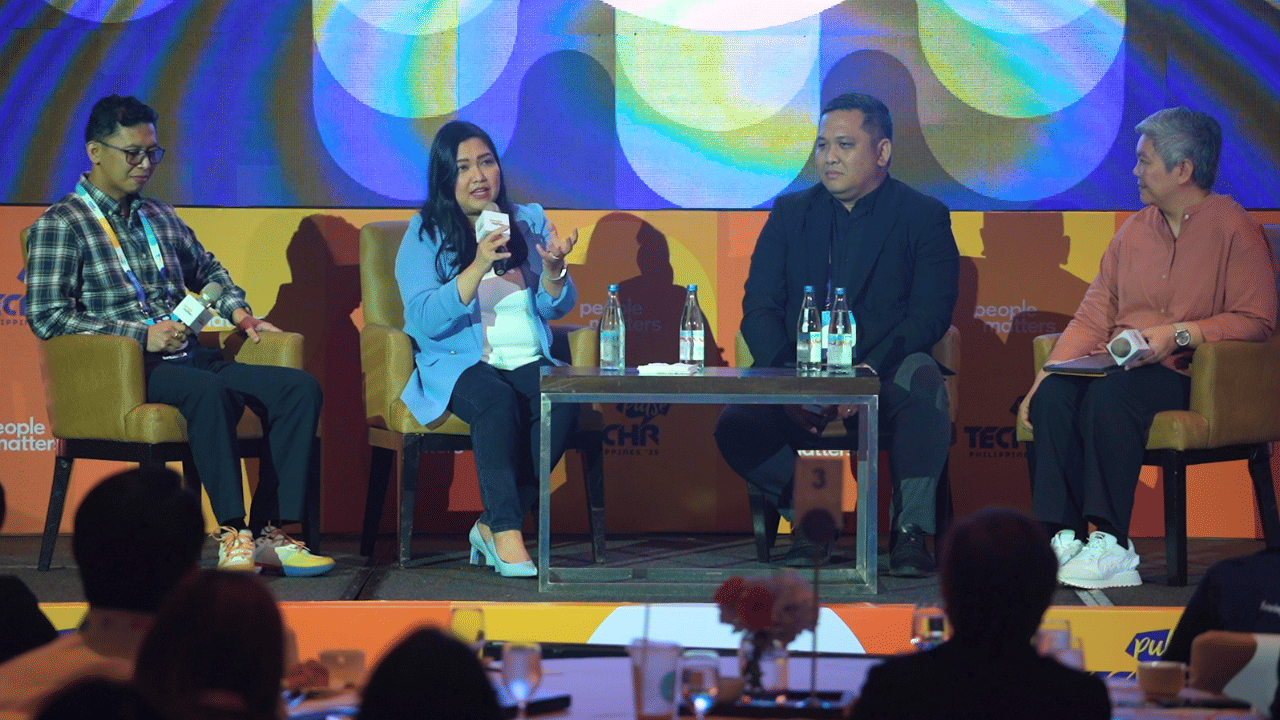
At Tech HR Pulse 2025 Philippines, a dynamic panel of HR leaders explored how organizations can create career pathways that accelerate development while keeping employees engaged, motivated, and future-ready.
Alpha Omega Aquino, a seasoned HR leader, opened the session with a bold statement: “The traditional career ladder is now obsolete!” She discussed the tools and approaches that help personalize career paths – AI-powered platforms to suggest roles and skills, mentorship and coaching, manager training for career conversations, and clear frameworks showing all possible job roles.
She turned to the panelists seeking insights on:
Designing simple, personalized, and meaningful career pathways for a diverse workforce
Sharing a brief about SM Supermalls’s operations and stakeholders, Cheryll Ruth Lat-Agsaoay, Senior Vice President-HR Group Head at SM Supermalls said, “We have 7,500 employees spread across 88 malls, soon to be 89. We make career journeys personal for such a large workforce, by building a talent ecosystem anchored on five things:
- Business-anchored: Revamping all job descriptions and building a comprehensive skills architecture. Together with leaders, we mapped out the skills needed today and projected those required 5–10 years into the future, done collaboratively, not just by HR but with full business involvement
- Leader-led: Coaching and mentoring became part of leaders’ KPIs. Today, 87% of our coaches are on track or ahead of their targets.
- Employee-owned: Career development with a SharePoint-based career tool, gamifying career paths, and employees could “click through the mall” to explore possible roles and see the skills needed for each, giving them a tangible sense of ownership.
- HR-guided: Moving HR teams from administrative tasks to acting as talent managers, helping employees navigate their career paths.
- Tech-enabled: First showing impact even without a big budget to convince the leadership. Then with promising results, transitioning to AI-powered solutions that further enhance career development.”
Leveraging AI-driven platforms to manage employees, and their learning and development
Dante Crisostomo, Head of HR & SEA Talent and Learning Lead at Dentsu, Southeast Asia shared, “One important distinction is enablement versus empowerment is – employees should own their day-to-day and their careers.”
He further added that a mentor or coach helps, but employees cannot wait for the next step to take action. “That’s where enablement comes in: creating an environment where people feel supported to reach, experiment, and try things out.”
Sharing his career journey as an example, he explained, “Having spent 14 years in the L&D space, one of the first philosophies I came across was ‘totality, showing, and learning.’ Similarly, career growth is about change, which can be intimidating. To make it safer for employees, organizations need to do a bit of handholding - First, by clarifying the skills required for a role. Then, by showing how it’s done through immersions, mentoring, and job shadowing before employees actually step into that role.”
“Too often, people jump at a role that seems attractive, only to realize later it’s not what they expected. By approaching it this way, employees get the chance to learn, experiment, and even fail, but in a safe environment.”
Finally, the shift toward skills-based growth, as skills are fast becoming the new currency in today’s constantly changing world, even beyond VUCA. “That’s why we need to enable employees to continuously build new skills and adapt for the future. Technology plays a big role here. Platforms can democratize learning, making it accessible to everyone, while helping employees not just acquire skills but truly own their development journey,” he concluded.
Growing and retaining talent in the public sector
Career growth in the public sector isn’t about promotions. Angelo Macario, Chief Human Resource Officer at National Museum of the Philippines, explained, “In the government sector, promotions once required navigating a long list of qualifications. For years, there was a public perception that many positions were already “reserved” for certain individuals.”
Reflecting on his journey, he shared, “When I joined the Museum in 2021, HR had not seen real change for nearly a decade. We had only 198 employees and just two people in HR. Today, that has grown to 553 employees and a 17-person HR team.”
“From the start, I decided to be the change. I challenged management and the statutory board, led a restructuring, and introduced a five-year recruitment plan with a merit-based selection system. Most importantly, we made promotion criteria and standards transparent and accessible to all employees, so everyone clearly understands what is needed to advance in their careers,” he added.
“We also transitioned from a seniority-based system to one focused on competencies and skills, revamping every job description accordingly. This was a challenging shift, particularly for long-serving staff, but we supported them with learning and development programs to bridge skills gaps. The aim was never to leave anyone behind but to help everyone adapt as technology and workplace demands evolved.
To reinforce this, we launched a structured L&D plan, introduced international scholarships, partnered with institutions, and secured substantial government funding. When I started, our annual L&D budget was only ₱200,000 ($3,440.62 USD); by 2025, it has grown to ₱50 million ($859,712.14 USD), driven by a solid plan, team support, and careful justification before the Senate and Congress.
The results speak for themselves, as attrition has dropped from 9% in 2021 to 4% today, and our initiatives now extend across 20 regional component museums nationwide.
The Museum is one of the country’s oldest institutions, but with the right structures, transparency, and investment in people, we are proving that even traditional organizations can successfully adapt and thrive.”
Aquino concluded the session remarking, “Relevance today is about skills you practice, not just titles you hold. I heard a great example recently: a registered nurse who moved into agriculture. At first glance, the industries are unrelated—but when you think about transferable skills, there’s a lot there.
As Simon Sinek once said, one essential skill for Gen Z is simply talking to strangers. Social skills are foundational, yet often overlooked in our digital age.”