









The Philippines has long leveraged its talent pool, service capabilities and cost competitiveness to attract global business. But as artificial intelligence, automation and skills-based work reshape the labour market, the next phase of growth will depend on whether the country can move further up the value chain.
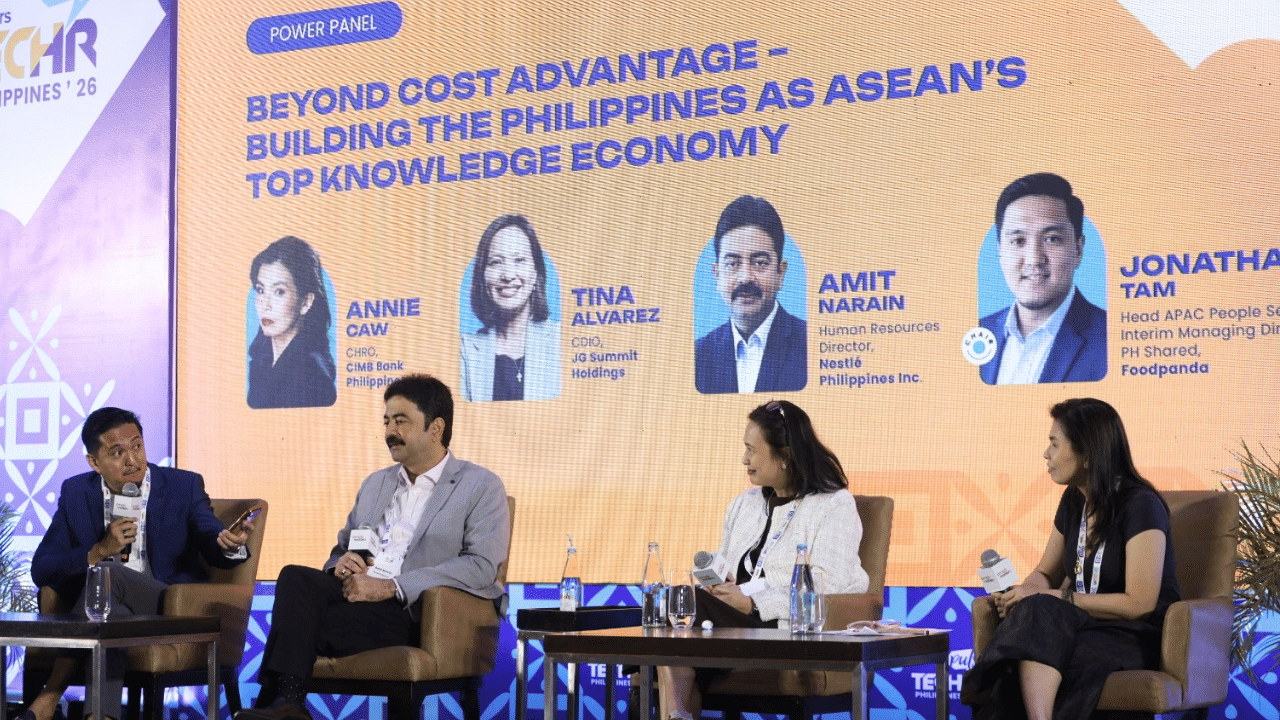
The central theme of the Power Panel, “Beyond Cost Advantage – Building the Philippines as ASEAN’s Top Knowledge Economy,” at People Matters TechHR Pulse Philippines was how the country can build on its talent advantage to move towards a higher-value, knowledge-driven economy.
The panel brought together Annie Caw, CHRO, CIMB Bank Philippines; Tina Alvarez, CDIO, JG Summit Holdings; Amit Narain, Human Resources Director, Nestlé Philippines; and Jonathan Tam, Head APAC People Services and Interim Managing Director, PH Shared, foodpanda, to explore what it will take for the Philippines to move beyond its labour-cost advantage and build a higher-value, knowledge-driven economy.
The conversation pointed to a broad shift already underway: the Philippines' competitive advantage can no longer rest primarily on the availability or cost of talent. Its next opportunity lies in building deeper capabilities across AI, digital engineering, data analytics, cybersecurity, experience design and problem-solving.
From talent availability to knowledge capability
The panellists acknowledged that the Philippines already has several of the foundations needed to make that transition.
The country has a large, young workforce, a strong services industry and an established position in global business operations. But the challenge is to convert those advantages into capabilities that can create greater business value.
That means moving beyond the question of how many people can be employed towards what those people can solve, design, analyse and improve.
As the discussion highlighted, organisations increasingly need talent that understands not just the what of a task, but also the why behind it.
This distinction becomes particularly important as routine work is increasingly supported or automated by technology.
Employees who can understand customer problems, interpret data, connect ideas across functions and design solutions are better positioned to contribute to higher-value work.
For the Philippines, that creates an opportunity to position its workforce not simply as an efficient delivery engine, but as a source of knowledge, innovation and business problem-solving.
The shift from jobs to skills
One of the strongest themes emerging from the discussion was the transition from a job-based to a skills-based workforce.
As roles change faster, organisations cannot rely solely on traditional job descriptions and fixed career paths. They need a clearer view of the skills they have, the capabilities they will need and the gaps between the two.
Narain pointed to the growing importance of this shift, noting that progressive organisations are increasingly looking across the entire people value chain, from hiring and development to mobility and workforce planning.
The emphasis is also moving towards curiosity and willingness to learn.
Hiring people with the right foundation is only one part of the equation. Organisations also need to create environments where employees can continuously experiment, learn and apply new capabilities.
Technology can help make this more targeted. One example discussed during the panel was the use of learning technology to identify capability gaps by function. Instead of relying entirely on broad training programmes, organisations can use data to identify the areas where specific teams need development and then design more targeted interventions.
This changes the role of learning from a largely programme-led activity to a more data-informed capability-building function.
AI is accelerating the skills conversation
AI is adding another layer to this transformation. The panellists discussed experimentation with AI-enabled platforms and tools not only to automate work, but also to understand changing skill requirements and prepare employees for future roles.
For HR, this creates a dual challenge.
First, organisations need to understand which capabilities are becoming more important as AI changes how work is performed.
Second, they need to ensure employees have opportunities to build those capabilities.
The implication is that AI adoption cannot be separated from workforce development. Technology may identify patterns in skills and learning needs, but organisations still need leaders and managers who can interpret those insights and translate them into meaningful development opportunities.
That makes the ability to navigate the people side of transformation increasingly important.
Young talent needs problems to solve, not just training to complete
The discussion also turned to the Philippines' young workforce, with panellists highlighting the significant share of Gen Z and younger employees in their organisations.
The question, therefore, is how companies can move young talent beyond completing training towards developing stronger problem-solving and critical-thinking capabilities.
One approach shared on the panel was to give employees real business problems to solve through cross-functional teams.
At JG Summit, for example, young employees have participated in squads designed to tackle systemic business challenges. These teams bring together people from different functions, such as HR and IT, to understand a problem, identify the customer pain point and develop a solution.
The model has evolved beyond a formal programme. Rather than waiting for a dedicated initiative to launch, teams can now be formed when a business problem emerges and given the space to work collectively towards an outcome.
The problems can range from manual processes to collections and balance-sheet reconciliation.
The important shift is that employees are not simply being asked to learn a new tool or complete a course. They are being asked to understand a problem, work across functions and deliver a measurable outcome.
That approach can also change how younger employees interact with hierarchy.
Instead of automatically relying on a supervisor or manager to solve a problem, employees develop the confidence and experience to work with colleagues, test ideas and take ownership of solutions.
Experience could become the differentiator
As technology makes processes faster and more efficient, the panel also stressed the importance of experience.
Cost, speed and productivity remain important measures, but they do not fully capture the value organisations can create.
Customer experience, employee experience and the ability to understand the context behind a problem can become increasingly important differentiators.
This requires organisations to look beyond the immediate output and consider the broader experience surrounding it.
Empathy, therefore, remains relevant even as organisations become more data-driven and technology-enabled.
Understanding what customers and employees actually need requires interpretation and human judgement, capabilities that cannot be reduced to a process or metric alone.
For the Philippines, this could be particularly significant. Its established strength in service delivery provides a foundation, but the opportunity is to build deeper expertise around the experiences and business problems those services are designed to address.
Building the ecosystem around talent
Moving towards a knowledge economy will also require more than individual companies investing in skills.
The panel discussion pointed towards the importance of the broader ecosystem, including education, employers, technology platforms and industry partnerships, in developing the capabilities required for the future.
The Philippines already has a strong base of engineers, technology professionals and services talent. The next step is to connect that talent more deliberately with emerging areas of demand.
That could include AI operations, digital engineering, analytics, cybersecurity, product development and experience design, among other knowledge-intensive areas.
It also means creating pathways for employees to move between skills and roles as the economy changes.
From employment to employability
Ultimately, the conversation pointed towards a broader redefinition of what workforce competitiveness means.
For years, the Philippines' talent proposition has been closely associated with employability in global services. The next chapter could depend on strengthening long-term employability. The ability of people to acquire new skills, solve unfamiliar problems and move into higher-value work as technology and business models evolve.
That requires a different approach from simply preparing people for today's jobs.
It means building curiosity, experimentation, cross-functional collaboration, critical thinking and the ability to connect technology with business outcomes.
The Philippines already has many of the foundational ingredients: a large talent pool, a mature services ecosystem and a workforce with experience serving global organisations.
The question now is how those foundations can be converted into deeper knowledge capabilities.
The shift from cost advantage to knowledge advantage will not happen through technology alone. It will depend on how effectively organisations, educators and the wider ecosystem develop people who can understand the what, question the why and create the how.