









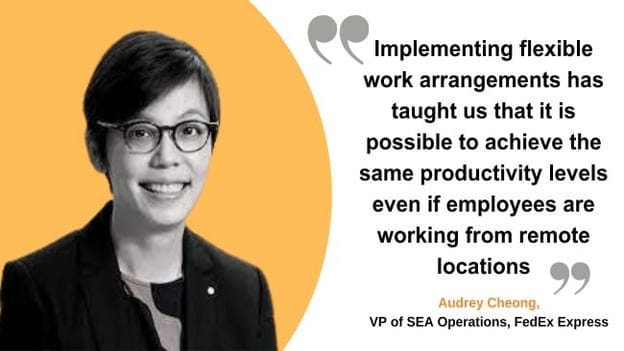
What steps would a global organization, with a diverse workforce, take during a pandemic situation? How can they ensure the engagement, productivity, and safety of their employees while also celebrating cultural values in a remote work environment? In an exclusive interview with People Matters, Audrey Cheong, Vice President of SEA Operations at FedEx Express, shares actionable insights on addressing challenges like productivity loss, employee well-being, cost management, and absenteeism during pandemic-like scenarios.
Please tell us about FedEx's COVID-19 pandemic approach, specifically in terms of productivity, staff support, and cost management, including addressing issues such as absenteeism and productivity loss.
According to an MSD report, indirect costs, including absenteeism and productivity loss, will remain the bulk of the total ongoing economic costs of COVID-19. In a base case scenario, the estimated economic cost of the pandemic in Singapore is around SGD 3.6 billion per year, with 96% of costs due to productivity losses, either due to personal illness or caring for dependants affected by COVID-19.
The report also shows that the economic costs of COVID-19 borne by critical industries – which includes logistics, may increase under a Pandemic 2.0 scenario, under which frontline workforces may be required to isolate while they recover. The resulting loss of productive time in this scenario can be up to 30% greater than non-frontline employees.
Driven by our People-Service-Profit (PSP) philosophy, our teams proactively responded to the challenges and built workplace resilience by focusing on three key areas: safeguarding employee wellbeing, ensuring business continuity, and maintaining productivity. As an essential service, we had to ensure the smooth movement of supply chains, and at the same time, determine how we can provide new working solutions to our team members.
The past two years have helped us learn how to best support our team members, whether it is by supporting them navigate the challenges of working remotely or maximising their time when they come into the office. Part of that support includes measures to ensure continued collaboration and facilitate stronger working relationships, such as weekly 'Collaboration Days', where team members return to the office for the day.
Could you share FedEx's initiatives or programmes aimed at enriching employee morale and engagement during the pandemic? What was the impact of the pandemic on employee productivity and engagement, especially when employees are filling in for sick colleagues or working overtime?
As an essential service provider, we faced the challenge of ensuring the seamless functioning of our supply chains, while also exploring new work solutions for our team members. FedEx Singapore and Hong Kong were the first two offices in the region to roll out the Hybrid Workplace Model – a key initiative we introduced during the onset of the pandemic, designed to provide non-frontline employees with greater control over their work schedules and accommodate their individual needs.
- Team members were also frequently consulted on their preferences towards flexible workplace arrangements through the Survey-Feedback-Action programme. This gave managers insight into how employees were coping with the unique challenges of hybrid work, and if the flexible work model would continue to be well-received.
- By allowing employees the flexibility to work remotely, we observed that they could maintain the same pre-implementation productivity levels. Simultaneously, this approach allowed them to enjoy more personal time, reduce stress, and be more engaged during work hours.
- When they were in the office, we implemented community measures such as mask-wearing and social distancing, which were also integral in managing COVID-19 and its impact globally. Adapting such measures also helped to minimise further disruptions, particularly before vaccinations and therapeutics were introduced.
- Post-pandemic, we regularly organised team gatherings to build cohesion. This included celebrating local festivals such as Hari Raya, Deepavali, Chinese New Year and Christmas, and a spectrum of fitness activities championing various health and wellness initiatives.
- For example, during Chinese New Year, team members were encouraged to create and share handicrafts made using red packet envelopes. For Deepavali, a ‘Thankful Deepavali’ initiative saw team members sharing a ‘Thank You’ note to express appreciation to colleagues. During the holy month of Ramadan, our team members from Operations distributed snacks and meals to frontline employees for breakfast as one team. Several workout activities and virtual fitness sessions such as HIIT Boxing and strength training were also organised to bring the team together.
- At an organisational level, our various initiatives have allowed us to optimise our office space utilisation and expand our access to a broader talent pool. This aligns with our employee-first philosophy, strengthening our commitment to fostering a supportive work environment.
To assist female employees in balancing work and caregiving responsibilities during the pandemic, what support systems or measures has FedEx implemented? Please share examples.
At FedEx, not just our female employees, but parents in general have benefited from the Hybrid Workplace model. An example is our team member from HR, Pauline Xu, who has shared how this flexible working model has greatly improved her family’s ability to manage childcare responsibilities. It has enabled her to be more present for her children’s milestones and spend more quality time together as a family. Additionally, Pauline found value in the weekly well-being check-ins with her manager, where she was able to discuss her struggles with morning sickness during her pregnancy.
Could you provide insights into how FedEx is addressing challenges like productivity failures in SEA regions? How has technology been used to alleviate employee burdens and maintain operational efficiency during the pandemic, and are there specific technological solutions or innovations that FedEx has implemented for this purpose?
It is important to acknowledge the pivotal role of technology in addressing the challenges faced by businesses. For FedEx, we contend with various risks, including supply chain disruptions, operational issues, transportation challenges, and shipment risks.
To mitigate these risks, we employ several strategies. For instance, we harness predictive analytics to anticipate and address potential supply chain disruptions, by having our analytics centre work closely with FedEx Dataworks, our centralised data platform. This enables us to optimise the FedEx network through advanced analytical methods, enhancing our ability to forecast and prepare for potential disruptions.
- At our South Pacific Regional Hub (SPAC) in Singapore, we have implemented an AI-powered robotic sortation arm that helps increase overall efficiency for manual tasks, reducing operational risks. With it, we can sort 1,000 packages bound for 100 different destinations simultaneously in an hour with an accuracy of more than 99.5%.
- The safety of our courier partners is our priority and with FedEx’s Fleet Management Technologies, we can optimise transportation activities, thus ensuring driver safety and minimising risks associated with accidents, breakdowns, and unauthorised vehicle usage.
- For our customers, we offer a wide array of solutions to reduce shipment risks. This includes the FedEx Surround feature, developed in partnership with Microsoft. This empowers customers to tackle challenges like shipment transparency by leveraging data to provide near-real-time analytics.
- Finally, we have been actively expanding our self-collection services throughout Southeast Asia. These services play a crucial role in improving our operational efficiency by reducing the instances of failed deliveries and delivery attempts. Moreover, they contribute to an enhanced customer experience by providing greater flexibility and convenience for package collection. To illustrate, we've established a network of more than 2,000 self-collection points in Singapore through collaborations with various retail outlets.
Has FedEx introduced any reskilling or upskilling programs aimed at enhancing employee engagement and ensuring that employees are prepared for different roles or responsibilities that may emerge as a result of the pandemic?
At FedEx, we believe our employees are our greatest asset and are devoted to cultivating a work environment that enables our team members to create an impact, learn and grow, and “spread their wings”.
We wholeheartedly embrace talent development as a core element of our commitment to offering our employees lifelong careers. We consistently host cross-functional learning sessions to provide our employees with valuable chances to broaden their expertise and abilities, going beyond their current job responsibilities. This approach yields multiple benefits. Besides fostering stronger interdepartmental connections and cultivating enhanced trust among employees, it also ensures multiple employees are trained to perform critical tasks. This, in turn, helps mitigate the potential impact of individual absences and contributes to the overall resilience of our workforce.
To further support our employees, we launched the Linc Up AMEA mentoring programme, in which selected applicants will receive mentorship guidance from FedEx executives. The programme aims to help mentees expand their range of professional competencies, gain better confidence in interacting with senior executives, broaden their strategic thinking skills, and better plan their individual career pursuits.
How has FedEx's response to the pandemic evolved over time, and what strategies have been most effective in managing costs and supporting employees? Please share insights on how to approach similar challenges in the future.
Firstly, we need to recognise that the effectiveness of a strategy varies depending on the sector and may be influenced by factors such as an organisation’s size, culture, and workplace dynamics. The past two years have taught us the importance of remaining nimble and agile to adapt and respond to change. Implementing flexible work arrangements has taught us that it is possible to achieve the same productivity levels even if employees are working from remote locations.
- Over the past year, our hybrid workplace model has helped to boost non-frontline employee morale and job satisfaction and even helped us attract a wider talent pool. Employees now have more time with their families and for themselves, which promotes a more engaged workforce. Our actions cultivated a positive workforce culture, demonstrated by the strong retention rate of an average tenure of 13 to 14 years within the company and a favourable employee engagement rate of 85% in the 2022 Survey Feedback Action programme.
- We also introduced a hot desk system which enabled optimised use of office space. This setup provides team members with the opportunity to better work together on designated weekly Collaboration Days.
- For our front liners, we introduced modified scheduling, split shifts, and shift-swapping options. These have allowed us to offer our employees the flexibility necessary to maintain a healthy work-life balance while ensuring operational efficiency and customer satisfaction.
Today, we are proud to be a hybrid-ready business that remains committed to our team members and customers to deliver outstanding experiences every day.