









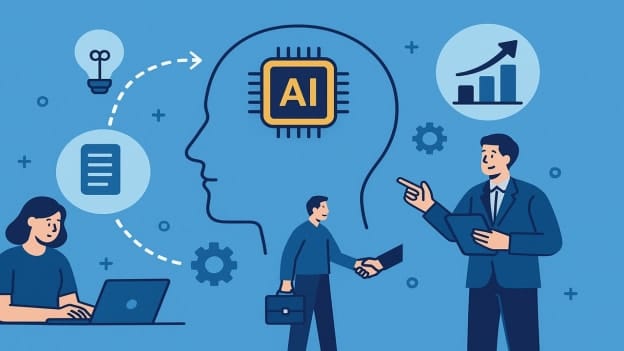
Artificial Intelligence in HR is an active, disruptive force reshaping industries, workflows, and job roles. For many employees, this shift feels exciting, yet has its share of uncertainty too. A recent Skillsoft workplace report found that nearly 7 in 10 professionals are anxious about AI impacting their roles, yet only a fraction feel equipped to adapt.
For HR and L&D leaders, this presents both a challenge and a strategic opportunity: how do we bridge the widening gap between AI awareness and practical capability at scale?
What’s becoming clear for leaders is that simply exposing employees to AI concepts isn’t enough. Tinkering with AI-based tools or watching webinars doesn’t translate to performance or confidence. What organisations truly need is a structured, hands-on learning path that turns curiosity into competence quickly because the workforce of the future isn’t one that avoids AI, but one that knows how to work alongside it: creatively, critically, and confidently.
In this article, we will explore how L&D teams can lead that transition, helping employees progress from basic AI literacy to applied skills that make a tangible difference. And we will look at how organisations can enable themselves with platforms and tools like Skillsoft’s Percipio and the immersive CAISY™ AI simulator, to move from experimentation to transformation.
The confidence gap: Where curiosity stalls
Many employees have tested out tools or tried using AI to automate small tasks. But when it comes to understanding its potential for advanced integration into job responsibilities, there’s still scope to grow. The gap doesn’t come from a lack of intelligence or motivation. It often stems from two things: lack of context and lack of practice. Learning about AI is one thing. But continuously applying it in a meaningful way is another.
This is where most upskilling efforts fall short for most organisations. For the upcoming AI revolution on jobs and skills, its not enough to build just awareness, companies must give learners a safe, structured environment to experiment, explore, and make the connection to their actual roles.
A more thoughtful path to AI Fluency
Building AI capability is about designing progression, i.e. moving them through a learning journey that feels relevant and builds real confidence.
That journey must typically unfold in four stages:
For building awareness and literacy, what works is instructor-led training, which starts with the instructor explaining the relevance, builds confidence through context, and encourages learners to test their understanding in low-stakes, experiential environments.
Why experience still trumps explanation
And organisations should go a step further. People don’t fully grasp what AI can do until they try it for themselves. It’s in ‘doing it’, i.e. creating a piece of content with AI, refining a process, or interpreting AI-driven insights that the learning starts to click.
This is why simulation-based learning has gained traction of late. When learners are placed in realistic, role-specific scenarios where AI tools can be explored and applied, something shifts. The tech stops being abstract. It becomes useful.
It’s also why immersive practice, whether through live labs, guided scenarios, or role-play simulations, is proving more effective than static content. Learners can experiment without fear of failure, gain confidence through repetition, and receive feedback in real time.
Making AI upskilling work and then scaling it
Scaling this kind of learning experience across a team or organisation requires more than good intentions. It takes structure, i.e. a platform or system that supports both content and application, and adapts to different learning styles.
Successful initiatives often blend short-form content with modular pathways, role-based tracks, and access to simulations or use-case exercises. This combination allows for flexibility while still guiding learners toward tangible outcomes.
The key isn’t just providing access to AI learning. It’s ensuring that what’s learned can be transferred directly into the flow of work.
Rethinking the role of L&D in the AI era
What this moment demands from L&D leaders is more than just instructional design. It also calls for strategic enablement. Leaders have to develop the ability to create conditions where people are not just learning about AI, but actively reshaping how they work because of it.
That also means choosing tools and approaches that feel accessible to the learners. L&D leaders have to start championing experimentation and normalise the discomfort that comes with learning something new. Most importantly, they have to integrate AI into broader conversations about growth, creativity, and career development by not treating it as a siloed or standalone skill.
Ultimately, the aim is to cultivate a culture where people are open to new ways of working and have the necessary skills and support to try them. AI is accelerating at a fast pace, but human capability can too, especially when given the right context, tools, and encouragement.
By focusing on practical, purpose-driven learning experiences and tools, L&D leaders can move beyond passive awareness into active, confident use of AI, not as a replacement for human skill, but as a powerful partner in the transformational work ahead.
To learn more about how to augment AI-based skills and learning: Click here