









Southeast Asia’s boardrooms are humming with talk of transformation. Capital is flowing, cross-border skill mobility is accelerating, and AI promises to turn workforce management into a precision science. On the surface, HR looks ready to lead.
The People Matters SHRPA State of HR Industry 2025 Southeast Asia Insights study found three key gaps that will define HR's success story in 2026. These around HR's effectiveness, its ability to improve adoption and create an organisation wide AI readiness.
Borderless growth poses newer challenges for the region
The primary driver of business growth for Southeast Asia is the access to foreign capital and talent. Growing premium on niche skills and shrinking local talent pipelines mean companies in the region look externally to fill their talent demands. This pressure has exacerbated in the last year.
Contrary to its current high relevance in 2025 as a key factor, SHRPA 2024 report found access to foreign talent 7 points lower in the comparative ranking. Employers are hiring across jurisdictions to plug widening skills gaps in AI, analytics, and digital operations.This pushes up the cost of talent and has a cascading impact on how talent and technology challenges impact business growth.
Looking closely at the different set of challenges that impact HR across Southeast Asia, five major areas emerge. Areas that directly impact businesses and require HR’s attention. These are:
Talent Excellence: Includes aspects like productivity and managing multi-generational workforce
Change Management: Managing change and leading HR tech transformation journeys
Leadership: Building the right leaders and managers
AI and Emerging Technologies: Selection, implementation and adoption of HR tech solutions with AI and other emerging technologies
Total Workforce Planning: Hiring, skilling, and deployment of talent
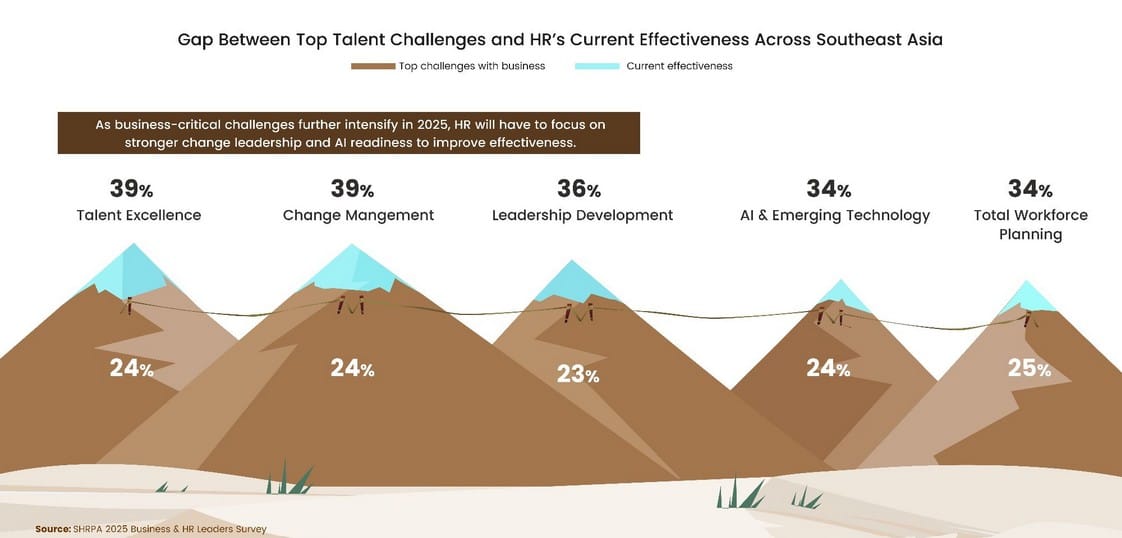
Comparing these challenges to HR’s effectiveness in solving them, we get our first major gap. Across areas like talent excellence, change leadership, workforce planning, and AI precision, HR effectiveness SEA lags. This has major implications for both HR and business. With these challenges directly impact business outlook and growth, low effectiveness creates roadblocks and hampers competitive advantage. In turn, it threatens HR’s own strategic importance and will lead to companies looking for external solutions. Addressing HR's effectiveness gap is a first key step to improving its strategic impact on business.
To address this, HR’s agenda in 2026 needs to be around improving talent excellence, building change leadership, making workforce planning more strategic, and finally improving their AI usage.
While the first three remain squarely within HR’s domain, AI adoption and usage raises questions beyond just effectiveness.
Route to advanced AI needs to answer key questions
HR has learnt to automate tasks; it has not yet mastered the orchestration of intelligence. Only one in five leaders report full adoption of generative AI, and even these cite capability shortages as their biggest obstacle. The irony: in the race to modernise, technology has outpaced the talent meant to use it.
Today adoption of GenAI remains low – a mere 17% of companies in SEA say it’s fully adopted across the different HR functions. This is surprising when we see that investments and innovations around AI powered solutions have been skyrocketing. HR leaders say across the board, their investments in HR tech solutions are going to rise. On the other hand, HR tech leaders are betting big on AI powered innovations to help HR address its challenges.
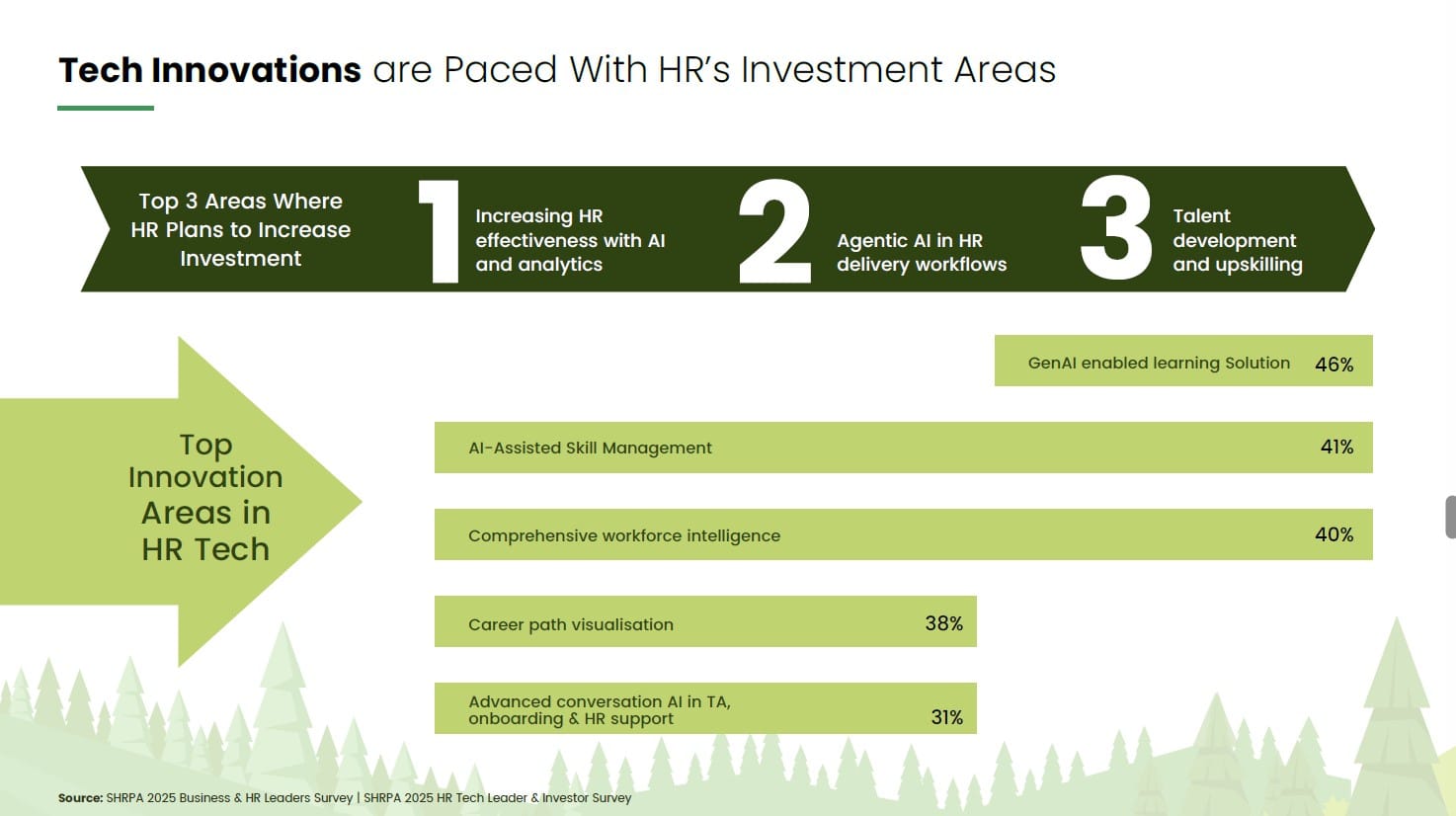
This paradox in growing market momentum but low adoption raises an important question: how are HR leaders realising value and ROI through their investments? The data also shows this trend. Compared to 2024, the SHRPA 2025 report notes an almost 40% rise in the criticality of ROI and value realisation demands.
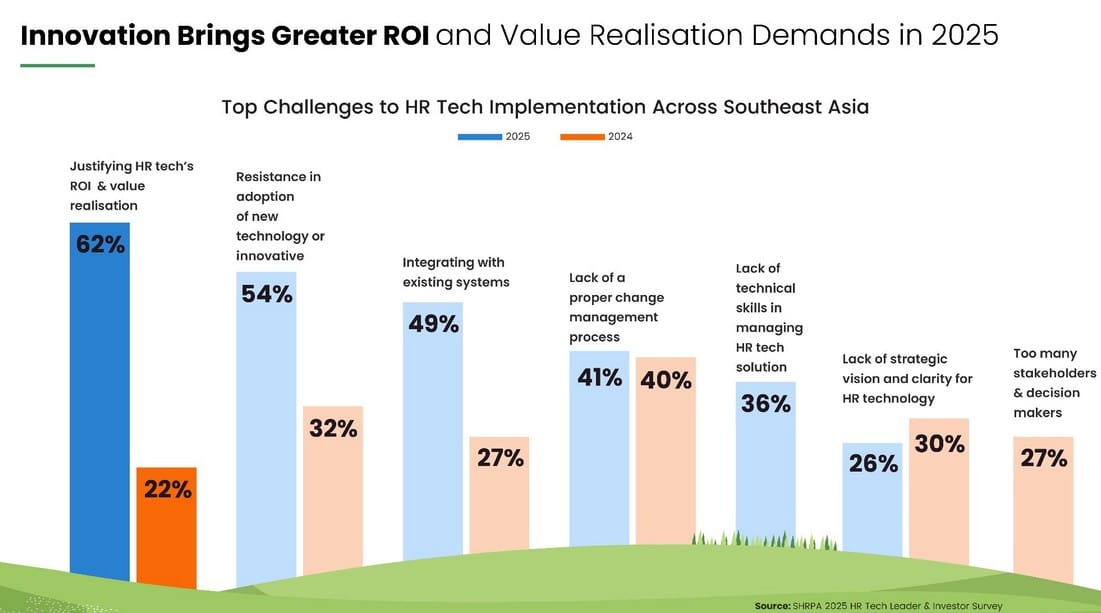
This brings into focus the need for HR leaders and teams to shift their focus from just implementing newer tools to focusing on adopting them. And this goes beyond just HR. Tech partners too have a major role to play in ensuring adoption and overcoming change resistance.
Across implementation challenges that influence adoption, two key demands emerge:
HR realities have changed, requiring more nimble and agile, and responsible platforms. Tech partners need to collaborate better with HR leaders in ensuring their solutions are built not just for the present but also the future.
HR’s own AI readiness and capabilities are lagging, hampering their ability to improve adoption
The value realisation gap, the report notes, impacts businesses' trust in HR to be ready for an increasingly AI-driven future. To overcome this gap, HR will have to become more adoption focused, even having to restructure their teams and adopt more agile, capabilities driven operating models to ensure adoption.
But even this shift will only be successful in creating the sustainable business impact if it’s supported by an organisational shift to AI readiness.
Cultural shift required to enable AI readiness
The People Matters SHRPA 2025 Southeast Asia Insights found that 78% of HR leaders in the region believe they are prepared to handle change. Yet peel back the optimism and a more sobering picture emerges: only 24% describe themselves as AI-ready.
This gap—between enthusiasm and execution—defines the new HR paradox. Transformation is no longer about whether to change, but how fast, with what capabilities, and to what measurable end. The report’s warning is clear: 57% of HR functions will miss transformation goals if change readiness fails to equal AI readiness.
The AI readiness gap within HR is accentuated through multiple factors, Firstly adoption levels of is stagnating. Secondly we see that while HR tech architectures are becoming progressively sophisticated, many miss the mark because of low AI readiness. Thirdly, HR’s strategic relevance by hampering how it assesses, adopts, or integrates AI into talent processes.
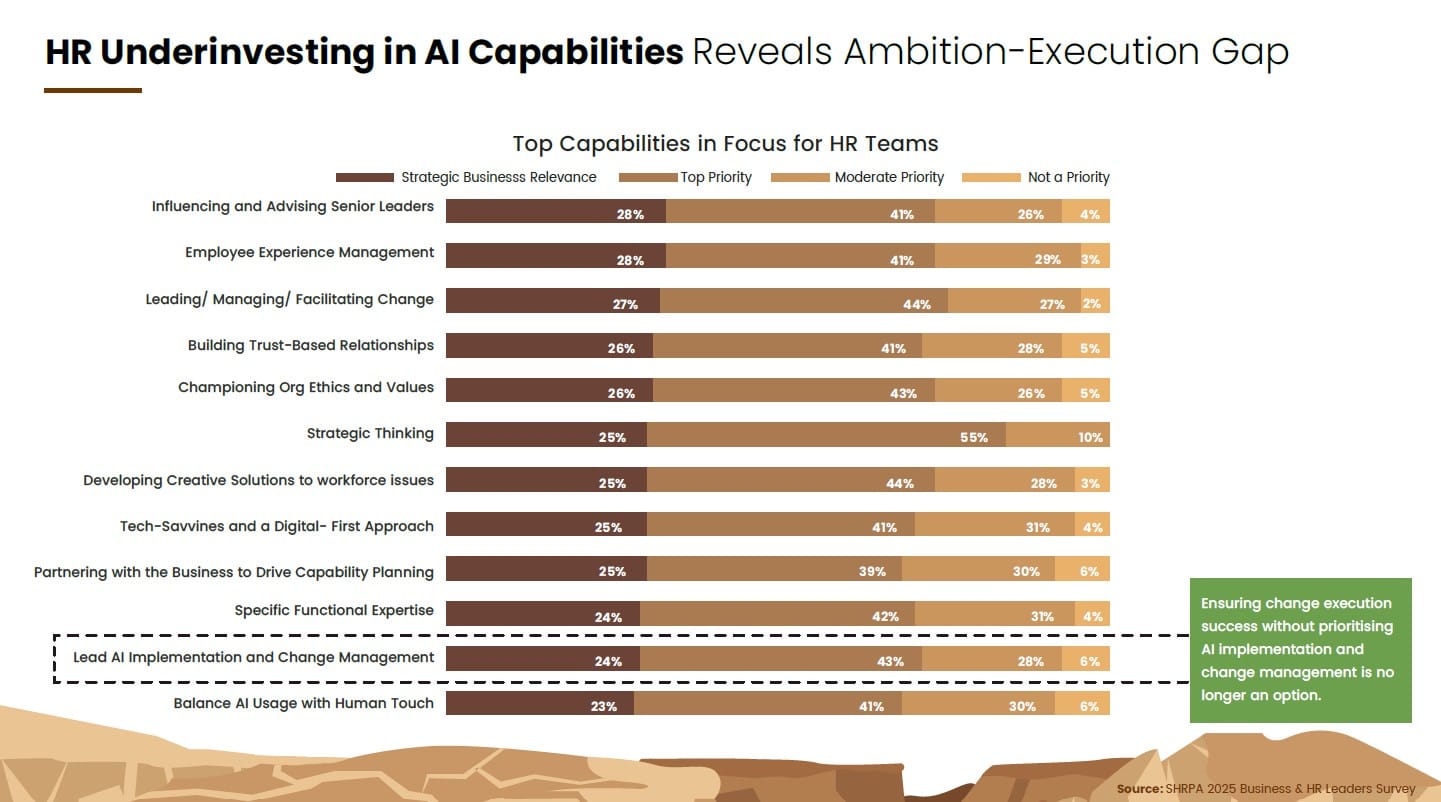
For HR teams, this gap stems from the lack of prioritisation of AI capabilities across the function. Only 24% say leading AI implementation is a strategic focus. Even fewer say balancing AI usage and human touch is prioritized at a business level.
When those variables balance, HR becomes the driver of enterprise agility. When they diverge, transformation stalls.
The report reveals Southeast Asia’s HR leaders stand at a crossroads. They can either remain change-confident and AI-cautious—well intentioned but impact-light—or they can reprioritise capabilities and rebuild their functions to lead in the age of intelligent work. The region’s talent advantage, its demographic dynamism, and its investment appetite all provide tailwinds. What it lacks is coherence.
The next chapter of HR will not be written by those who automate faster, but by those who integrate smarter—aligning technology, talent, and leadership in one continuous loop of adoption and value creation.
To delve further into the different facets of these gaps and explore how they translate into future imperatives for HR across Southeast Asia, download the report here.