









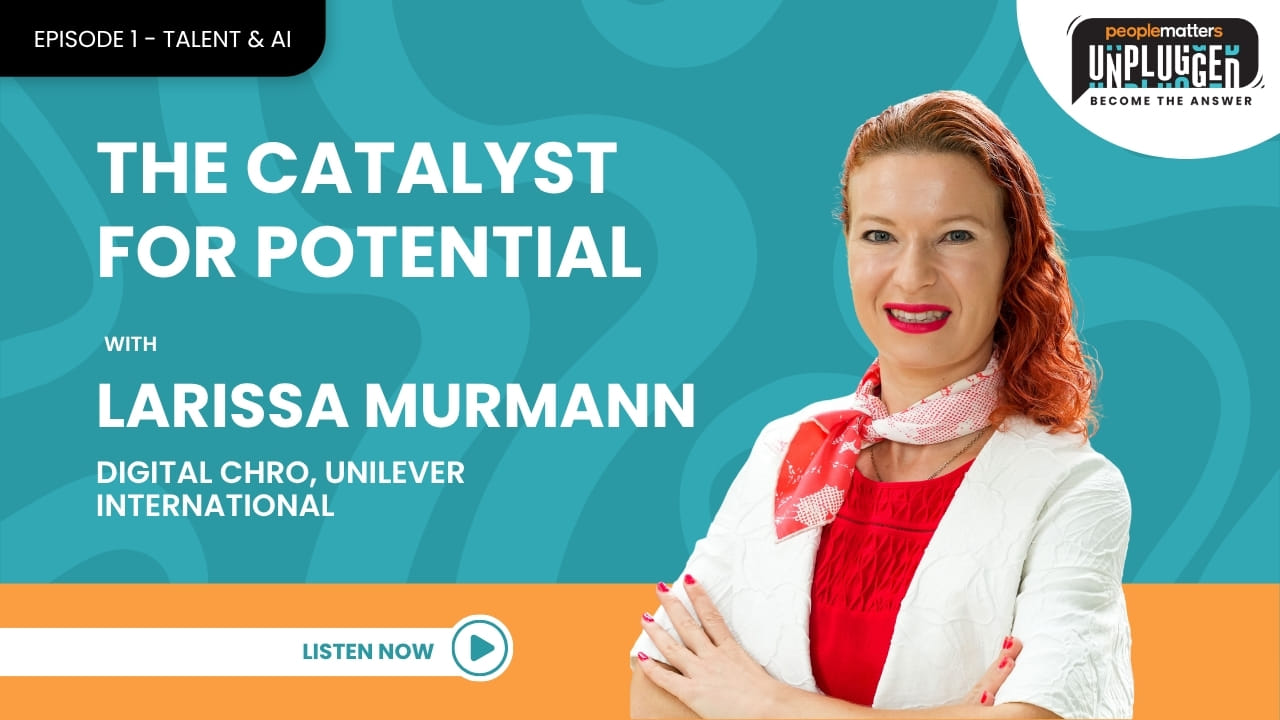
Today, HR is no longer confined to the traditional boundaries of talent management. It sits at the intersection of business, society, technology, and even the planet. In the first episode of Season 4 of People Matters Unplugged, Cheshta Dora, Head of Research & Content Strategy at People Matters, spoke with Larissa Murmann, Digital CHRO of Unilever International, to explore how HR can harness AI responsibly, drive workforce transformation, and prepare organisations for a future where humans and machines collaborate seamlessly.
Larissa’s journey is emblematic of how modern HR leaders are redefining their roles. With experience spanning Singapore, Switzerland, the US, Argentina, Spain, and Mexico, she has consistently pushed the boundaries of conventional HR practices. Her title—Digital CHRO—is not just symbolic. It was born out of a change management initiative aimed at reshaping leadership mindsets around digital adoption. “We decided to start changing job titles internally to give leaders a new identity,” Larissa recalls. “Once I added ‘Digital’ to my title, I suddenly got invitations to speak at conferences and realised that HR and technology must collaborate to shape the future of work.”
AI as a collaborator
Larissa’s perspective on AI is grounded in practicality. Rather than being swept up by hype, she emphasises understanding the real implications of AI for her role, her team, and the organisation. Her first encounter with AI came at a conference in Dubai. There, she experienced a digital clone of herself capable of speaking multiple languages and interacting intuitively. While the initial reaction was anxiety, it also sparked curiosity. “If this technology can perform parts of my job better, more politely, and consistently, how can I use it to augment my work and my team’s productivity?” she asked herself.
This mindset—viewing AI as a collaborator rather than a replacement—is central to Larissa’s approach. She conducted a personal audit, analysing which tasks she valued and which could be augmented by AI. She then extended this framework to her team, aligning AI adoption with employee upskilling, engagement, and ethical considerations.
Larissa underscores that AI implementation cannot be one-size-fits-all. For instance, recruitment AI tools can enhance objectivity and reduce human bias; however, they must be rigorously tested to ensure fairness across various demographics, including nationality, gender, and background.
“AI will learn from humans, so you must train it responsibly. Otherwise, you risk embedding biases into systems that are meant to be more equitable,” she explains.
Integrating AI into business functions
At Unilever, Larissa spearheaded initiatives to create a digital AI hub in Singapore. Collaborating closely with the CTO, she designed roles and processes that integrate AI into business functions—from marketing to supply chain, finance to HR. This hub doesn’t just automate tasks; it enables teams to respond faster to consumer trends, streamline operations, and create cost efficiencies, all while maintaining a human-centred approach.
Larissa also stresses the importance of governance and data privacy, particularly in a global context. “You need advisors and technology partners to ensure that your AI tools are ethical, compliant, and aligned with business goals,” she advises.
Employee-driven upskilling
A critical insight from Larissa’s work is that upskilling must be employee-driven. She argues that HR cannot unilaterally make employees “future-ready.” Instead, employees must see the value and relevance of new skills to their own goals.
To make learning engaging, Unilever launched a digital academy delivering bite-sized, AI-assisted learning videos. “Three-minute videos, one per week, in a Netflix-like format, make upskilling fun and relevant,” Larissa says. By combining creativity with technology, the academy has increased engagement while preparing employees for evolving roles shaped by AI.
Larissa also shares an intriguing concept: the human-agent ratio. As AI agents take on more responsibilities, organisations will need to measure how humans and machines interact. Metrics will track the balance of human and AI contributions, helping HR leaders understand workforce dynamics, optimise productivity, and maintain engagement. This forward-thinking approach reflects Larissa’s belief that AI should enhance human creativity rather than replace it, and that HR’s role is pivotal in orchestrating this collaboration.
Ethical AI, responsible adoption, and augmentation over replacement are recurring themes throughout Larissa’s journey.
She emphasises that organisations must move beyond anxiety about AI’s potential to displace jobs and focus instead on opportunities to accelerate innovation, creativity, and efficiency. By embedding AI thoughtfully, HR can facilitate upskilling, enhance fairness in hiring, and unlock new business value. “We must transition from viewing AI as a threat to seeing it as an enabler of human potential,” she notes.
Larissa also challenges traditional notions of leadership in AI adoption. She encourages HR leaders to explore AI daily, experiment safely, and think about practical applications for their teams. This proactive approach contrasts with the slow, cautious adoption often seen in large corporations. While risk management is critical, Larissa believes that organisations that move too slowly risk falling behind agile startups and competitors who embrace AI as a strategic advantage.
The podcast also explores the broader societal implications of AI. Larissa distinguishes between workplace adoption and community adoption. AI is increasingly integrated into personal lives—planning holidays, managing finances, even creating personalised experiences. Employees arrive at work with expectations shaped by these experiences. Organisations must acknowledge this reality and create frameworks that balance innovation with ethical responsibility. By doing so, HR can ensure that AI adoption supports both business outcomes and societal good.
Larissa’s vision extends beyond efficiency and productivity. She imagines a future where AI enables a more fulfilled workforce, potentially even a three-day workweek, by automating mundane tasks and allowing employees to focus on creativity, problem-solving, and human connection. She highlights that emotional intelligence, empathy, and complex decision-making remain uniquely human domains. AI should augment these abilities, not supplant them.
Reflecting on her own learning, Larissa acknowledges gaps in technical knowledge, particularly around AI architecture, governance, and data management. She mitigates this by partnering with technology experts and continuously upskilling herself. This humility and commitment to learning reinforce her philosophy: AI adoption is not just a technical challenge—it’s a leadership and cultural one.
In conclusion, Larissa’s insights on People Matters Unplugged illuminate the transformative potential of AI when paired with thoughtful leadership, ethical considerations, and a human-centered approach. HR can no longer remain a back-office function; it must be a strategic driver of innovation, talent development, and responsible technology adoption. By embracing AI as a collaborator, fostering curiosity, and empowering employees to own their upskilling journey, organisations can unlock new levels of human potential, create more inclusive workplaces, and prepare for a future where humans and machines thrive together.