









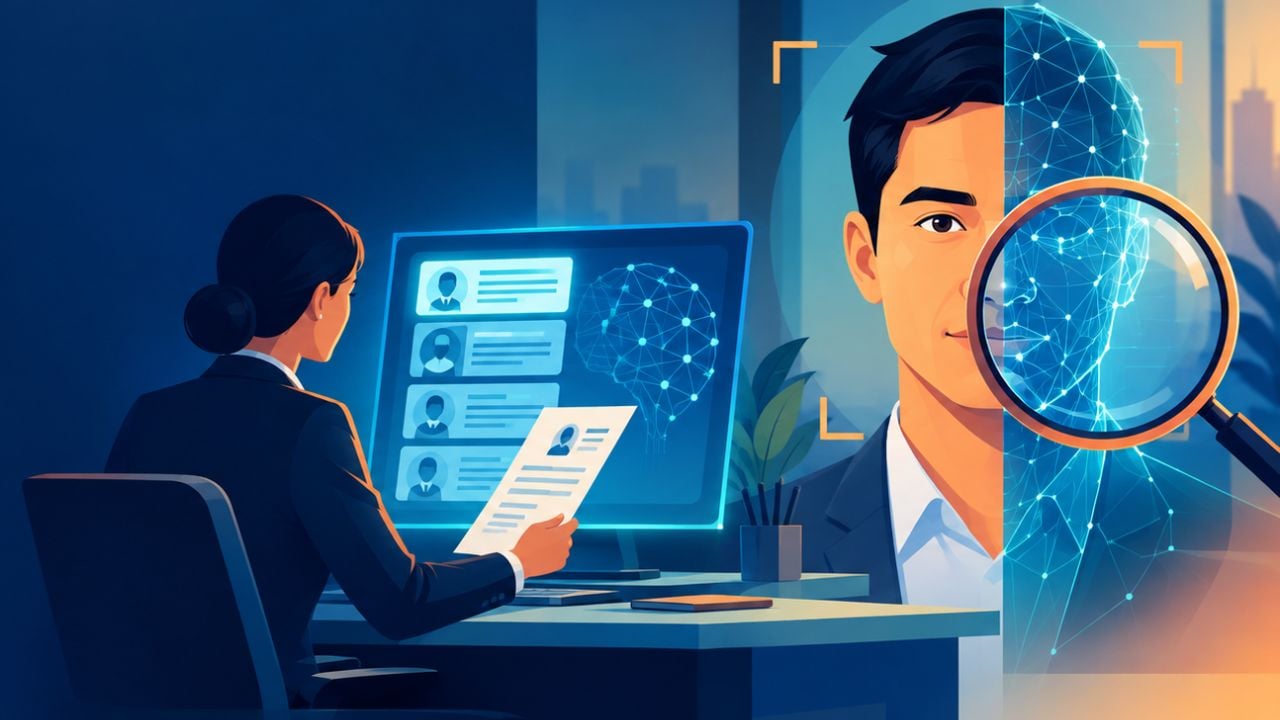
Artificial intelligence (AI) has become a standard part of recruitment, with 87% of hiring managers using the technology in at least one stage of the hiring process.
However, as employers increasingly integrate AI into their recruitment processes, concerns are growing over the authenticity of candidates’ applications and interview responses, according to a survey by Resume Genius.
The survey of 1,500 US hiring managers and hiring team members found that 82% were concerned about candidates using AI in job applications, while 86% believed the technology would create challenges in verifying candidate authenticity over the next year.
The findings highlight the growing challenge for employers of balancing the efficiency of AI-powered recruitment with the need to verify candidates’ skills, experience and suitability for roles.
AI streamlines hiring
Resume screening is the most common use of AI in recruitment, with 58% of hiring managers using the technology to review CVs and job applications. Other applications include writing job descriptions, matching candidates to roles and scheduling interviews.
The survey identified the most common uses of AI in recruitment:
58% use AI to screen CVs and job applications.
46% use AI to write job descriptions and job postings.
44% use AI to match candidates to roles based on their skills.
41% use AI to schedule interviews.
35% use AI for background checks and verification.
33% use AI for skills assessments.
AI adoption is less widespread in areas requiring more subjective assessments. Only 20% of hiring managers reported using AI to reduce hiring bias, while 18% used AI-assisted video interviews.
The findings suggest that organisations are primarily using AI to streamline administrative tasks and improve recruitment efficiency, rather than relying on it for every stage of candidate evaluation.
Candidate authenticity concerns
While employers are using AI to accelerate recruitment, candidates are also adopting the technology to prepare applications and participate in assessments.
This is making it more difficult for hiring teams to determine whether submitted materials accurately reflect applicants’ capabilities.
According to the survey, 58% of hiring managers had encountered AI-generated CVs or cover letters, while 46% had seen candidates use AI to answer interview questions. A further 34% had encountered AI-generated LinkedIn or other social media profiles.
Other reported instances included AI-generated portfolio projects and assistance with online skills assessments.
The survey found that:
34% had encountered AI-generated LinkedIn or other social media profiles.
29% had received AI-generated portfolio projects or creative work.
28% had encountered candidates using AI to cheat on online skills assessments.
17% had caught candidates using deepfake technology during video interviews.
Although deepfake use was less common than other forms of AI-assisted applications, it presents an additional challenge for recruiters seeking to verify applicants’ identities and assess their suitability for roles.
The findings indicate that AI is influencing multiple stages of the job application process, raising questions about how employers can distinguish candidates’ own abilities from work generated or assisted by technology.
Efficiency and trust
Despite concerns about candidate authenticity, hiring managers remain optimistic about AI's potential to improve recruitment outcomes.
The survey found that 72% believed AI would make recruitment faster and more efficient over the next year.
Meanwhile, 68% expected the technology to help identify higher-quality candidates, and 65% believed AI hiring tools could support diversity efforts by helping reduce bias.
However, these perceived benefits coexist with concerns about the reliability of candidate assessments.
While employers are adopting AI to improve their own recruitment processes, they are also becoming more cautious about how applicants use the technology.
For recruitment teams, the challenge is to retain the efficiency gains of AI while ensuring that candidates’ qualifications, work samples and interview performances accurately represent their knowledge and skills.
AI disclosure remains inconsistent
The survey also found that organisations differ in how they inform candidates about the use of AI during recruitment.
While some employers disclose when AI tools are used in interviews or candidate evaluations, others provide information inconsistently or do not disclose their use of the technology.
Resume Genius found that 35% of hiring managers said their organisations always disclosed AI use during interviews or candidate evaluations, while 26% said they disclosed it only sometimes.
Meanwhile, one in five organisations did not disclose their use of AI to candidates.
This included 12% that had no plans to reveal their use of the technology and 8% that intended to disclose it in the future. A further 19% said their organisations did not currently use AI tools during interviews or evaluations.
The findings point to a lack of consistency in how employers communicate AI's role in recruitment.
As adoption becomes more widespread, transparency about when and how the technology is used could become increasingly important in building trust with job seekers.
With AI now embedded in many recruitment processes, employers face the task of balancing faster hiring with reliable candidate assessments and clear communication about the technology's role in selection decisions.