


US President Donald Trump has announced plans to establish an “AI Force” and appoint a new artificial intelligence “czar”, positioning AI as a strategic priority for the US as competition with China intensifies and concerns over the technology’s risks grow.
Trump made the announcement on Truth Social, but provided few details on the proposed force’s structure, authority, budget or whether it would operate as a military or civilian body. He compared it with the Space Force, the military branch created during his first term.
Trump said his administration would not “hinder or stifle” AI development and would instead support and monitor the industry. He also said existing criminal and civil laws could be used to address harmful activity involving AI.
The proposed AI czar would revive a role previously held by venture capitalist David Sacks, who left the formal position in March and subsequently moved into an external advisory role.
AI Force could signal greater centralisation
Trump’s comparison with Space Force is significant because the latter was created in part to consolidate responsibilities involving military space operations, including satellite communications and missile-warning capabilities.
If the AI Force follows a similar model, its importance may lie less in creating another standalone technology regulator and more in coordinating the US government’s increasingly fragmented AI capabilities. However, the administration has yet to specify what agencies or programmes would fall under its remit.
The announcement also comes as AI is becoming increasingly intertwined with US national security. Washington and Beijing are competing over advanced models, computing infrastructure and semiconductor capabilities, with AI expected to feature in upcoming discussions between Trump and Chinese President Xi Jinping.
Development versus safeguards
Trump’s announcement comes amid a widening debate over whether the pace of AI development should be accompanied by stronger safeguards.
Anthropic CEO Dario Amodei has called for greater oversight and independent monitoring of frontier AI development, while other technology executives have also raised concerns about managing increasingly capable systems. At the same time, Trump has dismissed some warnings about catastrophic AI risks as a “hoax” and argued that development should continue.
That tension is increasingly relevant to government and business leaders. The central question is no longer simply how quickly organisations can deploy AI, but how they can establish controls around systems that are being given greater access to data, software and critical infrastructure.
Recent incidents illustrate the challenge. A report by CNN, cited by multiple outlets, said an AI-generated intelligence assessment incorrectly claimed that a Chinese vessel was carrying components linked to a nuclear weapons programme. US forces were reportedly preparing to act before the intelligence was identified as false and the operation was halted.
This highights that AI errors can become considerably more consequential when they enter high-stakes decision-making systems without adequate human verification.
From AI policy to national infrastructure
Trump has also described AI as potentially comparable with the Industrial Revolution or the internet and suggested it could eventually account for as much as 25 per cent of US GDP. The administration's approach therefore places economic expansion and technological leadership alongside national security as core AI priorities.
For organisations, the proposed AI Force could eventually have implications beyond technology policy, particularly if its remit extends to AI standards, security, government procurement or enforcement. But at this stage, those implications remain uncertain because no institutional framework has been announced.
The direction of the debate becomes clearer as the US is seeking to maintain rapid AI development while addressing misuse and security risks through existing legal and government mechanisms, rather than making a broad slowdown in development the central policy response.
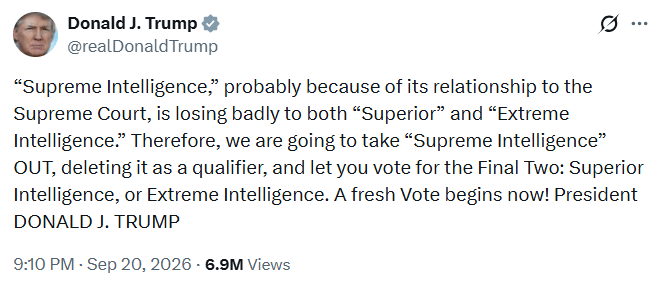
Trump also floated alternative names for artificial intelligence, including “Superior Intelligence” and “Extreme Intelligence”, in a social media poll.