









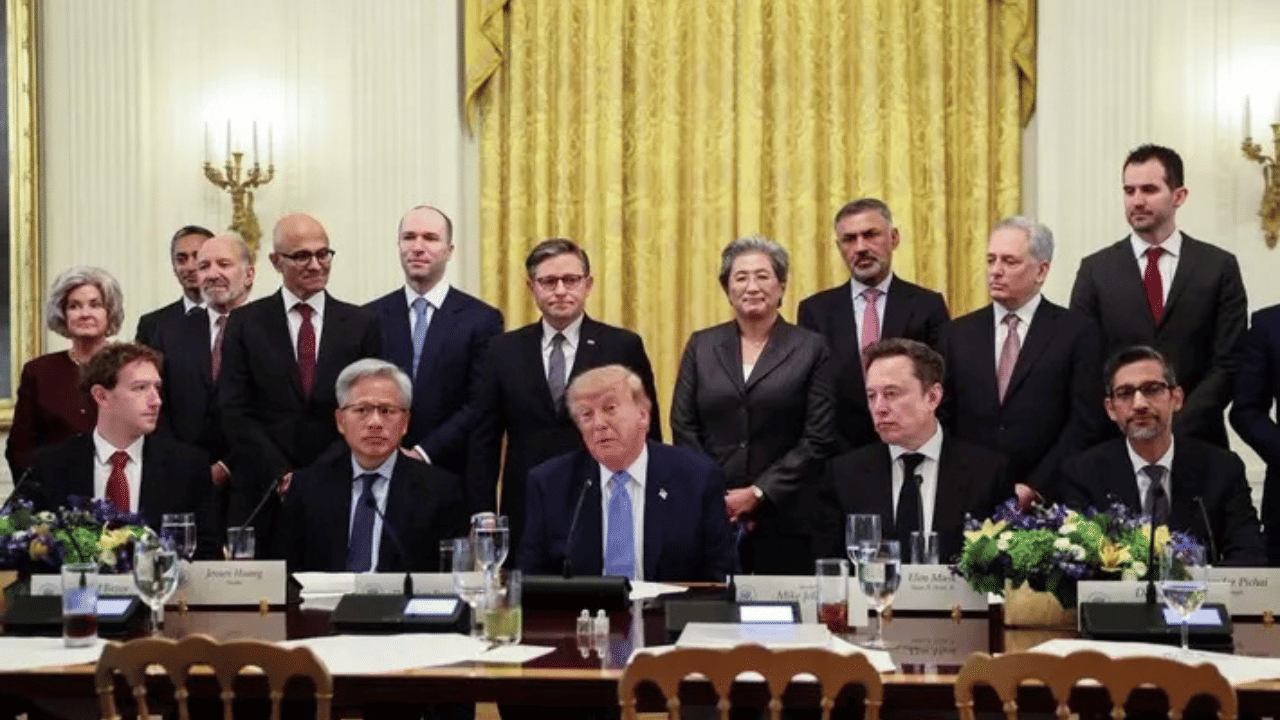
US President Donald Trump brought together leaders from some of the world’s biggest technology companies at the White House on September 29 to discuss the future of artificial intelligence, safety and the infrastructure needed to support its rapid expansion.
The meeting included executives from OpenAI, Anthropic, Nvidia, Meta, Google and SpaceX, as Trump promoted what he described as an “extraordinary gathering” of companies helping build America’s technology-driven future.
The summit produced three notable developments: a voluntary AI safety pact, renewed backing for data centre expansion and a push to replace “artificial intelligence” with “Super Intelligence” in US government communications.
1. Tech firms sign voluntary AI safety pact
Trump said the technology companies had signed a “morally binding” agreement under which they would take responsibility for the safety of their AI systems.
The accord calls on companies to implement safeguards to keep AI models operating as intended, identify and address problems quickly, and work with independent auditors to assess their systems. It also says companies should ensure their platforms do not hack or access technical systems in unintended ways.
Trump said he would establish a board to oversee AI safety, although he did not provide details on its membership or powers.
The agreement was signed by Trump and executives including Google CEO Sundar Pichai, Anthropic CEO Dario Amodei, Meta CEO Mark Zuckerberg, OpenAI president Greg Brockman, SpaceX founder Elon Musk and Nvidia CEO Jensen Huang.
Trump compared the pact to a “constitution” for the industry.
The voluntary approach has, however, drawn criticism from AI governance and legal experts. Jose Miguelito Enriquez, an AI governance researcher at Nanyang Technological University, said the agreement reflected an emerging consensus but did not address accountability when AI-related incidents occur.
University of Sydney law professor Kimberlee Weatherall argued that the agreement leaves companies significant discretion over what constitutes safety and does not establish clear consequences for breaches.
The debate comes as AI developers face growing scrutiny over the risks associated with increasingly capable models.
2. Trump backs rapid data centre expansion
The summit also reinforced the administration’s support for expanding data centre capacity, which is essential to powering increasingly sophisticated AI systems.
The expansion has faced opposition in parts of the US because of concerns over electricity consumption, infrastructure demands and the impact on local communities.
A Marist Poll survey conducted with NPR and PBS News earlier in September found that 65% of registered voters opposed data centres being built in their communities.
Trump said technology companies would need to demonstrate benefits to communities hosting the facilities, including through investment and economic contributions.
Nvidia CEO Jensen Huang described data centres as “super intelligence factories”, arguing that they could contribute to the reindustrialisation of the US and create jobs.
3. Trump wants AI renamed ‘Super Intelligence’
Trump also signed an executive order directing US government departments and agencies to use “SI” and “Super Intelligence” instead of “artificial intelligence” in official correspondence, websites, reports and other communications.
The order argues that increasingly advanced AI capabilities represent a new era of “Super Intelligence”.
Trump has previously criticised the term artificial intelligence, saying the word “artificial” makes the technology sound fake. Some technology executives, including Zuckerberg and Musk, have also begun using the terminology.
AI and digital ethics expert Jeannie Paterson of the University of Melbourne said the US could influence how the technology is described globally if technology leaders adopt the terminology.
However, some experts have questioned whether “Super Intelligence” will gain broader acceptance, given that the term has traditionally been associated with hypothetical or highly advanced AI systems rather than the broader range of technologies currently described as AI.
The White House summit therefore highlighted three parallel strands of the US AI strategy: allowing technology companies to develop their own safety safeguards, accelerating the infrastructure needed to expand AI and shaping the language used to describe the technology itself.