









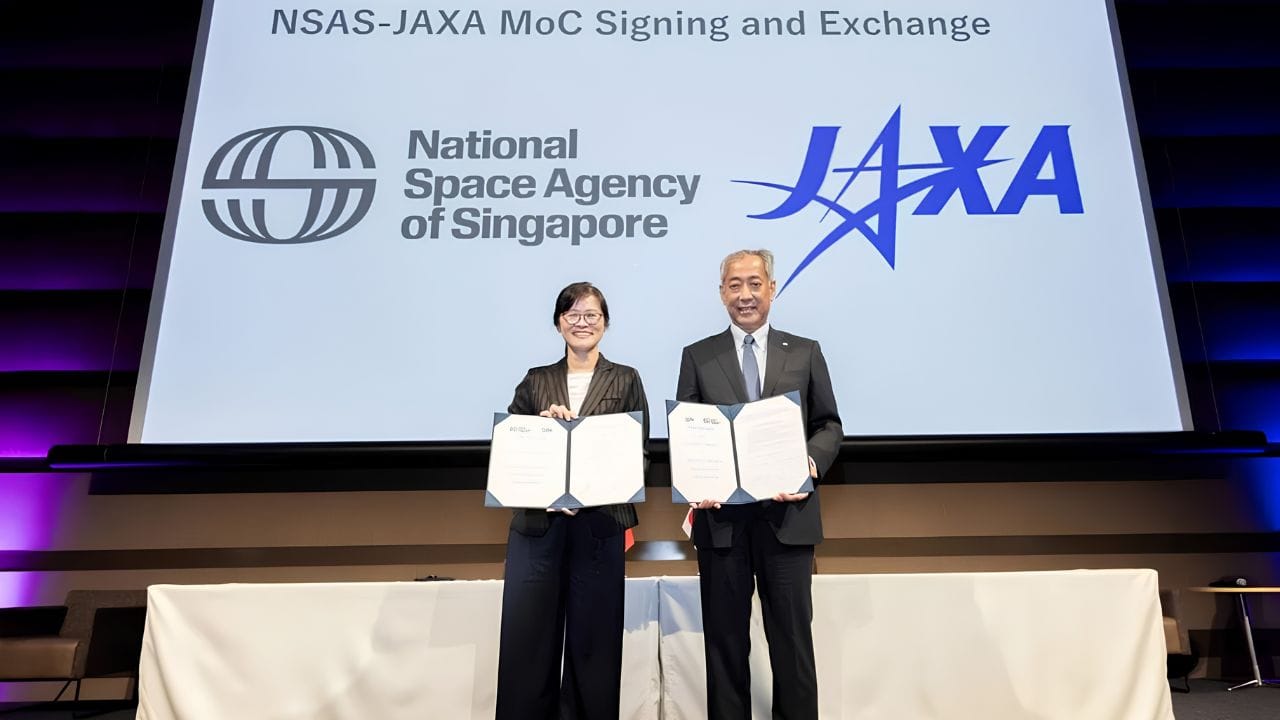
Singapore and Japan have signed a landmark agreement to deepen bilateral cooperation in the peaceful use of outer space, marking the first international partnership for the National Space Agency of Singapore (NSAS) since its establishment in April, according to multiple media reports.
The Memorandum of Cooperation, signed by NSAS and the Japan Aerospace Exploration Agency (JAXA) at the SPACETIDE 2026 conference in Tokyo, will strengthen collaboration across space technology development, space science and exploration, industry development, education, and policy and regulatory exchanges.
The agreement follows commitments made by Singapore Prime Minister Lawrence Wong and Japanese Prime Minister Sanae Takaichi during their bilateral summit in March, when both countries identified space as a key pillar of their strategic partnership as they celebrate 60 years of diplomatic relations.
Expanding collaboration
Alongside the agency-level agreement, NSAS and JAXA exchanged letters to promote business and industrial cooperation under JAXA's Co-funded Business Promotion Framework (CBPF).
Singapore becomes only the third international partner in the programme after the United Kingdom and France.
"Through the CBPF, both agencies will support greater collaboration between Singaporean and Japanese companies and facilitate partnerships in areas of mutual interest," NSAS said in a statement.
NSAS Chief Executive Ngiam Le Na described the agreement as a significant milestone for Singapore's growing space ecosystem.
"NSAS believes that strong international partnerships are essential to unlock opportunities for our growing space ecosystem," she said.
"Together, we hope to deepen collaboration across our space ecosystems and create globally competitive opportunities for innovation and industry growth, while contributing to safe and sustainable uses of outer space."
JAXA President Dr Hiroshi Yamakawa highlighted the longstanding relationship between the two countries in the space sector.
"As we mark this new milestone, we look forward to further deepening our cooperation with Singapore, a key partner with whom we share common values, to contribute to addressing global challenges and advancing space science and technology," he said.
He also noted previous collaborations, including the launch of Singapore's satellites aboard Japan's H-IIB rocket and deployments from the International Space Station's Kibo module.
Industry partnerships
The agreement was among several partnerships announced during SPACETIDE 2026 to strengthen commercial and research ties between the two countries.
The Association of Aerospace Industries (Singapore) and the Society of Japanese Aerospace Companies signed a memorandum to boost collaboration across aerospace, unmanned aircraft systems and the space sector, with a focus on innovation and regional supply chains.
Singapore-based start-up Transcelestial Technologies also entered into a partnership with Japanese inter-satellite communications company Warpspace to strengthen collaboration in advanced communications technologies.
AI for space
Nanyang Technological University (NTU) and Japanese cloud computing company Fusic signed a separate agreement to develop artificial intelligence systems capable of managing increasingly complex satellite constellations.
The collaboration will explore how AI can support routine satellite operations, mission scheduling, ground station allocation and the early detection of technical issues as the number of satellites in orbit continues to grow.
"As satellite constellations grow, the space sector will need new ways to manage missions safely, efficiently and at scale," said Professor Christian Wolfrum, Deputy President and Provost of NTU.
NTU's Satellite Research Centre, which has designed, built and operated 13 satellites since launching Singapore's first locally developed satellite in 2011, will provide mission data to train and validate the AI systems.
Growing ambitions
Established on 1 April under Singapore's Ministry of Trade and Industry, NSAS aims to advance the country's national space ambitions and strengthen its role in the global space economy.
Singapore's space industry currently comprises around 70 companies and 2,000 professionals, with growing investment in satellite technologies, quantum communications and space-enabled digital infrastructure.
The latest agreements underscore both countries' ambitions to expand cooperation in emerging space technologies while supporting innovation, commercial growth and the sustainable use of outer space.