










More than 7.41 million employed Filipinos were still looking for additional work in April 2026, highlighting persistent challenges in job quality and income security despite a rise in overall employment, according to the latest Labor Force Survey released by the Philippine Statistics Authority (PSA).
The PSA reported that the country's underemployment rate climbed to 15.2 percent in April 2026, up from 14.6 percent a year earlier and 13.2 percent in January 2026. The figure means that nearly one in six employed workers wanted longer working hours, an additional job, or a new job that could provide more work and income.
In absolute terms, 7.41 million of the country's 48.89 million employed Filipinos expressed a desire for more work opportunities during the month.
The increase in underemployment came even as total employment rose by 220,000 year-on-year, from 48.67 million in April 2025 to 48.89 million in April 2026. The employment rate stood at 95.3 percent, while the labor force expanded to 51.30 million people.
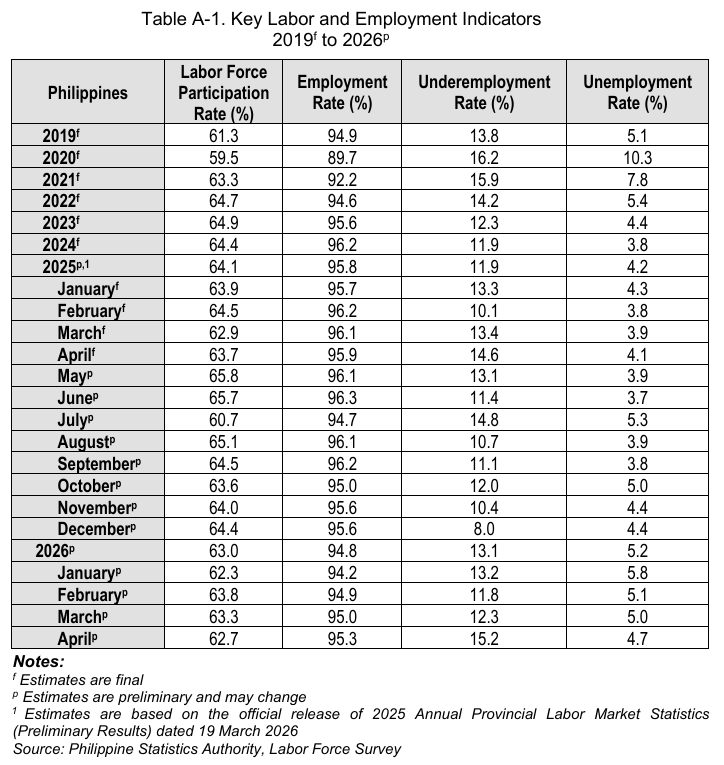
The data suggests that while the Philippine labor market continues to generate jobs, many workers remain dissatisfied with the number of hours they work or the income they earn from existing employment.
More than half of underemployed workers, or 56.8 percent, were classified as visibly underemployed, meaning they worked fewer than 40 hours a week or had no work during the reference period.
The remaining 43.2 percent were invisibly underemployed, workers who already worked 40 hours or more weekly but still sought additional employment, often reflecting concerns about low wages and rising living costs.
The services sector remained the country's largest employer, accounting for 62.3 percent of all jobs, followed by agriculture at 19.4 percent and industry at 18.3 percent. Wholesale and retail trade remained the biggest source of employment, followed by agriculture and forestry, and construction.
Among industries posting the strongest annual job gains were accommodation and food service activities, which added 510,000 jobs, manufacturing with 259,000 additional workers, and transportation and storage with 189,000 new jobs.
However, significant job losses were recorded in wholesale and retail trade, agriculture and forestry, and fishing and aquaculture.
The report also pointed to ongoing pressures among younger workers. The employment rate for Filipinos aged 15 to 24 fell to 87.4 percent from 88.5 percent a year earlier, while the proportion of youth not in education, employment, or training (NEET) increased to 12.2 percent from 10.6 percent.
Meanwhile, unemployment rose to 4.7 percent in April 2026 from 4.1 percent a year earlier, translating to 2.41 million unemployed Filipinos. However, it improved from January 2026, when unemployment stood at 5.8 percent.
Economists often view underemployment as a critical indicator of labor market quality because it captures workers who are employed but unable to secure sufficient hours or earnings. The latest figures suggest that while employment creation remains positive, ensuring access to stable, adequately paid, and full-time work remains a key challenge for the Philippine economy.