









Indonesia has taken a significant step toward strengthening responsible business practices, as government and business leaders jointly reaffirmed their commitment to advancing human rights across corporate operations and supply chains.
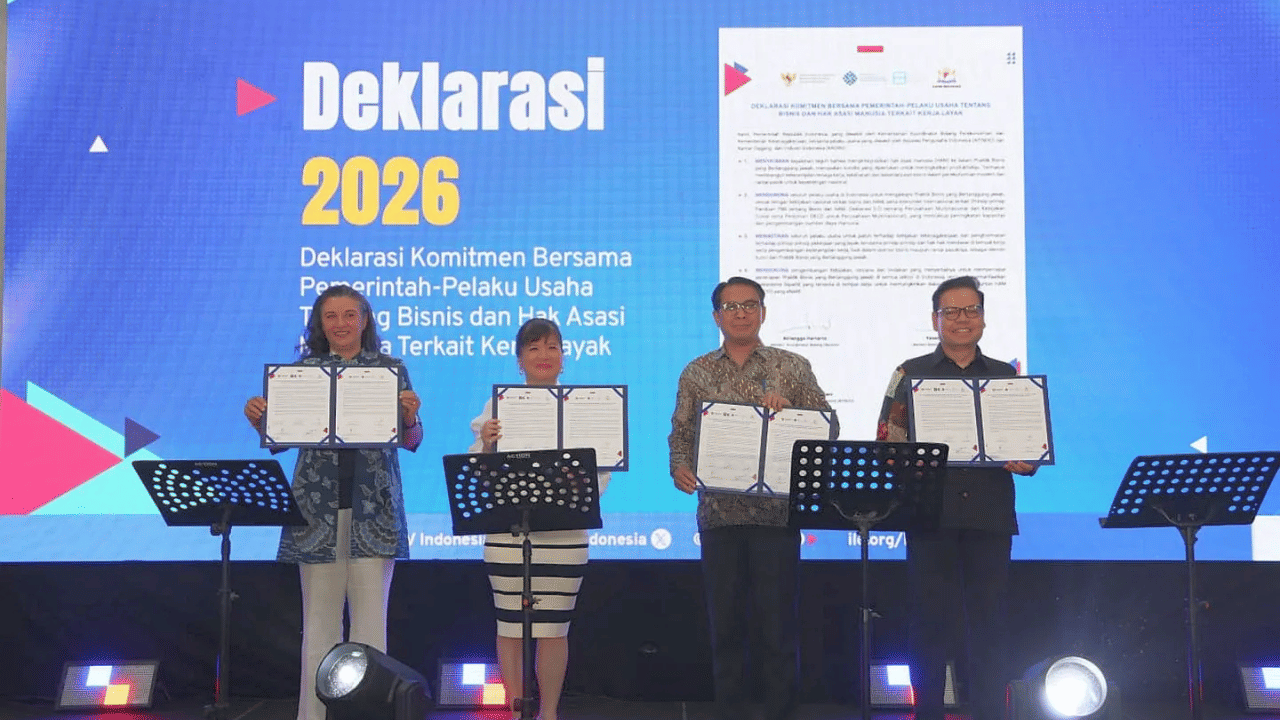
At a signing ceremony in Jakarta, the Government of Indonesia and national business representatives, supported by the International Labour Organisation (ILO), endorsed the Declaration on Joint Government–Business Commitment to Business and Human Rights, a move positioned as reinforcing the country’s push for sustainable and inclusive economic development.
The Declaration was signed by Coordinating Minister for Economic Affairs Airlangga Hartarto, Minister of Manpower Yassierli, along with leaders from the Indonesian Employers’ Association and the Indonesian Chamber of Commerce and Industry. It underscores a shared understanding that
respect for human rights and decent work is fundamental to sustainable enterprises, workforce development, and resilient supply chains.
Four pillars for responsible business
Under the Declaration, the government and business community jointly committed to:
Integrating human rights into Responsible Business Conduct (RBC) to boost productivity and workforce capability
Encouraging businesses nationwide to adopt RBC aligned with national policies and international standards
Ensuring full compliance with labour laws and Fundamental Principles and Rights at Work across operations and supply chains
Advancing policies and workplace mechanisms, particularly bipartite dialogue, to strengthen human rights due diligence
Government signals alignment with investment goals
Emphasizing the strategic importance of the initiative, Airlangga Hartarto said Indonesia aims to attract investment while safeguarding national priorities.
“The Government of Indonesia is committed to attracting investment while ensuring alignment with our national priorities. We greatly appreciate this initiative, which is in line with Indonesia’s commitment to active participation in global supply chains, while ensuring decent work and strengthening inclusive and sustainable competitiveness.”
Representing the Ministry of Manpower, M. Arif Hidayat, speaking on behalf of Yassierli, highlighted that labour rights protection and skills development remain central to inclusive growth. He noted that stronger RBC regulations have improved compliance with labour standards while enhancing social dialogue and human capital development.
ILO support and regional supply chain focus
The initiative is supported through the ILO’s Resilient, Inclusive and Sustainable Supply Chains Asia (RISSC) project in Indonesia, funded by the Government of Japan. The programme aims to strengthen global supply chains while advancing decent work and mitigating labour rights risks.
Simrin Singh, ILO Country Director for Indonesia and Timor-Leste, described the Declaration as a milestone. “This Declaration sends a strong signal that respect for human rights and decent work is integral to sustainable business success,” she said, adding that the ILO has also supported a joint positioning paper by ten Indonesian trade union confederations and the creation of a university network to reinforce responsible business conduct.