









Over the last two generations, Singapore has successfully improved the physical health of its citizens to the point where lifespans are extended and severe disease is minimised. But what about their ability to work and stay economically active during that longer and healthier life?
This question has been percolating among policymakers for a good few years now, even as geopolitical turmoil upended the global economy and the World Economic Forum issued increasingly urgent warnings about the impact of AI on jobs.
"If we want our people and our businesses to continue to thrive, we need to be very proactive, very preemptive about career health and the entire journey that comes with it," said Singapore's Minister for Manpower Dr. Tan See Leng.
Delivering a special address at the inaugural Career Health Summit organised by Workforce Singapore and the Singapore Business Federation, the minister said that employers are the best placed to identify and invest on building the skills they most need. Furthermore, there has to be a shift away from credentialism and towards a skills first approach - focusing on what individuals can do, not just what qualifications they possess.
"As a former businessman, this is a truth that I deeply appreciate: organisations prosper and organisations decline based on the quality of their people," he said.
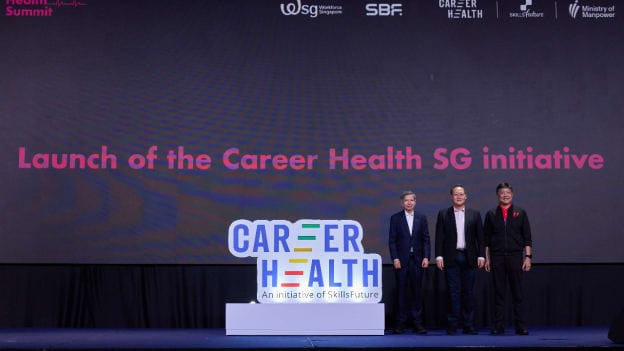
The summit was also the occasion for the launch of Career Health SG, a new national initiative in support of the SkillsFuture lifelong learning movement by the Ministry of Manpower, Workforce Singapore and SkillsFuture Singapore. Under this initiative, both organisations and individuals are offered increased access to resources to upskill, develop career progression pathways, and tap on government grants and programmes.
How to move from awareness to action
Plenty of businesses see value in investing in their employees' career health and future-readiness, but only half know how to do it, and only 23% have actually carried out workforce development training so far, according to data from the Ministry of Manpower.
Dr. Tan highlighted three steps businesses can take: firstly, to assess their workforce and understand the skills gaps and which roles can potentially be disrupted by technology - not just advanced digital tools like AI, but even automation of manual processes.
Secondly, he said, businesses need to take that knowledge and chart a plan for actually raising the value of their human capital. They need to consider factors such as how they are planning to invest in their employees, what tangible steps they will take, what timeline they are following, how much they expect to spend.
Finally, they have to actually execute the plan, including adopting a skills-first approach and creating career progression pathways and opportunities for employees.
Ultimately, the minister said his vision is for career health to be the new normal. "It should be as central to our entire career journey, our lives, and our businesses as physical health is, something that is already discussed and actively managed by all. To achieve this, we will need a nationwide movement, and I exhort all of you to be the agents of change, where all the individuals, employers, our tripartite partners, our labour market intermediaries, and, of course, the government are collectively engaging in fresh approaches towards growing human capital."
Top image: Launch of the Career Health SG initiative, with (left to right) Mr Tan Hee Teck, President, Singapore National Employers Federation; Dr Tan See Leng, Minister for Manpower and Minister-in-charge of Energy and Science & Technology; Mr Ng Chee Meng, Secretary-General, National Trades Union Congress. Courtesy of Workforce Singapore and Singapore Business Federation.