










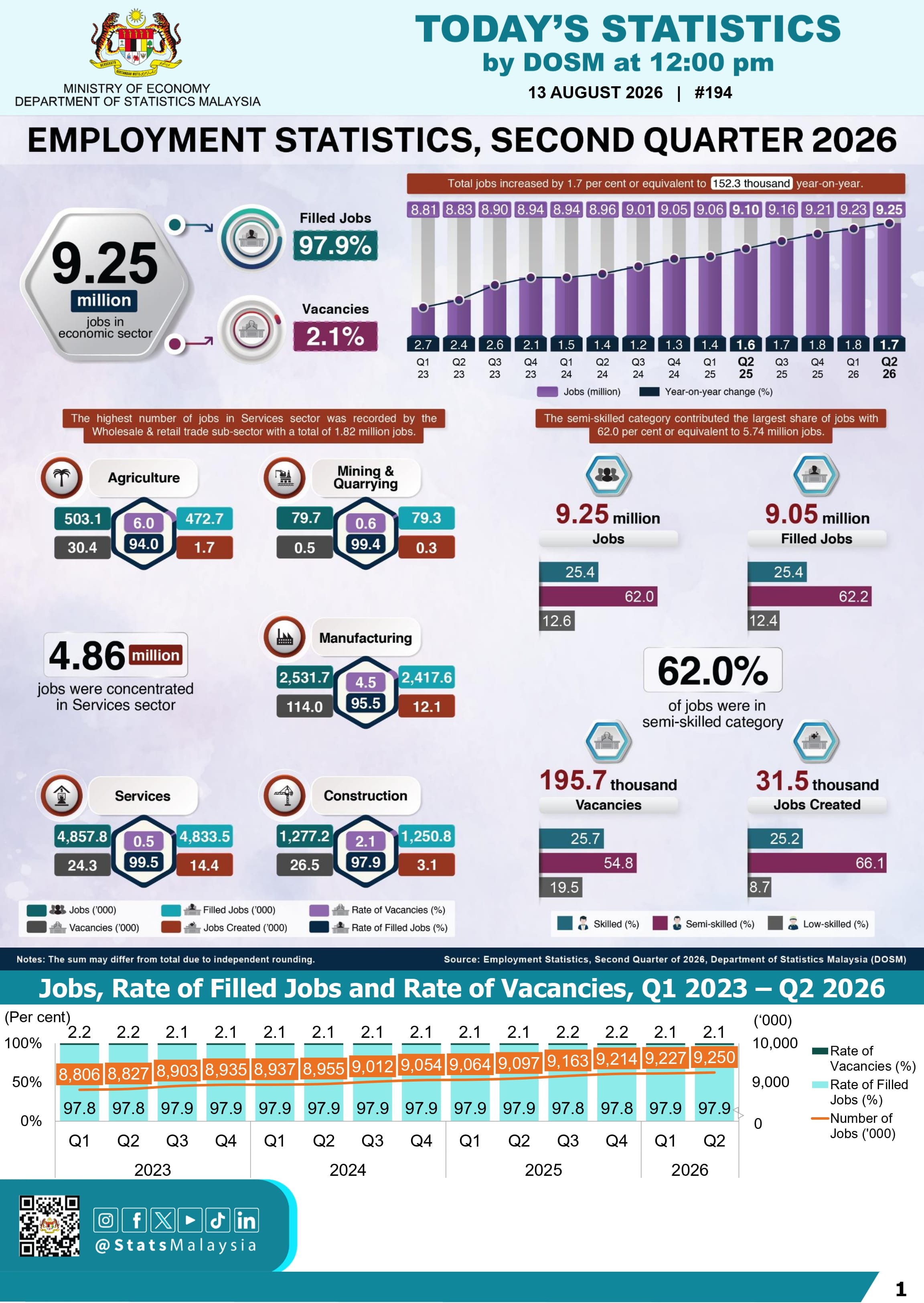
Malaysia’s total number of jobs rose to 9.25 million in the second quarter of 2026, up from 9.10 million in the same quarter last year, as labour demand continued to be concentrated in semi-skilled roles, according to the latest Employment Statistics released by the Department of Statistics Malaysia (DOSM).
The total number of jobs comprises filled jobs and vacancies. Filled jobs increased 1.7% year-on-year to 9.05 million, while vacancies rose marginally by 0.4% to 195,700. The filled jobs rate stood at 97.9%, while the vacancy rate was 2.1%. Meanwhile, jobs created declined 1.2% year-on-year to 31,500, compared with 31,900 in Q2 2025.
Semi-skilled roles account for 62% of total jobs
Semi-skilled positions remained the largest category of labour demand, with 5.74 million jobs, up 1.1% year-on-year from Q2 2025. The category accounted for 62% of total jobs, 62.2% of filled jobs, 54.8% of vacancies and 66.1% of jobs created.
Of the 5.74 million semi-skilled jobs, 5.63 million were filled, representing a filled jobs rate of 98.1%. Vacancies stood at 107,300, equivalent to 1.9% of total semi-skilled jobs.
The category also recorded 20,800 jobs created during the quarter, a marginal increase of 1% from 20,600 in Q2 2025.
Skilled jobs increased 2.5% year-on-year to 2.35 million, compared with 2.29 million a year earlier. The category represented 25.4% of total jobs and filled jobs, 25.7% of vacancies and 25.2% of jobs created.
Within the skilled category, 2.30 million jobs were filled, with the filled jobs rate remaining at 97.9%. Vacancies accounted for 2.1% of skilled jobs, equivalent to 50,200 positions. Jobs created, however, declined slightly to 7,900 from 8,000 in Q2 2025.
Low-skilled jobs recorded the fastest annual growth among the three categories, increasing 2.8% to 1.17 million from 1.13 million a year earlier. The category accounted for 12.6% of total jobs and 12.4% of filled jobs.
Of the total, 1.13 million low-skilled jobs were filled, giving a filled jobs rate of 96.7%, while 38,200 positions remained vacant, equivalent to a vacancy rate of 3.3%. Jobs created in the category, however, fell 17% year-on-year to 2,800 from 3,300.
Overall, the semi-skilled category accounted for more than half of every labour-demand indicator. It represented 62% of total jobs, 62.2% of filled jobs, 54.8% of vacancies and 66.1% of jobs created.
The skilled category was the second-largest contributor, accounting for 25.4% of total jobs and filled jobs, 25.7% of vacancies and 25.2% of jobs created. Low-skilled roles recorded the smallest shares, representing 12.6% of total jobs, 12.4% of filled jobs, 19.5% of vacancies and 8.7% of jobs created.
Services sector leads employment demand
By economic activity, labour demand remained heavily concentrated in the services sector, which accounted for 52.5% of Malaysia’s total jobs, equivalent to 4.86 million positions.
Manufacturing followed with 2.53 million jobs, or 27.4% of total jobs, while construction accounted for 1.28 million jobs, representing 13.8%. Agriculture contributed 503,100 jobs, or 5.4%, while mining and quarrying recorded the smallest share at 0.9%, equivalent to 79,700 jobs.
The services sector also dominated filled employment, accounting for 53.4% of all filled jobs, or 4.83 million positions.
Manufacturing contributed 26.7%, with 2.42 million filled jobs, followed by construction at 13.8%, with 1.25 million.
Agriculture accounted for 5.2% of filled jobs, equivalent to 472,700 positions, while mining and quarrying represented 0.9%, with 79,300 filled jobs.
Manufacturing accounts for nearly 60% of vacancies
Despite services having the largest overall employment base, manufacturing remained the largest contributor to vacancies during the quarter.
Manufacturing accounted for 58.3% of all vacancies, equivalent to 114,000 positions. Agriculture ranked second with 30,400 vacancies, or 15.5% of the total.
Construction accounted for 26,500 vacancies, representing 13.5%, while services recorded 24,300 vacancies, or 12.5%. Mining and quarrying recorded the smallest share, with 500 vacancies, or 0.2% of total vacancies.
The figures indicate that manufacturing continued to account for a disproportionate share of unmet labour demand compared with its overall share of jobs.
Services and manufacturing drive new job creation
The services sector was also the largest contributor to jobs created during Q2 2026, generating 14,400 new positions, or 45.7% of the total 31,500 jobs created.
Manufacturing followed closely, contributing 12,100 new jobs, or 38.3% of the total. Construction accounted for 3,100 jobs created, representing 9.8%, while agriculture contributed 1,700 jobs, or 5.3%.
Mining and quarrying recorded the smallest contribution, with 300 jobs created, equivalent to 0.9% of the total.
Overall, the Q2 2026 figures show that Malaysia’s labour demand continued to expand, with the number of total and filled jobs increasing year-on-year. However, the marginal decline in jobs created highlights a slower pace of new job generation, while the concentration of vacancies in manufacturing points to continued demand for workers in the sector.
The data also underscores the central role of semi-skilled employment in Malaysia’s labour market, with the category accounting for nearly two-thirds of total jobs and more than half of vacancies.