










The Philippine government has directed government offices in 15 provinces across Luzon to adopt alternative work arrangements on September 1, 2026, as heavy rainfall linked to the enhanced Southwest Monsoon is expected to continue.
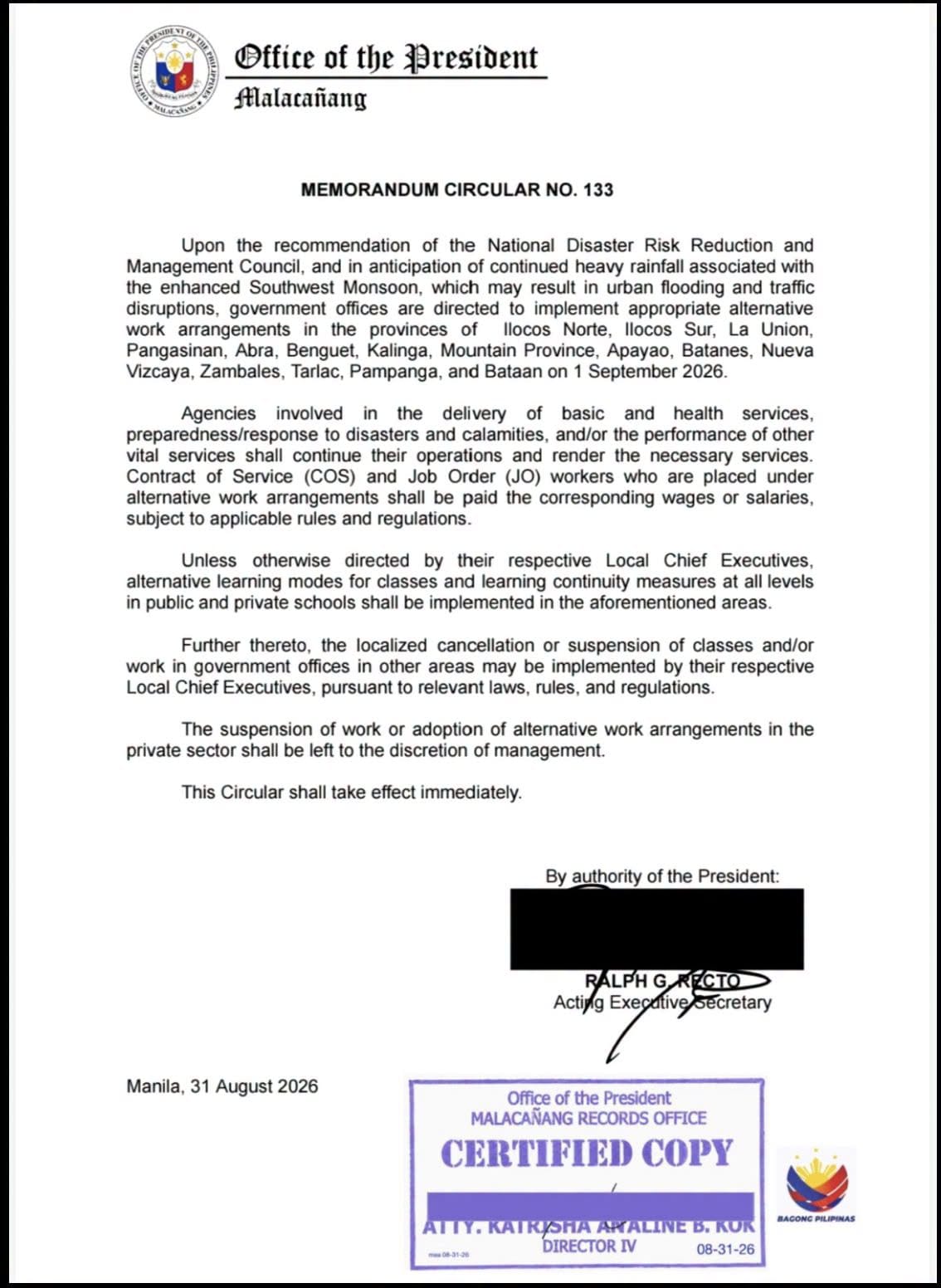
The directive was issued through Memorandum Circular No. 133 by the Office of the President on August 31, following a recommendation from the National Disaster Risk Reduction and Management Council (NDRRMC).
The circular covers Ilocos Norte, Ilocos Sur, La Union, Pangasinan, Abra, Benguet, Kalinga, Mountain Province, Apayao, Batanes, Nueva Vizcaya, Zambales, Tarlac, Pampanga and Bataan.
The government said the measures were being introduced in anticipation of continued heavy rainfall that could lead to urban flooding and traffic disruptions.
Under the circular, government offices in the affected provinces are required to implement appropriate alternative work arrangements on September 1.
However, agencies responsible for basic and health services, disaster preparedness and response, and other vital services will continue operating and providing necessary services.
The directive also provides protection for Contract of Service (COS) and Job Order (JO) workers affected by the alternative arrangements. These workers will continue to receive their corresponding wages or salaries, subject to applicable rules and regulations.
Schools to shift to alternative learning modes
The government has also directed schools in the affected areas to implement alternative learning modes and learning continuity measures at all levels in both public and private schools.
The measures will apply unless the respective Local Chief Executives issue different instructions.
The move is intended to allow learning to continue while reducing the risks associated with travel and potential flooding caused by the severe weather conditions.
Local authorities in other areas may also order the localized cancellation or suspension of classes or work in government offices, in accordance with existing laws, rules and regulations.
Private sector decisions left to employers
For private-sector employees, the national directive does not impose a blanket suspension of work.
Instead, the decision to suspend operations or adopt alternative work arrangements will be left to the discretion of company management.
This means private employers in affected areas will need to assess local weather conditions, commuting risks and operational requirements when determining whether employees should report to workplaces or work under alternative arrangements.
The latest directive highlights the importance of flexible work arrangements as part of business continuity and workforce safety measures during severe weather events.
The circular took effect immediately and applies to the specified provinces on September 1, 2026.