









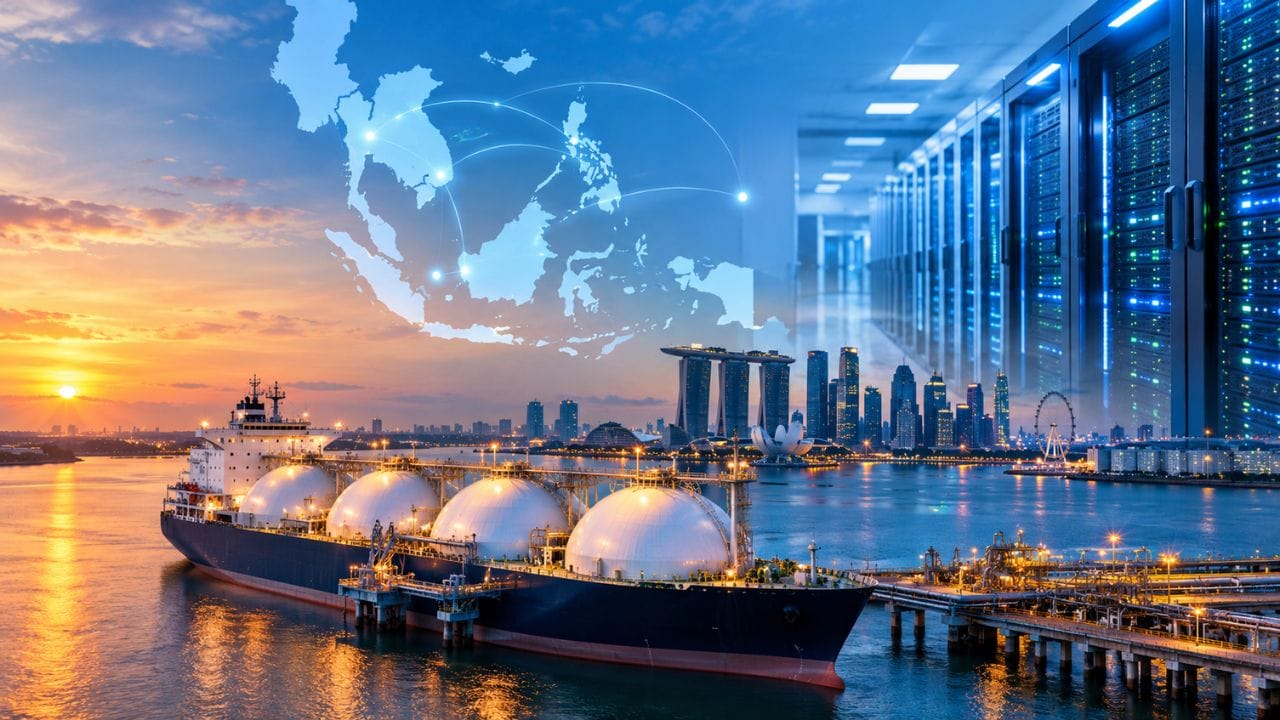
Southeast Asia’s speedy expansion of the data centre market is set to become a major driver of LNG demand, as Singapore, Malaysia, Thailand and Indonesia scale up digital infrastructure and require reliable power around the clock.
According to Wood Mackenzie, LNG demand in Southeast Asia is expected to grow 16% annually through 2035, with the region’s data centre capacity more than tripling from 2.8 GW to 9.4 GW over the same period. Electricity demand from these facilities is forecast to rise from 17 TWh to 57 TWh.
The growth is putting energy supply at the centre of Southeast Asia’s digital infrastructure race, with gas-fired generation expected to remain one of the most practical options for meeting data centres’ 24/7 power needs at scale.
Singapore anchors Southeast Asia’s data centre growth
Singapore is at the heart of the region’s data centre ecosystem and is expected to remain a key LNG demand market.
Around 95% of Singapore’s electricity grid currently runs on gas, while its reliance on LNG is expected to reach 100% as piped gas imports from Malaysia and Indonesia decline.
The country’s established data centre industry, strong digital infrastructure and LNG import capabilities make it one of the region’s most important markets for gas-backed power.
Md Fadhlullah Omarali, principal analyst at Wood Mackenzie said, “what makes data centre demand interesting from an LNG perspective is the counterparty profile. These are large, creditworthy off-takers with power needs that remain stable regardless of economic cycles. That does change the risk of calculus for new supply into Southeast Asia.”
Malaysia and Thailand emerge as key growth markets
Malaysia is rapidly becoming one of Southeast Asia’s largest data centre hubs, with 3.9 GW of capacity under development.
The country is also expanding its gas and LNG infrastructure, creating an opportunity to support the growing power requirements of large-scale data centres.
Thailand is another important market. Around two-thirds of the country’s electricity generation comes from gas, while its LNG share of gas supply is expected to exceed 50% by 2035 as domestic production and pipeline imports from Myanmar decline.
"Malaysia and Thailand are at a turning point. Data centre investment is growing quickly just as domestic gas output peaks and declines." Omarali added. "New import infrastructure is being developed and the importer base is broadening. For LNG suppliers with volumes in place, this timing is important."
Indonesia’s digital infrastructure race gains momentum
Indonesia is also emerging as a major data centre market, with Batam alone having more than 450 MW of capacity in the pipeline.
Its proximity to Singapore gives Batam a strategic advantage as companies look to expand data centre capacity across Southeast Asia. However, grid reliability remains a key constraint to wider growth.
The broader regional expansion is creating a growing need for dependable electricity supply, particularly as data centres operate continuously and require high levels of power reliability.
Southeast Asia takes the LNG lead
The region’s data centre expansion is creating a different energy story from markets such as India, where cheaper renewable power and battery storage are making LNG less competitive.
For Southeast Asia, the combination of rapid data centre growth, rising electricity demand, declining domestic gas production and expanding LNG infrastructure is creating a new long-term market for imported gas.
Wood Mackenzie expects this convergence to make data centres an increasingly important driver of Southeast Asia’s LNG demand through 2035.