









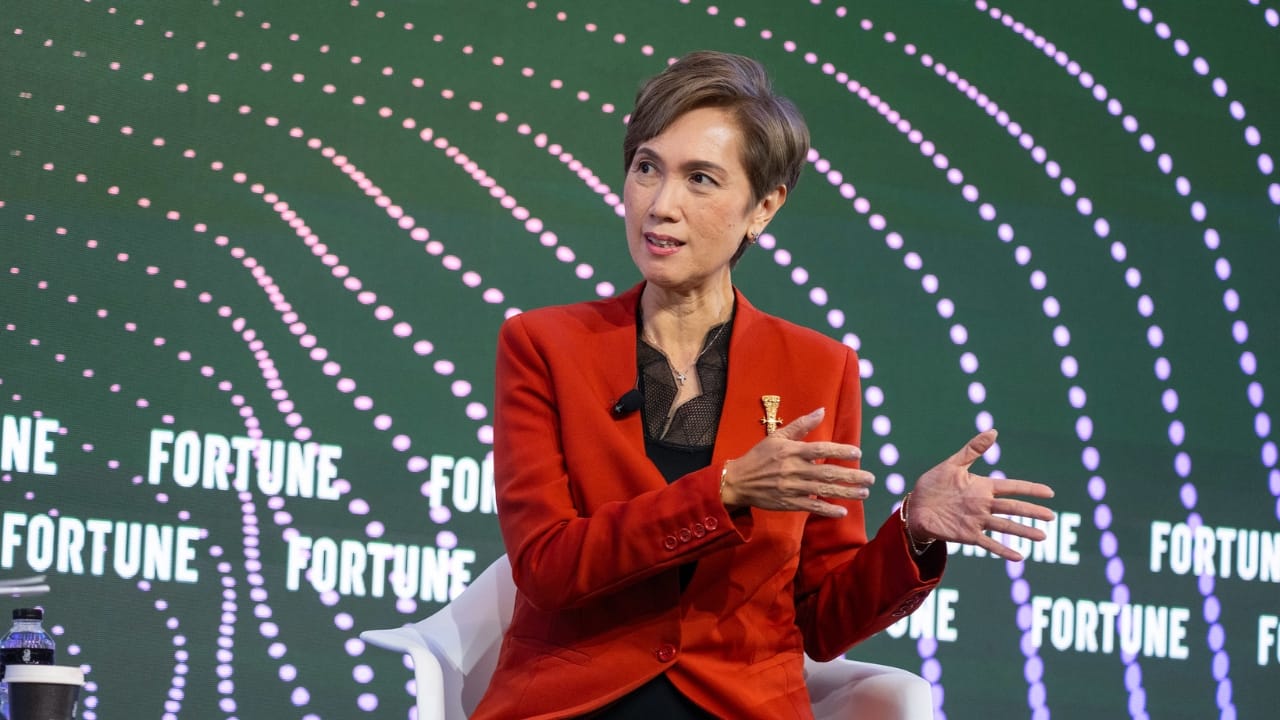
AI is not a one-size-fits-all model, nor is it something that should be approached from a competitive mindset. This was the underlying message at the opening session of Fortune’s Brainstorm AI 2025 conference in Singapore this week.
“[AI] is a general technology that you want to be very widely adopted across many industry settings, as well as across a whole range of organisations,” said Singapore’s Minister for Digital Development and Information Josephine Teo, speaking in a one-on-one fireside chat with Fortune executive editor Clay Chandler.
In Singapore’s context, she said, this does not just mean commercial applications, but AI for the public good: public healthcare, public transportation, public safety. And that in turn means responsible deployment, ensuring that AI must be developed in a safe and responsible way, with proper governance and mutual collaboration between the multiple stakeholders.
“This whole dynamic [of new and increasingly efficient models being developed] is not necessarily only a competitive one, it is also mutually reinforcing,” said Teo in reference to cost-efficient breakthroughs such as Deepseek.
For example, she pointed out that large Western LLMs may not meet the needs of Southeast Asian users simply due to linguistic differences, necessitating the development of local models - but those models can draw upon the construction of tools that utilise Western LLMs, while the Western LLMs can in turn build on local models to better serve users in multiple languages.
The role of governance
“In the Singapore context, when we think about AI governance and AI innovation, the two are not necessarily at odds with each other,” said Teo. “Being able to assure ourselves of safety and proper governance actually can enable innovations to go further.”
But what does responsible deployment and sound governance look like? Teo, who also previously served as Minister for Manpower, noted that there is as yet no international or even industry consensus on this, but individual stakeholders are already experimenting with finding definitions that could be more widely applicable.
One such global initiative is the Global AI Assurance Pilot, launched in February this year by the Infocommunications Media Development Authority of Singapore (IMDA) and its subsidiary the AI Verify Foundation. The pilot, which has 29 participants from around the world at the time of writing, has a stated objective to help codify emerging norms and best practices around technical testing of Generative AI applications.
A key point of the pilot, said Teo, is that at this early stage there are still no interoperable standards that apply across the globe, and there is also no clear timeline for achieving such.
“Singapore's modern hope is to contribute to this conversation and to bring about international collaboration so that we can all develop best practices in AI development,” the minister said.