









The Philippines does not have an AI awareness problem. Filipino professionals are already among the region’s most active adopters, with one in four qualifying as a “Frontier Professional” in Microsoft’s 2026 Work Trend Index, compared with 16% globally.
At the same time, the International Labour Organization estimates that only a relatively small share of Philippine jobs sits in the highest GenAI exposure category, suggesting that the bigger story is likely to be the transformation of work rather than widespread job elimination.
That distinction matters in an economy where services account for a dominant share of employment and where the IT-BPM sector continues to move towards higher-value, technology-enabled work. The opportunity is significant, but so is the challenge. Organisations now need to decide how work should change, which capabilities will matter more, where AI can create real value, and how leaders can carry people through that transition without weakening trust or performance.
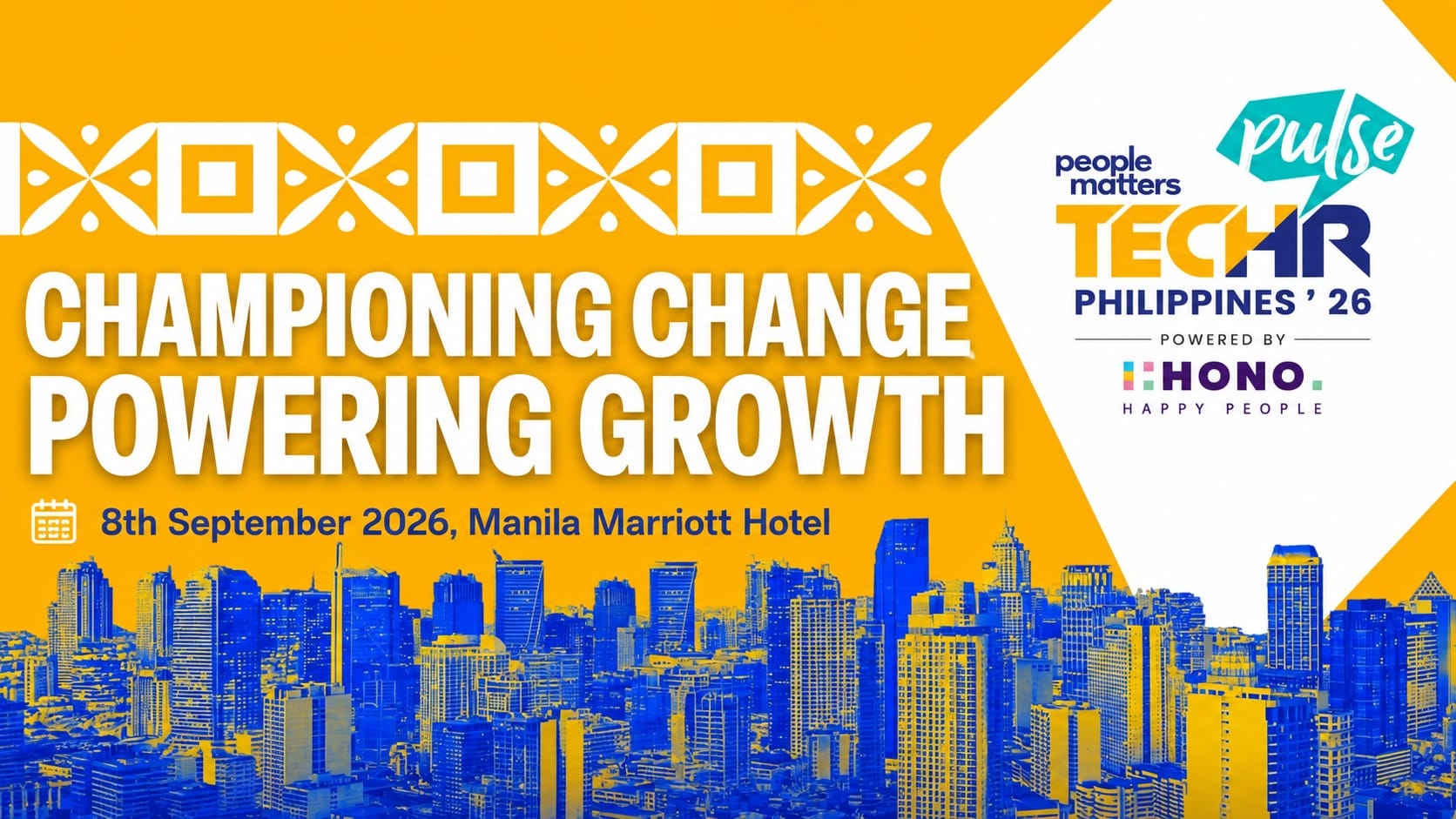
That is the context in which People Matters TechHR Pulse Philippines 2026 returns on 8 September 2026 at Manila Marriott Hotel, Newport World Resorts, bringing together close to 200 HR, business and technology leaders, more than 20 speakers and over 15 HR and work-tech partners under the theme Championing Change: Powering the Next Chapter of Growth Through People, AI and Leadership.
Here is what leaders can expect to gain from being in the room.
1. See how people, technology and growth fit together
One of the biggest challenges facing leaders today is that transformation rarely sits neatly inside one function. An AI decision changes jobs, a workforce decision affects productivity, a capability gap can slow down growth, and leadership behaviour can determine whether a technology investment becomes embedded in the business or remains stuck at the pilot stage.
TechHR Pulse Philippines is bringing these conversations together through four connected pillars: Economic Transformation, Enterprise Transformation, Workforce & Human Transformation, and Leadership Transformation.
The progression is deliberate. It moves from economic ambition to intelligent enterprise, from future-ready people to change-ready leadership, helping leaders understand how these pieces influence one another rather than treating them as separate transformation programmes.
For attendees, this creates a broader business lens on questions that are often discussed in isolation. It brings talent, productivity, AI, leadership and enterprise capability into one connected conversation about how the Philippines can move towards higher-value growth.
2. Work directly with Jason Averbook and leave with something practical
A keynote can change how leaders think, but the harder part is turning that thinking into action.
That is why Jason Averbook’s presence at TechHR Pulse Philippines goes beyond the main stage. He will also lead an exclusive two-hour workshop, Making AI Work at Work, designed for leaders who want to move from AI possibility to practical application.
Participants will assess their organisation through Averbook’s 4SET framework-Mindset, Heartset, Skillset, and Toolset- before taking a real HR process and examining what should be removed, automated, augmented with AI or kept human.
The workshop is designed around a practical outcome rather than a collection of ideas. Leaders should leave with a clearer view of their organisation’s readiness, one process already being rethought, and a concrete action they can begin applying immediately after the conference.
For leaders who have attended enough AI sessions to know what the technology can do, this creates a much more useful next step: working through what it should actually change inside their own organisation.
3. Learn from leaders navigating transformation in very different businesses
Transformation rarely follows a single playbook.
The speaker community at TechHR Pulse Philippines brings together leaders from aviation, banking, technology, conglomerates, shared services and other sectors that are experiencing change from very different starting points.
That diversity matters because the decisions facing a digital bank will not be the same as those facing an airline or a large conglomerate. Yet the deeper questions around productivity, workforce capability, AI adoption, leadership and trust increasingly overlap.
The value of the conversation lies in hearing not only what worked, but what leaders had to reconsider along the way. The most useful insight may come from understanding where resistance emerged, which assumption proved wrong, or what another leader would do differently if they were beginning the transformation again.
For attendees, those comparisons can be far more useful than a universal transformation framework.
4. Get closer to the workforce questions that will shape the next few years
The Philippine AI conversation is moving into a more mature phase.
The ILO’s latest assessment suggests that the bigger challenge is not simply widespread job displacement, but the redesign of tasks within occupations and the opportunity to improve productivity and job quality. At the same time, millions of clerical and service-oriented roles remain highly exposed to GenAI, making workforce planning, capability-building and career transition increasingly important.
This changes the nature of the conversation for HR and business leaders.
The focus is moving away from protecting every role exactly as it exists today and towards understanding how work should evolve, which tasks can be handed to technology, where human judgement becomes more valuable, and how employees can move into more complex work as routine activity changes.
These questions sit at the heart of the Workforce & Human Transformation pillar and will be central to many of the discussions at TechHR Pulse Philippines.
For leaders, the opportunity is to move beyond broad fears around job loss and think more deliberately about role redesign, career mobility and the future value of human capability.
5. Move from AI adoption to business impact
AI adoption is becoming a weak measure of transformation.
Filipino professionals are already adopting AI at a rapid pace, but the harder organisational question is whether that use is changing productivity, decision quality, customer outcomes or the way work is designed.
Recent research has also highlighted a gap between AI strategy and employee understanding, with many workers receiving limited guidance about how AI will change their roles or what should happen with the time technology gives back.
That is why the Enterprise Transformation pillar is focused on moving beyond experimentation and towards operating-model change, responsible governance and measurable business value.
For leaders, this shifts the conversation from “How many people are using AI?” to “What is the organisation now capable of doing differently because of it?”
That is a much more demanding question, but also a much more useful one.
6. Explore technology through the problems you are actually trying to solve
TechHR Pulse Philippines will also bring together more than 15 HR and work-tech partners, giving leaders access to technologies shaping hiring, workforce intelligence, employee experience, HR operations and transformation.
The real value, however, lies in how those conversations are approached.
Rather than beginning with product features, leaders can start with the business problem they need to solve: reducing employee friction, improving workforce visibility, strengthening hiring quality, simplifying manager decisions or identifying capability gaps before they become growth constraints.
That changes the technology conversation from product discovery to transformation relevance.
It also creates a better exchange between leaders and solution partners, because both sides can focus on whether the technology meaningfully changes the work rather than simply adding another system to the organisation.
7. Build relationships with people solving the same problems
There is a kind of learning that does not happen on stage.
When more than 200 HR, business and technology leaders come together in one room, the value is not only in the formal agenda but also in the conversations between sessions.
For leaders navigating decisions without established playbooks, hearing from peers who have already attempted a similar transformation can shorten months of trial and error. Someone else may already have faced the resistance you are encountering, tested the technology you are considering or learnt why a seemingly strong initiative struggled in practice.
Those conversations often create a different kind of insight, because they reveal what leaders would do differently the second time rather than what appears in the final case study.
That peer network is one of the most important reasons to be in the room.
Come with the challenge your organisation needs to solve
The Philippines already has momentum. Its workforce is large, its services economy remains a powerful engine of growth, its IT-BPM sector continues to expand, and Filipino professionals are emerging as some of the region’s most advanced users of workplace AI.
The next challenge is converting those advantages into higher-value work, stronger organisations and more sustainable growth.
TechHR Pulse Philippines 2026 is being designed for leaders who are already making those choices and want better context, stronger peer insight and practical ways to move forward.
If you are shaping how your organisation will grow, redesigning how work gets done, deciding where AI should create value, or preparing your workforce for what comes next, this is a room worth being part of.
Join global thinkers, Philippine business and HR leaders, technology partners and peers who are working through the same transformation challenges, and leave with sharper ideas for the decisions that will shape your organisation next.
Be part of TechHR Pulse Philippines 2026 on 8 September 2026 and help shape the next chapter of Philippine growth through people, AI and leadership.