









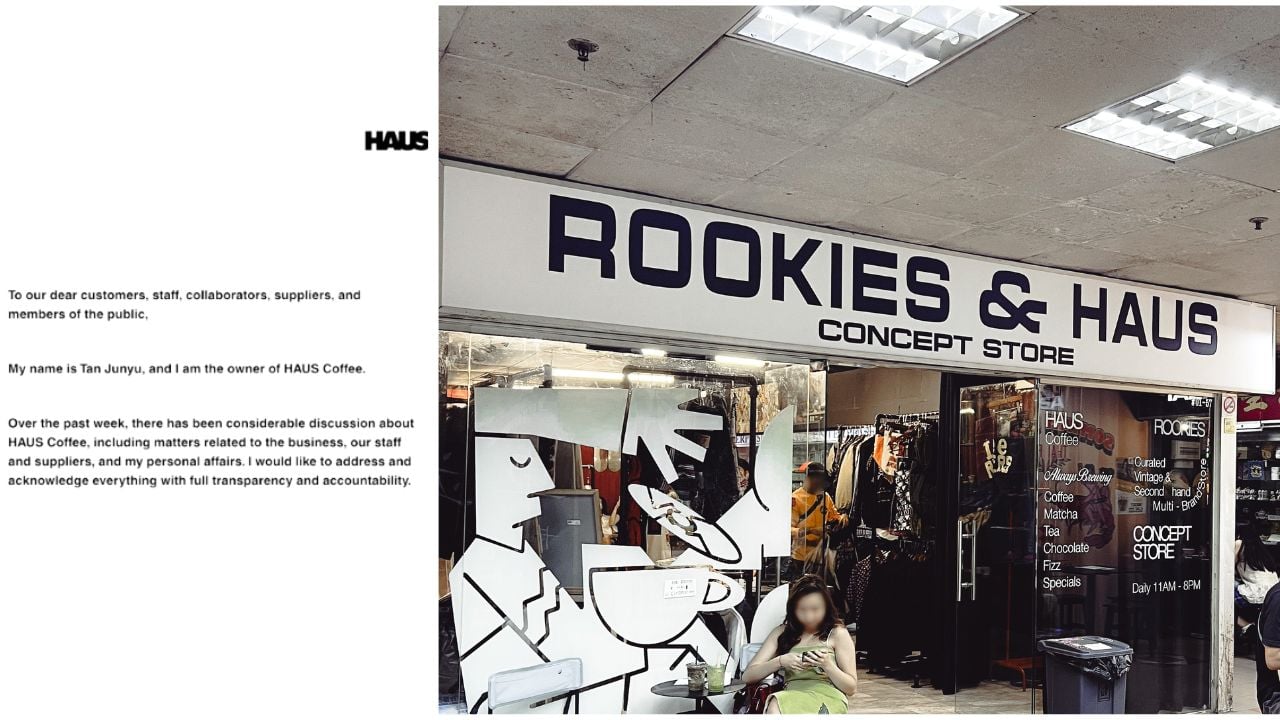
Haus Coffee owner Tan Junyu has stepped down from the business after admitting to repeated delays in employee salary payments and instances where staff used their own money to purchase supplies, according to media reports.
The development follows allegations on Reddit, TikTok and Instagram about the cafe's management after its Golden Mile Tower outlet temporarily closed on Sept. 17 to "sort out internal matters". Tan apologised in an Instagram post on Sept. 26, acknowledging failures in his responsibilities as an employer and business owner.
The episode has also brought workplace culture and employer accountability into focus, particularly around how financial and operational management decisions can affect employees' trust in the organisation.
Owner steps down
In his apology, Tan acknowledged that employee salaries had been paid late "more often than not". He also admitted that employees had, on several occasions, incurred out-of-pocket expenses for cafe supplies.
"I failed in my responsibilities as an employer and business owner, and as a result, I placed everyone in an uncomfortable and unfair position, and I take full responsibility for that," Tan wrote.
Tan also said his "reckless lifestyle and habits" had caused "great inconvenience and disappointment" to employees, customers, collaborators, friends and family.
The owner said he would step down from the business and "reflect on his actions" while working to address the situation.
Workplace trust
The allegations have raised broader questions around the link between financial discipline, management practices and employee trust.
For employees, repeated salary delays can extend beyond a payroll issue, affecting financial security and confidence in the organisation. The reported instances of employees using personal funds to purchase business supplies also highlight concerns around boundaries between employee responsibilities and business operating costs.
Tan acknowledged this in his statement.
"On several occasions, my employees even had to use money out of their own pockets to pay for stock, as I was irresponsible in making the appropriate arrangements to ensure the store had enough supplies to operate," Tan wrote.
Management changes
Tan said a new management team had been appointed to oversee the cafe's operations, including staff recruitment, training and financial matters.
The identity of the new owner or management structure was not disclosed in the statement, according to media reports.
The management change comes as the business faces questions around employee payments, supplier obligations and customer service. Some social media users claiming to be former employees also alleged that salaries had been delayed, while others raised concerns about supplier and consignment payments.
These claims have not been independently verified.
HR accountability
For HR leaders, the episode underscores how workplace culture is shaped by everyday management practices, not only by formal policies or employee engagement initiatives.
Timely salary payments, clear accountability for business expenses, adequate operational planning and transparent communication are fundamental to maintaining employee trust. When these systems break down repeatedly, the impact can extend beyond individual transactions to employees' confidence in leadership and the wider workplace.
The Haus Coffee episode therefore serves as a reminder that workplace culture is closely linked to how consistently an organisation meets its responsibilities to employees, particularly during periods of operational or financial pressure.
Read more:
Malaysia’s EIS contributors to get enhanced benefits, protection from October 1
Singapore financial sector to train 80,000 workers in AI skills by 2028
McDonald’s AI strategy puts employee redeployment ahead of job cuts