










San Francisco-based trading platform Robinhood's decision to cut nearly 10% of its workforce despite reporting strong business performance is drawing renewed attention to a growing trend across the technology sector: profitable companies reducing headcount in pursuit of leaner, higher-performing organisations.
The company announced this week that 290 employees would be laid off, representing about 10% of its full-time workforce.
In a memo to staff, CEO Vlad Tenev described the move as a proactive effort to “maximize our talent density” and create a “lean, hyper-focused team,” stressing that the decision was not driven by financial difficulties.
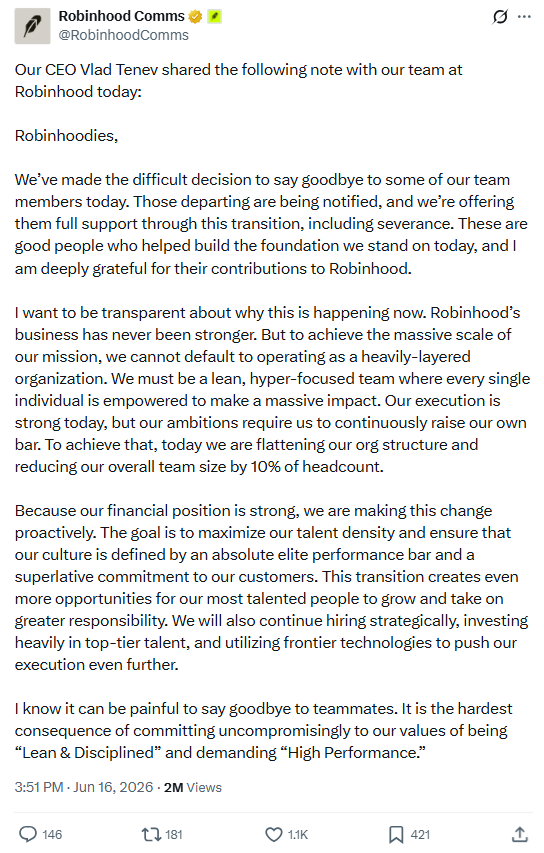
The announcement comes as a growing number of technology companies continue to reduce staff even while reporting healthy revenues. Microsoft, Block, Meta and Oracle have all announced workforce reductions in 2026 despite posting strong financial results. According to workforce data platform Trueup, the tech industry has eliminated more than 152,000 jobs through 397 separate layoff events so far this year.
Experts say the rationale behind such layoffs is also evolving. Instead of citing economic uncertainty or declining business conditions, companies are increasingly framing workforce reductions around performance and productivity. However, they also caution that performance-based layoffs can create uncertainty among employees who remain.
While performance-based layoffs may reduce feelings of survivor guilt by providing a clear explanation for workforce reductions, they can introduce new forms of pressure. Research has consistently linked high-performance work systems with increased stress and job insecurity, particularly when employees believe future layoffs remain possible.
The Robinhood announcement also reflects a broader shift in employer-employee dynamics. As hiring slows across the technology sector and talent supply increases, companies have gained greater flexibility to reshape their workforces.
For now, Robinhood's message appears carefully calibrated to reassure investors about operational efficiency while signalling higher expectations to employees. Whether that strategy strengthens long-term organisational commitment or fuels further workforce uncertainty remains an open question.
As more companies pursue growth with smaller teams, Robinhood's layoffs may represent less of an exception and more of a sign of where the future of work is heading.