










The Philippine government has ordered government offices in Metro Manila and 12 provinces to adopt alternative work arrangements on August 14 as continuous heavy rainfall caused by the Southwest Monsoon, locally known as Habagat, continues to affect large parts of Luzon.
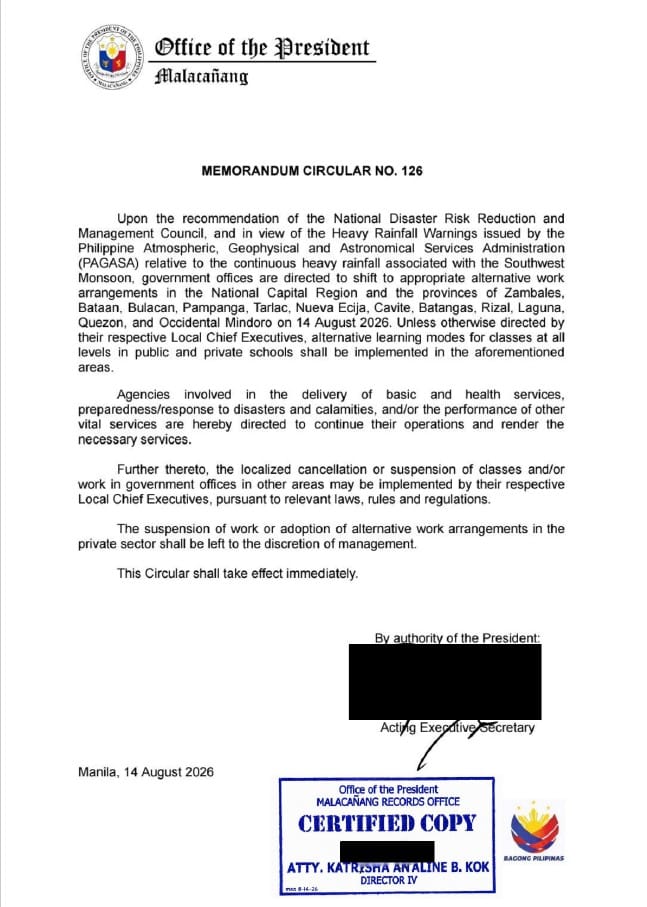
Malacañang issued Memorandum Circular No. 126 on Friday following a recommendation from the National Disaster Risk Reduction and Management Council (NDRRMC) and heavy rainfall warnings issued by the Philippine Atmospheric, Geophysical and Astronomical Services Administration (PAGASA).
The directive covers the National Capital Region and the provinces of Zambales, Bataan, Bulacan, Pampanga, Tarlac, Nueva Ecija, Cavite, Batangas, Rizal, Laguna, Quezon, and Occidental Mindoro.
Under the circular, government agencies in the affected areas have been instructed to implement appropriate alternative work arrangements to ensure the continuity of public services while reducing risks to employees and the public.
The order also extends to the education sector. Unless local chief executives issue separate directives, schools in both the public and private sectors are required to implement alternative learning modes at all levels.
However, agencies responsible for delivering essential services have been directed to continue operating. These include offices providing basic and health services, disaster preparedness and response, and other critical government functions.
The circular also allows local government units in other areas to impose localised work and class suspensions in accordance with existing laws, rules, and regulations.
Meanwhile, decisions on work suspensions or the adoption of flexible work arrangements in the private sector have been left to the discretion of employers.
The latest directive also highlights the growing importance of workplace preparedness during extreme weather events. Human resources experts have increasingly encouraged organisations to develop business continuity plans that prioritise employee safety while maintaining essential operations.
Measures such as remote work, staggered schedules, adjusted operating hours, paid emergency leave, and clear communication protocols can help reduce employee exposure to hazardous travel conditions. Employers can also strengthen emergency response systems by providing regular weather updates, identifying critical roles that require on-site presence, and ensuring that employees have access to the necessary tools to work safely from alternative locations.
The government said it continues to monitor weather developments and coordinate with relevant agencies to safeguard public welfare as heavy rains persist across several parts of the country.
Memorandum Circular No. 126 took effect immediately upon its issuance on August 14.