









Your AI use cases work, but are they scaling? 43% of organisations in the SEA region have moved beyond pilots. However, only 25% can scale them into enterprise AI transformation.
While a small group of enthusiasts drives experiments, enterprise-level transformation requires standardised processes people can trust and clear owners who can step in when things go wrong.
Additionally, only 10% of HR and business leaders are able to effectively demonstrate ROI on their AI transformation efforts. Organisations struggle with the ROI on AI transformation as the business case for bringing AI transformation is unclear most of the time.
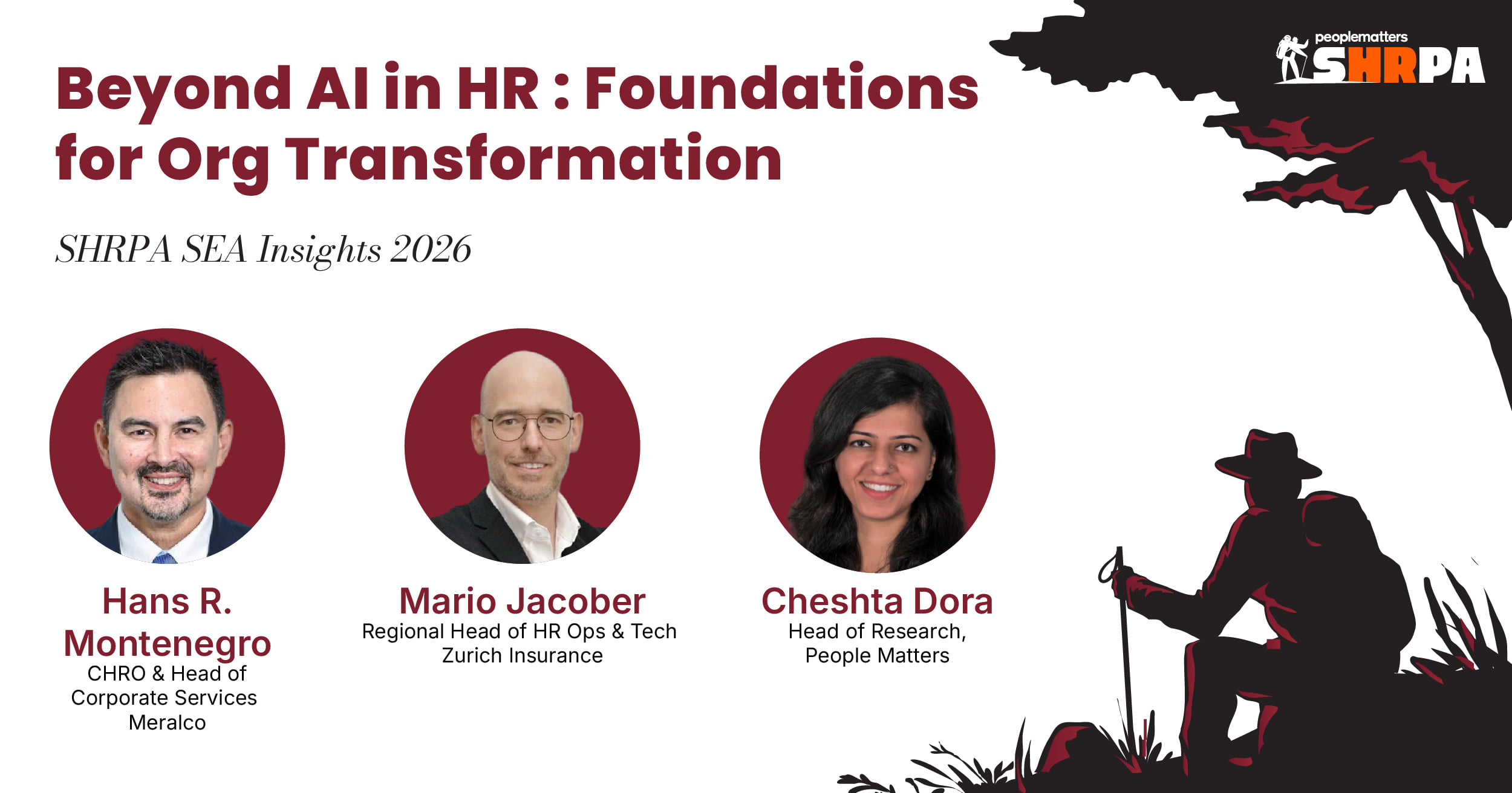
People Matters hosted a webinar with industry leaders from the SEA region, Hans R. Montenegro, CHRO and Head of Corporate Services, Meralco, Philippines and Mario Jacober, Regional Head of HR Ops & Tech, Zurich Insurance, Singapore, to discuss the topic, “Beyond AI in HR: Foundations for Organisations Transformation”, moderated by Cheshta Dora, Head of Research and Content at People Matters.
Leading with process re-engineeringHR and business leaders should rethink processes before making AI investment decisions for process improvements. Sometimes processes do not need AI but only need to be simplified and automated. Enabling technology on bad processes just ends up digitising the bad processes. Once the underlying processes are analysed, the role of the people should be assessed: how the new process will impact their work, and what capabilities they need to deliver their outcomes; only then should technology be introduced.
Fixing the data for scaling AI
Fragmented data across multiple digital and offline sources makes any transformation process challenging. Additionally, with multiple tools without any integration, it makes it difficult to collect the information in simple KPIs that is critical for leadership decision-making.
Agents that are deployed on a weak data infrastructure will not be able to extract reliable information and create dashboards that lead nowhere. Unifying data sources, cutting down on multiple tools and defining the few key metrics that leadership needs to make critical decisions will enable the technology to cut through the noise and deliver what is needed.
Proving value with one workflow
For a successful AI transformation, leaders should begin by selecting a workflow that is important. Redesigning it from start to end and ensuring the information that the workflow is built on is reliable. Having measurable results in place supports the evidence for proving success.
Once successful, they can use this experience to create other repeatable processes. This will enable them to learn where the data is available, how they can use it, and what organisational elements need to improve to create scalable workflows for enterprise transformation.
Promoting co-ownership across stakeholders HR should own the people and process part of AI transformation and collaborate with IT, finance and the CEO on the rest of the transformation process based on their areas of expertise. Any transformation process cannot be a success if the ownership is solely left to one function and needs co-ownership to succeed.
However, it might make sense to have a smaller team for initial pilots when the value of the transformation has to be proven. A single owner for up to three to four pilots may assist with agility and speed of learning and ensure that a stronger proof of concept is in place for scaling the transformation.
Investing in people to use and learn the technology
Introduction of AI in workflows will change roles and responsibilities of the workforce. New planning will be needed for new career paths, capability development and governance in using AI. Additionally, while most companies want to incorporate AI into their workflows, very few have training plans to upskill their workforce to use AI.
Employees should be encouraged to use the technology and involved in the re-engineering of the new process. This will ensure that the workforce is equipped with the necessary experience, and any resistance or hesitation to the new workflows can also be managed.
For a successful AI transformation, HR and business leaders should lead with a business problem, fix the processes and data foundations, have one proven workflow that promises value and take people along with them for the AI transformation.
As one of the leaders on the panel concludes the session, “Redesign one important workflow end to end, with a clear owner, reliable information, prepared people and an agreed measure. Then build a repeatable approach.”
Download the SHRPA 2026 HR Tech and Transformation Research SEA Executive Insights here.