









Organisations have become very good at giving employees access to AI learning. For Denise Naidoo, HR Lead-APAC, Avanade Asia, that access is now table stakes. “If you don’t, you’re going to become irrelevant,” she said. “But the harder challenge is enabling that application when the situation is ambiguous, time-sensitive, or high pressure.”
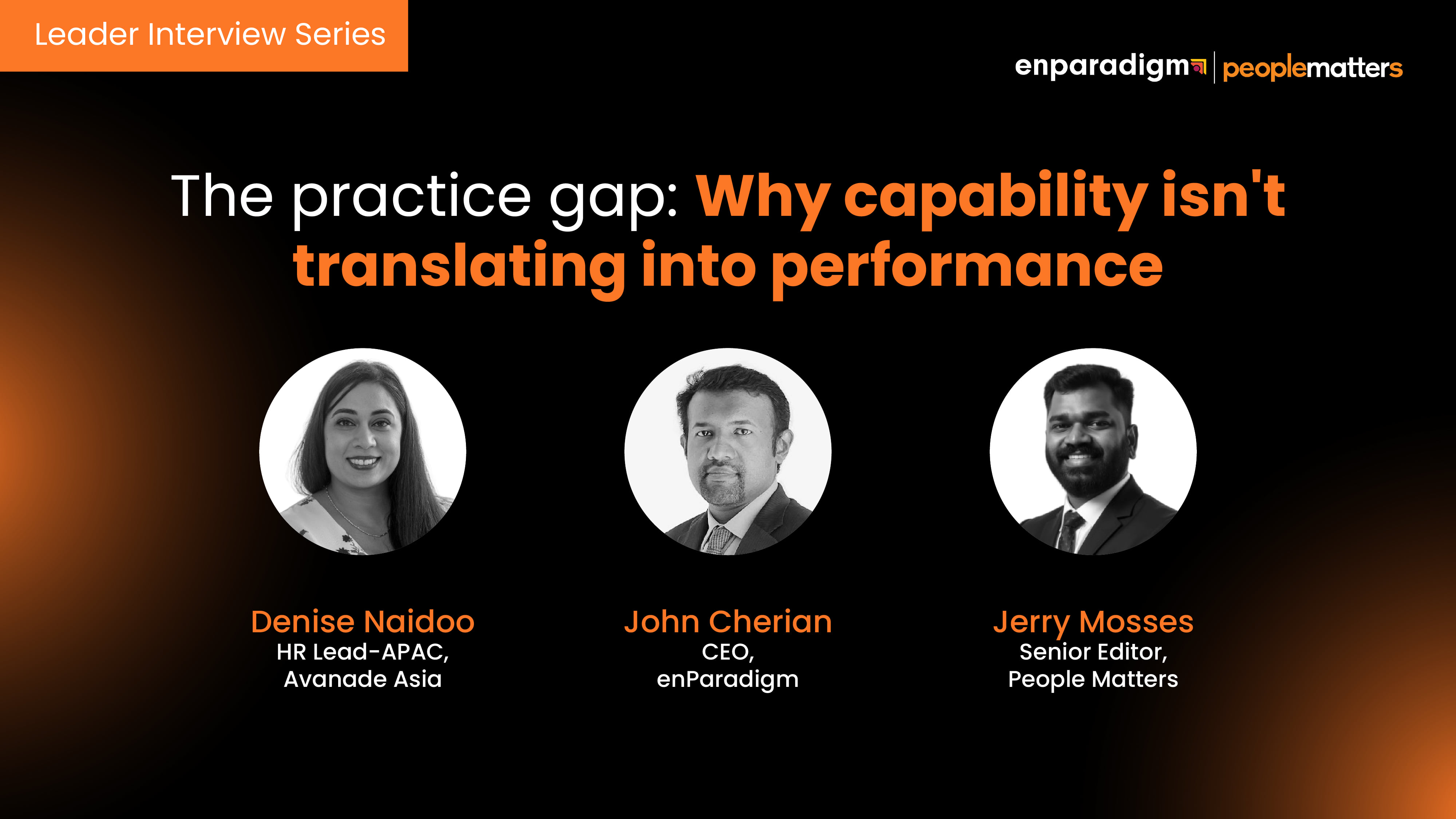
AI can drive productivity, but it's the people who still drive outcomes. This conversation is part of the expert video interview series in association with enParadigm. In this edition, Denise Naidoo, HR Lead-APAC, Avanade Asia, was joined by John Cherian, CEO, enParadigm, in conversation with Jerry Moses, Senior Editor, People Matters.
Start with the business outcome, then work backwards
John’s starting point was not a tool, but a sequence. “The mistake that many times we make is to put technology before the business objective,” he said. “You have to first look at the business outcome you’re trying to drive, and then work backwards to what solution helps you achieve that business outcome.” That sequencing still depends on talent expertise, the skills and capabilities layer beneath KRs and KPIs, and it has to come before an organisation reaches for AI.
Denise, speaking from Avanade’s experience as a Microsoft technology company that implements AI solutions for clients, said this is now “front and centre” for the business and its people. The company has had to drive a skills rotation so people understand the fundamentals of AI, use it in daily work, and can implement it with clients in the moment. The harder work is enabling application when there is no clear answer. “There’s a lot of ambiguity that we deal with on a daily basis,” she said.
Humans in the lead, AI in the loop
John framed the core problem as one of orchestration. “The biggest task out there is to know how human beings and AI are going to work together,” he said. “You just can’t replace a human being with AI and say AI will run the process. That still hasn’t worked yet.” Much of the knowledge that matters, he argued, is tacit and not captured in data: how customers behave, how people work with each other, and the politics of stakeholders.
“Maybe task execution moves to AI, but the direction and guidance still stays human, at least for the next one or two years,” he said. “Deciding how to orchestrate these two becomes the number one challenge.” Organisations then have to decide when a problem is probabilistic versus deterministic.
Most organisational processes, he noted, are relatively clear: if this happens, do that. Most AI systems will give a slightly different answer each time a question is asked. Get that choice wrong, and the organisation can end up paying twice: once for the AI, and again for the rework to fix what the AI does not.
Denise offered another formulation of the idea. “We talk about it as humans in the lead and AI in the loop,” she said. “The AI drives the productivity. But the people drive the outcomes.” That does not require a perfect answer every time. “It’s about framing the problem, working with incomplete information, making trade-offs and taking actionable steps.”
Culture is like gravity
Application will not hold if the environment pulls people back to old habits. “Culture is like gravity,” John said. “You try and jump off the Earth, and it’s just going to pull you back down.” Many learning interventions, he suggested, are like small jumps that culture drags back to ground zero. Shifting that pattern takes what he called “escape velocity”: incentive and motive alignment, a supportive environment, and managers who guide and nurture performance. “Many times we find that people lose track because somewhere the synergy and chemistry with the manager didn’t really take off.”
Denise placed leadership at the centre of that infrastructure. People need practice and timely feedback, which means leaders who “inspire, coach, [and] own outcomes, not leaders that simply direct activity.” “People would naturally thrive when they have an environment that allows them to challenge the assumptions, [and] that’s trusted with their psychological safety,” she said. “It’s leadership and culture that set the performance infrastructure in place.”
That infrastructure is under strain. “There’s just so much coming at people,” Denise said. Employees sometimes feel overwhelmed by the amount of change, something that has shown up in Avanade’s engagement surveys. She also pointed to a Gallup survey finding that engagement at the manager level has been dropping over the past year or so. To reduce that overload, leaders define learning priorities quarter by quarter, and create space to learn in the moment “through just bite-sized information or training that is available all the time.”
Measure four levels of evidence, not just completions
John argued that learning initiatives can usually be linked to a business goal: attrition and manager-support scores for a managerial capability solution; revenue per employee and time to productivity, including how quickly a salesperson hits at least 80 per cent of their targets, for a sales solution; and the share of senior roles filled from internal talent for leadership pipeline work.
But metrics, he cautioned, do not tell the whole story. Organisations also need to look for intermediate behaviours: whether the intended skill or behaviour is actually being displayed at work. “If yes, then you’ve started on the right path.” Business outcomes still matter for alignment, but they can be influenced by many things, from unexpected shocks to tailwinds that lift results even when a team has not changed how it works. “It’s always good to be aligning to the business outcome, and it’s always good to be able to show the pre-post data and metrics and see if there are any correlations.”
Denise started in the same place. “The measurement should certainly start with the business problem, not the learning programme,” she said. She described four levels of evidence, starting from what role should be performed differently and where the capability should be applied: capability, whether the person has developed and demonstrated the skill; deployment, whether they are applying it in the day-to-day job; performance, whether quality, speed or effectiveness has improved; and business impact, whether the skill has helped improve client value, reduce low-value work, improve productivity and create better client outcomes.
“Learning metrics just tell us what people completed, but business metrics tell us whether it matters,” she said. “Closing the practice gap means connecting learning to work, work to performance, and performance to growth.”
Watch the full video here: Humans in the lead, AI in the loop: Why outcomes still belong to people