








AI & Emerging Tech
The AI workforce shift is happening at the task level, not the job: WIC founder Vipul Mathur at TechHR Pulse Philippines '26





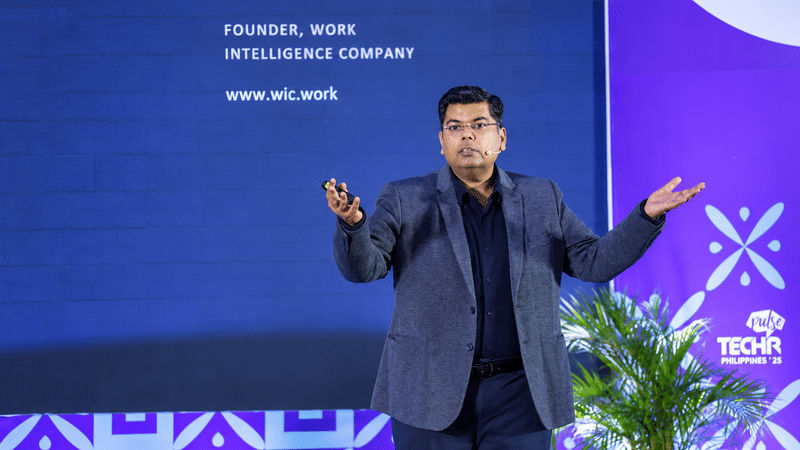
At TechHR Pulse Philippines 2026, Work Intelligence Company founder Vipul Mathur argued that building a human + AI workforce starts with understanding tasks, skills, and capacity, then deliberately deciding what people, AI, and both should own.
The conversation around AI and work often begins with jobs: which roles will disappear, which ones will change, and what new roles will emerge.
Vipul Mathur believes organisations need to look one level deeper.
Speaking at People Matters TechHR Pulse Philippines 2026, the Founder of Work Intelligence Company argued that the real unit of disruption is not the job, but the task.
“The unit of disruption is task.”
That changes the workforce question considerably.
Instead of asking whether an entire role should be automated, organisations need to understand the tasks sitting inside it, determine which can be automated, which can be augmented by AI and which should continue to depend primarily on human capability.
For Mathur, this shift from a job-centric to a work-centric organisation will require HR to rethink workforce planning, skills strategy and its own role in shaping how humans and AI work together.
From jobs to tasks
Mathur described the emerging shift as one from jobs to tasks, and from automation to intelligence.
Traditional work architecture starts with roles, then looks at tasks and the skills needed to perform them. But as AI begins taking on parts of work at different speeds, the task layer becomes increasingly important.
Two employees with the same job title, for instance, may find different parts of their work affected depending on which tasks can be automated or augmented.
According to Mathur, WIC has built a repository covering around 424,000 tasks across 53,000 roles to understand how work is changing. He said its analysis indicates that only a very small fraction of roles, around 0.02%, could currently have all of their tasks handled by AI, reinforcing his view that most roles are more likely to become blended than disappear wholesale.
The more immediate reality, therefore, is not necessarily human versus AI.
It is human plus AI inside the same role.
Some tasks will remain human-led. Others will be automated. In many cases, AI will support a person rather than replace the work entirely.
That makes orchestration the harder challenge.
The workforce plan has to move beyond headcount
If tasks are changing continuously, Mathur argued that workforce planning cannot remain primarily a headcount exercise.
Skills and tasks need to become more visible inputs into planning.
Organisations need to know what work is being performed, what capabilities it requires, how much time different tasks consume and where AI is already capable of changing that equation.
This becomes particularly important when automation creates additional capacity.
Mathur shared an example from WIC’s work in which analysis of an organisation’s task mix identified work that could potentially be augmented by AI and free up significant employee time. His point was not that those hours should automatically translate into job cuts.
The more strategic question, he argued, is what the organisation does with the capacity it creates.
Can people be redeployed towards work requiring greater judgement, problem-solving or business value?
For HR, this may become one of the defining workforce questions of the AI era: not simply how much capacity AI releases, but where that capacity should go next.
Three building blocks for a human + AI workforce
Mathur organised his approach around three elements: signals, augmentation, and trust and governance.
Signals are about visibility into how work is actually being done.
Organisations need what Mathur described as living skill graphs, alongside information about tasks, time and capacity. Without that understanding, organisations risk redesigning work around assumptions rather than evidence.
The second layer is augmentation: deciding how AI participates in work.
Mathur described four broad modes. AI may assist a person, automate a task end to end, augment human work by generating options or scenarios for people to evaluate, or increasingly orchestrate multiple tasks through agents.
The point is not that every organisation needs to move towards maximum automation.
It is that leaders need to know which model applies to which work.
AI can do the task. Who owns the outcome?
The third element—governance—may prove the most consequential.
As AI begins contributing directly to work and decisions, Mathur argued that organisations cannot allow accountability to become ambiguous.
“You cannot say that AI did wrong. Who takes accountability?”
His governance agenda included transparency around how humans and AI work together, fairness audits, clear accountability and the ability to explain AI-influenced decisions.
That means governance cannot be treated as something organisations add after deployment.
It needs to be designed into the operating model from the beginning.
If AI performs part of the work, someone still needs to own the outcome.
For HR leaders, that is likely to become increasingly important as AI enters areas involving employees, skills, workforce decisions and performance.
HR could become the ‘work system architect’
Mathur’s strongest challenge was directed towards HR itself.
He sees an opportunity for the function to move beyond managing the human side of the workforce and take a broader role in designing how work gets done.
“You need to be the work system architect.”
That could mean becoming the organisation’s skills strategist, helping determine where human capability and AI capability should sit, shaping governance around human-AI work and measuring the outcomes produced by both.
For HR, the shift is substantial.
Traditional workforce planning largely asks how many people the business requires and what capabilities they need.
A human + AI workforce forces another set of questions: What work needs to be done? Which tasks can AI perform better? Where does human judgement remain essential? What new capability will employees need when parts of their existing work change? And who remains accountable when humans and AI contribute to the same outcome?
Mathur believes HR has an opportunity to own that orchestration before another function does.
Start with the work, not the AI tool
Mathur closed with a practical set of priorities for organisations beginning this transition.
Build better visibility into skills. Understand the task architecture underneath jobs. Strengthen AI fluency across the workforce. Establish governance early. Measure what human-AI augmentation actually delivers. And involve employees in the redesign so that AI is not experienced purely as something being done to them.
Most importantly, he cautioned organisations against starting with an AI licence and looking for work to attach it to.
The foundation should be built from the work upwards.
That is perhaps the most useful distinction from his TechHR Pulse Philippines keynote.
AI adoption can begin with a tool. Building a human + AI workforce begins with understanding the work, and redesigning it deliberately.
Author
Loading...