








Employee Engagement
Can we design our workplaces to support our mental health?



 ||
||Updated on


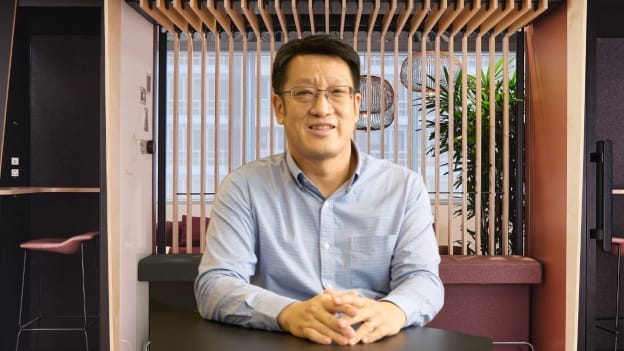
Yes - and we should, says Patrick Woo, Steelcase's HR Director for APAC, because physical and technological design will heavily influence how well people perform.
It started with the 2020 lockdowns. Back then, many companies were far quicker to adapt than they themselves would have thought, to the point that some analysts estimated ten years of digital acceleration had happened within six months.
But then the stress began to hit.
"The masks were working, the social distancing was working, but there was this strain in terms of workloads, the pace of work, and then just the mental toll of not being able to be physically with different people. I think that was the biggest challenge - not just getting your employees to perform. It was how to keep them engaged, because they were literally checking out," says Steelcase's HR Director for APAC Patrick Woo.
Speaking around the launch of Steelcase's Be my guest® in-office privacy system in June, he pointed out that this emphasis on mental health has carried on to the present day. A great many of the questions people ask about companies today are related in some way to whether the company, as an employer, is addressing its employees' mental health needs.
"In the past, people would ask what benefits you had, what was your medical insurance. Now it goes beyond that into how you address mental health. What are you doing for my mental well being? Do you have a rejuvenation room or a quiet space? Do you have employee assistance programs? Those are the types of questions I'm hearing now during recruitment. The number one priority is still family, which is not surprising. Number two is personal well being."
How do we manage these mental wellbeing needs?
Employees, Woo believes, are all looking for a certain type of experience that will maximise their mental wellbeing, and HR should come at it from the practical standpoint of how to create and optimise that experience. Doing so benefits everyone all around: it directly helps people to meet their own potential for development and for advancement, and it indirectly helps the business meet its performance requirements as a result.
Coming from the perspective of a firm that has done extensive research into the impact of the physical environment on wellbeing and performance, Woo's own suggestion for providing this experience is unsurprisingly rooted in workspace design and layout.
"In the workplace, you can't go eight full hours without taking a break. You need to socialise with a colleague, have some sort of human connection. And in the past, a lot of office layouts weren't facilitating that. You'd have to stand up and talk over a desk, which is awkward, or you'd have to stand next to someone and tower over them, which is intimidating."
A layout that genuinely encourages performance, he says, will offer several different kinds of spaces, or 'districts' where people can do different types of work. At the very least, there should be focus space where people can work individually without distractions; social space where people can interact and collaborate on a more casual level; private space where anyone who needs a one on one meeting, such as managers, can have more formal secluded conversations. Some companies add rest space where people can decompress; others have a larger community space to host broader-based conversations.
"Some people are very introverted and some people are extroverted, but you can give them control of what space they use. You don't have to force them to work down at Starbucks or in their home to get that level of privacy," he says.
The intersection of workspace and employee engagement
Before joining Steelcase in 2020 - right before the Covid-19 lockdowns - Woo transitioned through a wide range of different industries from public sector to manufacturing to aviation to consulting and more. That spectrum of experience tells him one thing: "At the heart of it, people are always people. They may have differing priorities, depending on their industry, their standing within the company, their own age, and where they are in their life."
"But at the end, people are still the same. They have the same needs around security and safety. They have the same aspirations in terms of getting better rewards and being treated fairly, and around opportunities to develop or grow. Some may be doing that for career advancement, some are just doing it for their own love of learning....at the end of the day, it's about making sure that we've met all those basic needs, and in doing so, given them the opportunity to unlock their own potential and succeed at whatever they're doing."
The physical environment can absolutely play a part in meeting those needs, he says. Of course, it's not just about designing and installing a nice workspace; there is a strong element of how to promote it to employees, and communicating the expectations of how the space should be used. The important thing to remember is that the space is for people - something which he thinks businesses only really started to lean into during the pandemic.
"They wanted an HR view because safety issues had become more sensitive...and then people had an aha moment. They were committing half a million dollars to redesign workspaces to create better employee experiences, and the people that work most closely in employee experience weren't part of that. It was an epiphany, and now people in HR are considered critical stakeholders and decision makers in workspace design."
So as a critical decision maker, what should organisations take into consideration the next time they redesign their workspace; what experience will the employees of the future expect?
In fact, future design is less about predicting the future than about being adaptable, Woo thinks. People's priorities may manifest in various different ways, and the current back and forth between in-office and remote models is a classic example of that.
"That balance between hybrid work and return to office could swing completely over to one side or the other at some stage. So the question is, how ready are you and how resilient and agile is the organisation to be able to shift?
Topics
Author
Loading...