








Employee Skilling
The skills reset: Why workforce capability is moving beyond job titles






Organisations can create the conditions for employees to learn, experiment and take on new responsibilities, but genuine ownership also depends on employees having the confidence and skills to act.
As AI, automation and digital transformation reshape jobs faster than organisations can rewrite job descriptions, the traditional approach to workforce planning is being put under pressure.
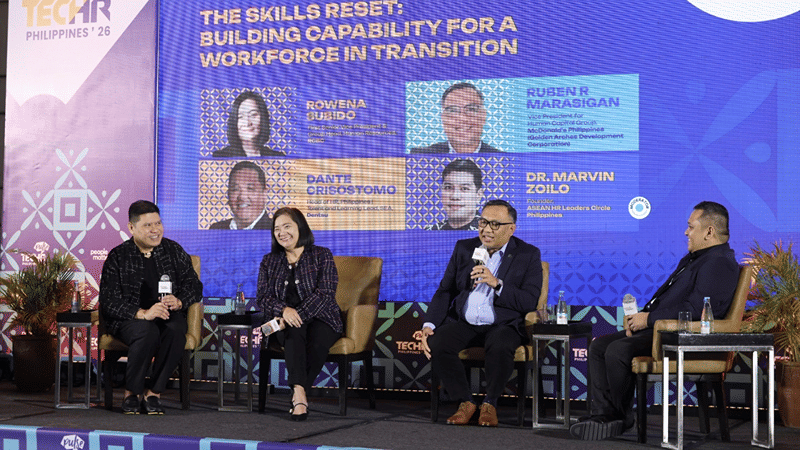
At People Matters TechHR Pulse Philippines 2026, HR leaders from banking, advertising and quick-service restaurants discussed what it takes to build capability for a workforce in transition. The conversation pointed to a common shift: organisations are moving from hiring primarily for roles and credentials to understanding what skills people have, what skills the business will need next and how employees can move towards those capabilities.
The panel featured Rowena Subido, First Senior Vice President & Group Head of HR, RCBC; Ruben R Marasigan, Vice President for Human Capital Group, McDonald’s Philippines; and Dante Crisostomo, Head of HR, Philippines and Talent and Learning Lead, SEA, Dentsu. The discussion was moderated by Dr Marvin Zoilo, HR General Manager, Tech Mahindra.
From job descriptions to skills
For the panellists, one of the clearest changes is the speed at which skills are emerging.
Crisostomo said organisations are seeing greater fluidity between functions, with employees moving across departments based on what they can bring to the business rather than being confined to their original job titles or academic backgrounds.
“Gone are the days where we're heavily focused on just the CV, the job titles, or maybe the course that you took in college,” he said.
That shift is particularly visible in sectors undergoing rapid digital change. Employees from HR can move into operations, while those from finance can move into other functions, bringing different perspectives and capabilities with them.
The question, therefore, is increasingly becoming: What skills do you bring to the table?
For Crisostomo, AI is an important part of that equation, but it is not the entire skills agenda. As AI becomes embedded across functions, organisations also need to strengthen capabilities such as critical thinking, curiosity and creativity.
He pointed to Japanese concepts used within Dentsu, including customer centricity and Kaizen, or continuous improvement, as examples of capabilities that remain fundamentally human.
“It's really AI, but for humans, with AI,” he said, highlighting the need to build both technology-related capabilities and the human skills needed to apply them effectively.
Start with where the business is going
Subido argued that skills planning needs to be anchored in business priorities rather than becoming an exercise in identifying fashionable capabilities.
The first question, she said, should be which skills are critical to the business. The second is whether those skills will contribute meaningfully to business outcomes.
That approach has shaped RCBC’s own transformation journey. During the pandemic, the bank accelerated its business transformation, requiring changes not only to processes and technology but also to its workforce. Subido described this as a people transformation agenda alongside the broader business transformation.
One example is the evolution of the bank's technology workforce, where legacy IT capabilities need to be upgraded alongside the development of cloud and other newer capabilities.
The objective is not simply to teach employees new tools. It is to ensure that the skills they develop are connected to where the business is headed.
That makes workforce planning a shorter-cycle exercise than it once was.
“It's how fast it is, rather than just three to five years,” Subido said, pointing to the emergence of roles that did not exist in their current form only a few years ago.
For organisations, this means looking at capability needs over the next 12 to 24 months while keeping sight of longer-term transformation.
Reskilling at scale: Take learning to the workforce
For McDonald’s Philippines, the challenge is one of scale. With a workforce of around 75,000, a traditional centralised approach to reskilling would not be practical.
Marasigan said the organisation therefore focuses on bringing learning closer to employees, including through training at the store level and online learning for managers.
The company is also changing what it expects from its restaurant managers. Rather than focusing only on restaurant operations, the role is increasingly positioned as that of a business manager, requiring stronger capabilities in areas such as data and technology.
The emphasis is also on accelerating career progression. With around 90% of the workforce comprising young people, Marasigan said the organisation does not want employees to wait unnecessarily long before moving into their next role.
Learning is consequently tied to career movement, while managers' development is monitored through online training and other programmes.
But the organisation is also looking beyond formal job-related skills.
Marasigan cited employees who are TikTok creators as an example. Rather than treating those capabilities as unrelated to work, McDonald’s has found ways to use employees’ interests and digital skills for internal communication, engagement and employer branding.
The broader lesson is that capability can exist outside an employee’s formal job description — and organisations can create value by recognising it.
AI adoption needs both structure and experimentation
At RCBC, the AI skills agenda has been formalised through an organisation-wide learning approach. Subido said the bank has established AI champions across business units and requires employees to complete an AI learning path, while also encouraging self-directed learning.
The approach extends into HR, where teams have developed multiple AI adoption projects across areas such as talent acquisition, learning and development, employee relations and talent management.
The aim is not to position AI as a replacement for human judgement. Instead, AI can take on elements of work that can be automated or augmented, allowing employees to spend more time on activities where judgement, context and human interaction matter.
That distinction becomes particularly important in HR, where decisions can involve sensitive employee situations and require an understanding of context that cannot simply be delegated to a tool.
The panel’s discussion also highlighted a broader challenge: access to AI does not automatically translate into effective adoption. Employees need to understand how to use these tools, where they add value and where human judgement must remain central.
From enablement to empowerment
For Dentsu, capability building also requires a cultural shift. Crisostomo distinguished between enablement and empowerment. Organisations can create the conditions for employees to learn, experiment and take on new responsibilities, but genuine ownership also depends on employees having the confidence and skills to act.
That requires an environment where people can learn from mistakes rather than being penalised for every failure. Mentorship becomes important here. Crisostomo noted that managers are themselves under pressure to deliver, leaving less time for coaching and mentoring their teams.
As organisations become more skills-focused, therefore, managers have a dual responsibility: delivering business outcomes while creating the conditions for people to develop.
Giving employees something to own
Marasigan linked capability building directly to accountability. “You have to give them something to own,” he said.
He argued that organisations can unintentionally weaken decision-making when employees become accustomed to escalating every decision to their managers. Giving people responsibility, alongside the skills and context required to exercise it, can help build ownership.
He also pointed to a shift from measuring outputs to outcomes. For a restaurant employee, for example, completing a defined number of tasks may represent an output. But understanding how those activities contribute to sales, profitability and the broader business strategy creates a clearer connection between individual work and organisational goals.
McDonald’s reflects this through team-level targets and incentives linked to metrics such as sales and profitability.
The underlying idea is that employees are more likely to understand their contribution when they can see how their work connects to the organisation’s larger objectives.
The human skills question
Across the discussion, one theme repeatedly surfaced: AI may change the nature of work, but it does not eliminate the need for human capability.
Critical thinking, creativity, curiosity, leadership, customer centricity, judgement and the ability to collaborate remain important even as technology takes on more tasks.
For HR leaders, that changes the question from “What jobs will AI replace?” to a more practical set of questions: What will the business need to achieve next? Which capabilities will enable that? Which skills already exist inside the organisation? And how can employees move from where they are today to where the business needs them to be?
The answers may not always require external hiring. They could involve reskilling legacy teams, enabling internal mobility, redesigning roles, creating faster learning pathways or giving employees opportunities to apply skills they already possess in new ways.
The skills reset, then, is not simply about preparing employees for AI. It is about creating a workforce that can keep adapting as the definition of work itself continues to change.
Author
Loading...