








Employee Skilling
Building lifelong learning as strategy: A conversation with Starbucks’ Shana Kruse


 ||
||

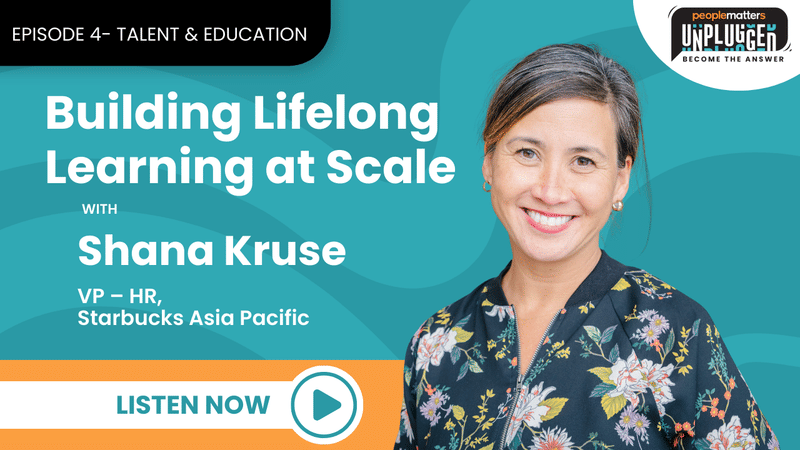
Starbucks’ Shana Kruse discusses talent, education, and building lifelong learning at scale—why employers must become educators in today’s evolving workforce.
Talent and education are colliding in ways few organisations can ignore. Skills are changing faster than traditional education systems can keep pace, and the gap between what employers need and what job seekers bring is widening across industries.
The question is no longer whether organisations should invest in learning, but how they build lifelong learning at scale, without reducing it to another training program or a compliance checklist.
In this episode of People Matters Unplugged, hosted by Cheshta Dora, Head of Content and Community at People Matters, Shana Kruse, VP – HR, Starbucks Asia Pacific, shares a grounded perspective on what it takes to make learning continuous, meaningful and scalable, especially in high-growth, frontline-driven environments where capability building directly influences customer experience, business performance and retention.
The core shift: employers are becoming educators
Shana’s starting point is a reality many HR leaders are confronting: economic progress has outpaced the ability of education systems to prepare the future workforce. At the same time, the “half-life” of skills is shrinking, creating constant pressure on people to keep up, pivot, and relearn. In this context, organisations are increasingly being pushed to play a larger role in learning, and not as a one-off intervention, but as an ecosystem.
For Shana, this shift isn’t about doing more courses. It’s about recognising that learning is now central to workforce resilience. The employer’s role extends beyond filling today’s roles to strengthening a person’s ability to adapt across roles, across technologies, and across life stages.
Learning as a promise, not a program
At Starbucks, Shana anchors learning in the company’s “Partner Promise,” which she describes as a bridge to a better future. That framing matters. It positions learning not as a perk, but as part of the relationship between organisation and employee, tied to growth, contribution, and community.
Shana’s insight here is subtle but powerful. She says lifelong learning becomes scalable when it is culturally owned, not centrally driven. When learning is connected to identity, purpose and everyday experience, it stops feeling like “extra work” and starts becoming “how we work.”
Scale requires design that fits the frontline reality
A major tension in learning strategies is this: many organisations design learning for corporate contexts and then try to “roll it out” to the frontline. Shana flips that. In fast-paced retail environments, learning must be designed to fit the flow of work, practical, social, and immediately applicable.
One of her standout beliefs is the importance of on-the-job development and peer-powered learning. Instead of treating learning as separate from work, she emphasises learning through shared experience, coaching, and real-time reinforcement. For leaders trying to build learning at scale, this is a crucial takeaway: the modality matters as much as the content.
The fear factor: “If we upskill, will we lose them?”
Most organisations have heard this concern, and many quietly operate from it. In high-mobility industries, leaders often hesitate to invest deeply in learning because competitors may benefit.
Shana acknowledges this as a real challenge, but offers a more purpose-driven lens: if organisations accept their role as educators, then skill-building isn’t only about retention, it’s also about contribution.
At the same time, she doesn’t romanticise attrition. Her view is pragmatic: the best response is to build an environment where people want to stay, learn and grow. In other words, capability building must be paired with culture, because learning alone doesn’t create loyalty, but learning plus belonging often does.
The keyword: adaptability
When Shana speaks about the skills mismatch, her answer isn’t a list of hot skills, it’s a mindset: adaptability. She points to a need for individuals to expand how they view learning and what they take from it, and for employers and educators to be more flexible in how learning pathways are built.
This matters because many organisations still treat skills as static checkboxes. Shana’s lens suggests the opposite: in an era of constant change, adaptability is what keeps skills relevant. It’s also what helps people translate education into employability, and employability into long-term mobility.
Democratizing learning beyond organisational walls
Another key thread in Shana’s perspective is access. Lifelong learning at scale can’t be limited to a select few or to leadership pipelines. When learning is democratized, across levels, roles and geographies, it becomes a lever for equity and engagement.
She also hints at a broader ambition: learning ecosystems that extend beyond the company into communities. This is where the “employer as educator” idea becomes larger than HR, it becomes part of how organisations shape future workforces, not just their own.
The metric most leaders miss: belonging
Perhaps Shana’s most provocative point is about measurement. Learning is notoriously hard to quantify, and many organisations rely on proxy metrics, completion rates, hours trained, course satisfaction. Shana points toward something more human: belonging.
Her belief is that people learn best when they feel safe, connected, and supported, when they can practice, ask questions, and grow alongside others. This is why she advocates for learning formats that create connection, not just consumption. In a world of digital learning, AI tools and micro-content, her reminder is timely: learning still needs humans to make it stick.
Why this conversation matters now
Shana’s insights land at a moment when every organisation is being tested on talent resilience. The companies that win won’t simply offer more training. They’ll build cultures where learning is continuous, accessible and tied to purpose, where people don’t just gain skills, but build confidence, community and mobility.
Topics

Loading...