








Employee Value Proposition
Don’t automate the friction: Converge’s Enrique Antonio Reyes on redesigning employee experience





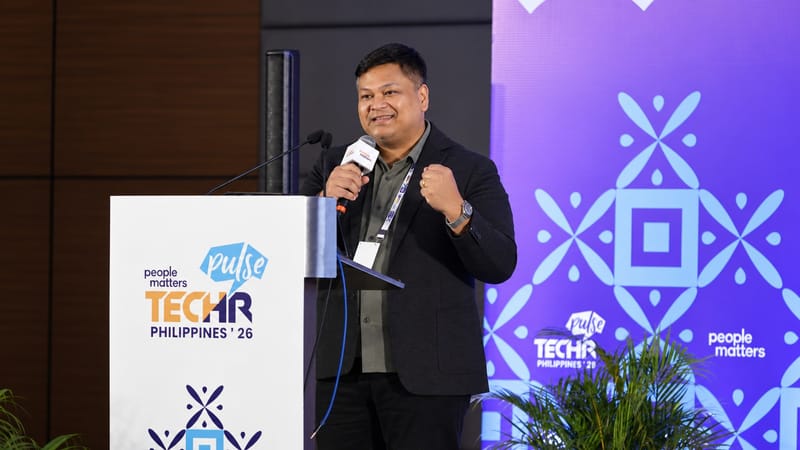
At TechHR Pulse Philippines 2026, Converge ICT Solutions’ Enrique Antonio Reyes argued that better employee experience begins not with another platform, but with understanding where work gets unnecessarily difficult, redesigning those moments and only then bringing technology in.
Employee experience is often discussed through platforms, engagement programmes, benefits or increasingly sophisticated digital tools. Enrique Antonio “Iks” Reyes believes organisations may be starting the conversation in the wrong place.
For the Vice President and Head of People Capability & Growth at Converge ICT Solutions, employee experience comes down to something far more fundamental: can people get their work done without navigating unnecessary effort, unclear ownership or processes that no longer serve a useful purpose?
Speaking at People Matters TechHR Pulse Philippines 2026, Reyes urged HR leaders to look closely at the work behind the experience before reaching for technology.
“The employee experience is really about them doing their work.”
His argument was not against digitisation or AI. It was against using either to make an already cumbersome process move faster.
As organisations invest in HR technology, the more important question may therefore be whether they are digitising good work, or simply automating friction.
Look at what employees actually experience
Reyes outlined a simple framework for finding where employee journeys break down: Listen, Observe, Visualise and Examine - or LOVE.
Employee listening can reveal how a process feels, but Reyes cautioned against stopping there. Observation shows what employees actually do when navigating a process, while journey mapping allows HR to see the experience end to end. Evidence then helps determine where problems repeatedly occur, how frequently they happen and how seriously they affect the employee.
Those breakdowns are often less dramatic than organisations expect. Employees may be waiting without knowing who owns the next step, repeatedly asking for status updates, entering the same information in different places or being pushed through unnecessary hand-offs before a simple request is resolved.
That is why journey mapping, in Reyes’ view, should not begin with the HR system itself.
The starting point should be the employee’s intended outcome. Instead of asking only how somebody uses an HR portal, HR should first understand what the person is trying to accomplish and then examine whether the journey actually helps them get there.
It is a subtle shift, but an important one: designing around the employee’s work rather than around HR’s process.
The goal is not a frictionless workplace
The word “friction” generally carries a negative meaning in employee experience, but Reyes challenged the assumption that organisations should remove all of it.
Some friction has a purpose.
Accessing confidential employee information should require safeguards. Disciplinary decisions should involve evidence and careful judgement. Significant financial commitments should include controls rather than happen instantly.
These steps may make a process slower, but they also protect fairness, security, quality and accountability.
“The objective is not to create a frictionless organisation. The objective is intentional friction.”
The problem is unnecessary friction: steps that consume employee effort without improving the quality of the outcome.
That could mean approvals that add nothing to the decision, repeated information requests, unclear ownership or forcing employees to move between systems simply because the organisation has designed the process that way.
For HR, this creates a more useful design test: preserve friction where it protects something valuable, and redesign it where it merely makes work harder.
Solve the right problem before building the answer
Once the friction has been identified, Reyes proposed another practical framework: Define, Involve, Visualise and Experiment - or DIVE.
The first step may be the most important.
A large number of messages to HR could appear to be a communication problem, for instance, when the actual issue is that employees cannot see the status of their request, do not know who owns the next action or cannot find a reliable answer themselves.
“When we define the wrong problem, the excellent solution will just solve the wrong thing.”
That principle becomes increasingly important as technology makes it easier to build solutions quickly. A sophisticated chatbot, workflow or automation can still fail if it has been designed around the wrong problem.
Reyes therefore argued that the people experiencing and delivering the journey need to be involved in redesigning it.
This should go beyond consultation designed simply to secure buy-in. Instead, employee experience should be co-designed with employees, allowing insight from the ground to influence how the solution is built.
From there, organisations can examine what can be eliminated, combined or clarified, where information should already be available and where employees genuinely need human assistance.
Simplify first. Digitise second.
Perhaps the clearest principle from Reyes’ session was also the simplest:
“You need to simplify before you digitise.”
If an HR process contains ten steps but only three are genuinely necessary, automating all ten does not represent transformation. It simply makes an unnecessarily complicated process more efficient at being complicated.
Reyes encouraged HR teams to eliminate what should not exist, simplify what remains and only then ask what technology can improve.
That sequence is becoming even more important as AI moves into HR workflows.
Conversational interfaces, automation and intelligent systems can increasingly complete actions for employees rather than simply provide information. But Reyes warned that the purpose should remain improving the journey rather than removing human involvement indiscriminately.
“AI should augment the journey, not automate the friction.” He said empathy, contextual judgement, fairness, accountability and difficult conversations continue to require a meaningful human role.
The objective is not to automate everything that can technically be automated, but to decide where technology genuinely makes the employee’s work easier and where human involvement protects the quality of the experience.
Converge is applying the same thinking to its own transformation
Reyes candidly said that Converge itself is still learning. "We’re just rebuilding ourselves.”
As the organisation evolves, its HR function has been developing its own technology capability, including an HR tech team working on applications and greater integration between systems and platforms.
But Reyes stressed that the transformation cannot stop with technology.
Converge is also examining workloads, asking where friction exists and identifying processes that should be simplified before they are digitised. The aim is not merely to create more technology-enabled HR processes, but to reconsider the employee experience surrounding them.
That approach reflects a broader tension facing HR transformation today. Technology can make processes faster and more scalable, but it cannot determine whether the process was well designed in the first place.
That remains a human decision.
Employee experience starts before the interface
As HR organisations adopt AI assistants, integrated platforms and increasingly automated workflows, the temptation is to equate a more digital experience with a better one.
Reyes’ message at TechHR Pulse Philippines offered a useful counterpoint.
Better employee experience begins by understanding what employees are trying to accomplish, seeing where their journeys break down and distinguishing safeguards that genuinely protect value from complexity that simply consumes effort.
Only then should organisations decide what technology belongs in the experience.
For HR leaders, that makes employee experience less about adding another programme or digital layer and more about designing work people can navigate with clarity and less unnecessary effort.
The principle Reyes left with the room is one many transformation teams may find worth carrying back:
Do not automate the friction. Understand it, remove what adds no value, simplify what remains, and then use technology to make the better journey work at scale.
Author
Loading...