








HR Technology
Architecting Human + AI organisations: TechHR Singapore 2027 sets the leadership agenda





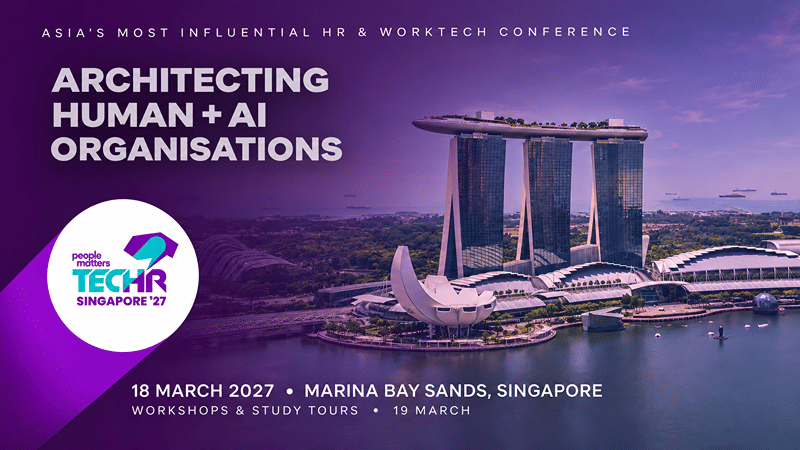
As AI is transforming how work gets done, TechHR Singapore 2027 brings leaders together to redesign work, strengthen human judgment, establish accountability and turn Human + AI collaboration into business value.
Last year, TechHR Singapore asked leaders to orchestrate growth with a human edge. This year, the brief is harder: once AI is in the room, someone has to decide what the room is for.
That question runs through People Matters TechHR Singapore 2027, themed “Architecting Human + AI Organisations.” The conference, exhibition and Infini-T Awards take place on 18 March at Marina Bay Sands, Singapore. Workshops and study tours follow on 19 March. More than 1,500 attendees, 40 speakers and 50 HR and WorkTech partners are expected across the experience.
The shift in theme follows a lesson from 2026. In a TechHR Singapore masterclass, leaders took apart broken HR processes before deciding where automation belonged. Elsewhere, People Matters CEO Pushkar Bidwai pointed to a gap between anticipating change and executing it. Both conversations exposed the same challenge: investment in technology has to be matched by decisions about the work, the people doing it and the value it creates.
The work itself is up for redesign
AI adoption may begin with a tool, but its effects rarely stay within one task. If a system prepares an assessment, what does the manager need to check? If an agent moves a case between teams, who handles the exception? If routine work takes less time, where should that capacity go?
TechHR Singapore 2027 puts these questions at the centre of the leadership conversation. The aim is to help organisations examine how work is structured, how decisions are made, how human capability develops and how a technology investment becomes a measurable business outcome. It is a practical challenge for HR, business and technology leaders alike: each sees part of the system, while the results depend on how those parts work together.
Four pillars give leaders a sharper set of questions
The New Blueprint asks how to design work for a Human + AI workforce. It covers workforce planning and organisational design alongside a more immediate choice: what should be automated, what should be augmented and what should remain human-led?
The Human Premium turns to the capabilities an organisation must protect and develop as execution changes. Judgment, trust-building and meaning-making matter most when employees have the opportunity and authority to exercise them. Time released by AI is useful only if leaders decide how people can put it to better work.
The AI Governance Advantage asks whether that new way of working can be trusted at scale. When AI influences who gets hired, promoted, paid or developed, oversight and accountability must be clear to the people making decisions and those affected by them.
The Value Mandate brings the test back to HR. Across talent, leadership, rewards, culture, skills and the HR operating model, how does redesigning work improve business performance? What evidence would persuade a CEO or CFO that the change has delivered?
These pillars are connected. A workforce plan depends on which capabilities will be valuable. A faster decision needs a clear owner. A productivity claim has to account for the work of checking, correcting and coordinating AI output. Delegates will be able to examine the questions closest to their remit while seeing where their answers depend on another function.
Decision rights become a leadership test
One of the most consequential choices is also easy to leave vague: who decides? A system may recommend, rank, draft or route. A person may approve its output without having enough information to challenge it. Speed can make that arrangement feel efficient until an unusual case exposes the gap.
The 2027 conversation gives leaders a chance to test where a human must intervene, who is answerable when a system gets something wrong and what an employee needs to understand a decision that affects their career. It also asks what good oversight requires in practice: access to the relevant information, authority to act and a way to learn from mistakes.
Those choices are especially important for organisations operating across Southeast Asia. Common systems may help an enterprise work consistently, but employees, managers and customers encounter them in different markets and contexts. At TechHR Singapore 2026, Koo Sengmeng of AI Singapore stressed the importance of technology that reflects the region’s linguistic and cultural diversity. In 2027, that insight belongs inside the design of work itself.
A speaker mix that reaches beyond HR
The first and key announced speakers reflect the breadth of the task. Ravin Jesuthasan, Senior Partner and Global Workforce Leader at Marsh Workforce and Rewards, and Toby Walsh, Chief Scientist at the UNSW AI Institute, bring perspectives on the future of work and AI. HR leaders include Fong Tuan Chen, Group Chief People Officer at Valiram; Joydeep Bose, Managing Director and Group CHRO at Olam; Anna Ho, CHRO at Vena Group; and June Cho, CHRO at SUTD.
They will be joined by Quah Ley Hoon, Group Chief Corporate Officer at CapitaLand; Edward Chen, Chief AI Officer at NCS Group; Celine Heissat Le Cotonnec, Chief Data Innovation Officer at Bank of Singapore; Yuan Shen Chua, Chief Executive Officer of Hocklim Engineering; and Alan Lai, founder and CEO of ProfilePrint, and many more.
The range is the point. A promising AI use case must withstand questions from the business that funds it, the people who operate it and the leaders responsible for its consequences. TechHR Singapore brings those perspectives into the same conversation.
Different formats make room for debate and practice
The conference will run across multiple spaces, including parallel studios, a masterclass studio and an unconference. Alongside keynotes, formats such as C-suite huddles, candid conversations, think tanks, Talent Snack case studies, Lighthouse Talks, Big Questions and live Q&A offer different ways to examine a challenge. A focused case study can show what happened when an idea met operational reality; a smaller peer discussion can surface the difficult choices behind it.
Masterclasses and workshops give those ideas more room to develop. The main conference offers opportunities for closer learning with thought leaders, while the 19 March workshops allow participants to work through questions in greater depth. Study tours will take delegates inside organisations to observe transformation in practice. The experiential learning programme adds activities designed to prompt a different way of thinking about familiar leadership problems.
Partners and awards bring evidence to the conversation
The HR and WorkTech exhibition gives delegates a place to examine solutions against the questions raised in the conference: what problem does a product solve, what changes for the people using it and how would an organisation judge its value? For partners, it is an opportunity to meet the HR, technology and business leaders shaping those decisions, and to show how their work responds to real needs.
On 18 March, the second People Matters Infini-T Awards SEA will recognise achievements in talent, technology and transformation. Its categories span Visionary Organisations, Revolutionary Teams and Individual Icons, with organisational awards covering areas including AI in HR Transformation, skills-based organisation design and high-trust workplace systems. Evaluation considers impact alongside intent, user experience, stakeholder engagement and learning from failure. The nominations will close on 25 February 2027.
TechHR Singapore 2027 brings the ideas, people, tools and examples together around a decision every organisation must make for itself: what should work look like when human intelligence and AI contribute to it together? The answer will be found in the roles leaders redesign, the judgment they develop, the accountability they establish and the value they can demonstrate.
Topics
Author
Loading...