








Leadership
At TechHR Singapore 2026, Pushkar Bidwai urges a shift to maverick leadership in the age of AI






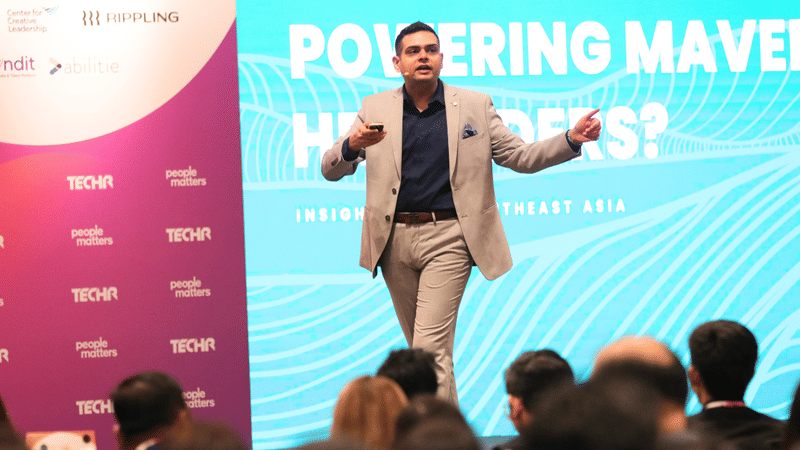
57% of HR transformation projects in Southeast Asia are set to fail, says Pushkar Bidwai, highlighting a critical mismatch in readiness and execution.
“As we look toward the horizons ahead, we must confront the barriers, challenges, and headwinds, especially those from a people standpoint that will shape our talent access, change management, and leadership development,” Pushkar Bidwai said, setting the tone for a deeply reflective and data-rich keynote at TechHR Singapore 2026.
Taking center stage, Bidwai, CEO of People Matters, brought urgency and optimism to the theme, “Leading The Legacy: Orchestrating Growth For All.” What followed was not just a diagnosis of where organisations stand, but a sharp critique of where they are falling short.
From the outset, he framed the conversation not around technology alone, but around the human edge, the interplay of talent, leadership, and transformation in an AI-driven world.
The Talent Excellence Paradox
Singapore, often seen as a benchmark for workforce maturity, presents a paradox.
“And if I was to call out Singapore as part of it, I think the biggest piece is our talent excellence. 4% of HR leaders and business leaders express that,” Bidwai shared.
While talent excellence is identified as the top priority, the effectiveness gap remains stark.
“So while we have a great piece on talent excellence, it goes down to change management and leadership development… there is a huge stride that we need to do as part of our own capability building agenda,” Bidwai said.
The data reveals a misalignment: organisations know what matters, but struggle with how to execute.
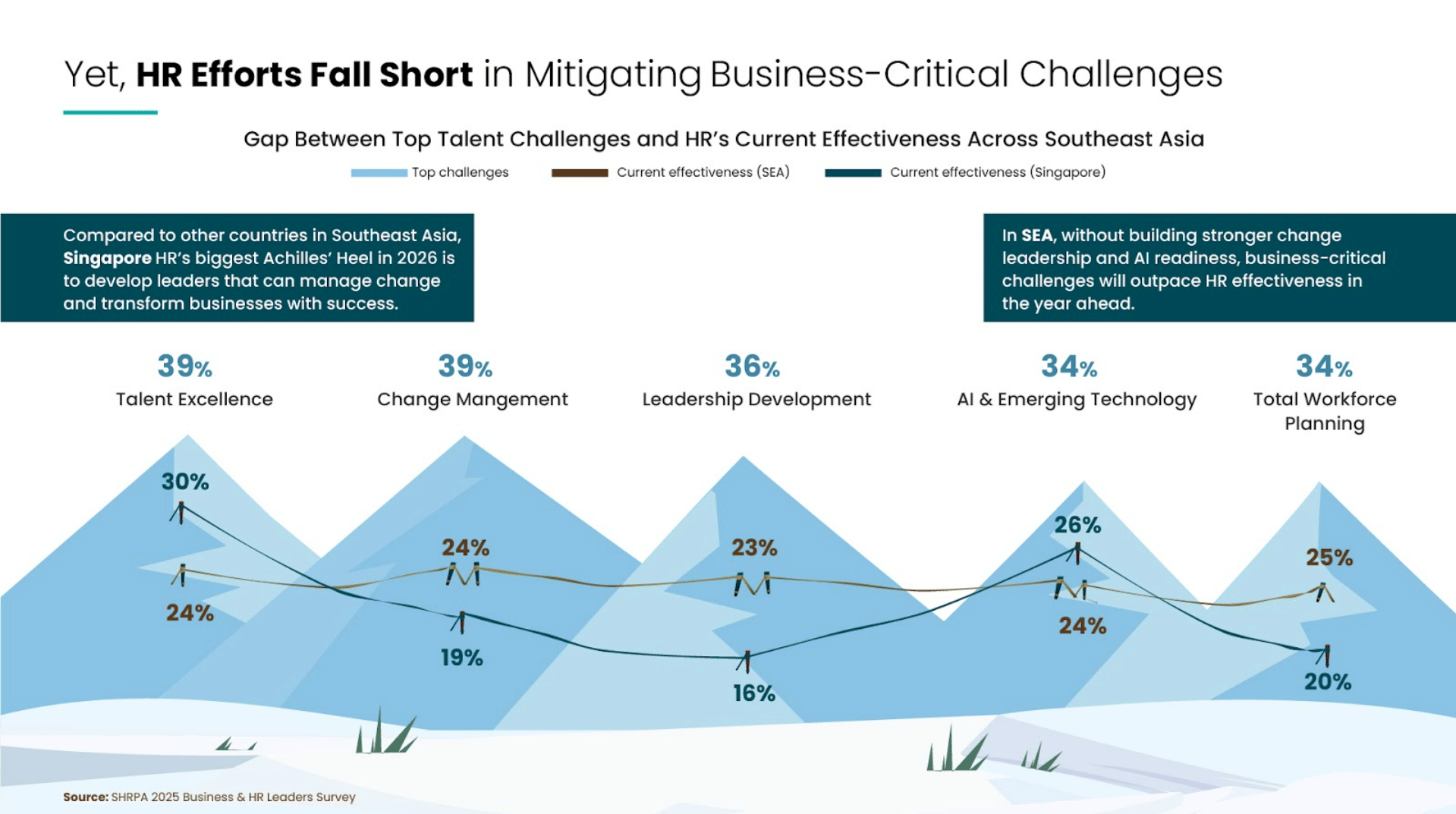
Insights from SHPRA 2025 Business and HR Leaders survey
The Execution Crisis in Change Management
A recurring theme, and a critical blind spot, is execution. “One is this whole aspect about change… we are effective when it comes to predicting change… where we are lacking is change execution,” Bidwai said.
Despite strong strategic foresight, organisations falter when it comes to operationalising change:
Building skilled change managers
Designing complex workflows
Translating strategy into action
“Many times when we look at strategy, we de-prioritise execution,” he added.
Notably, this is not a new issue. “This is the second year, when change execution has been highlighted as one of the key areas for the community to build on,” Bidwai shared.
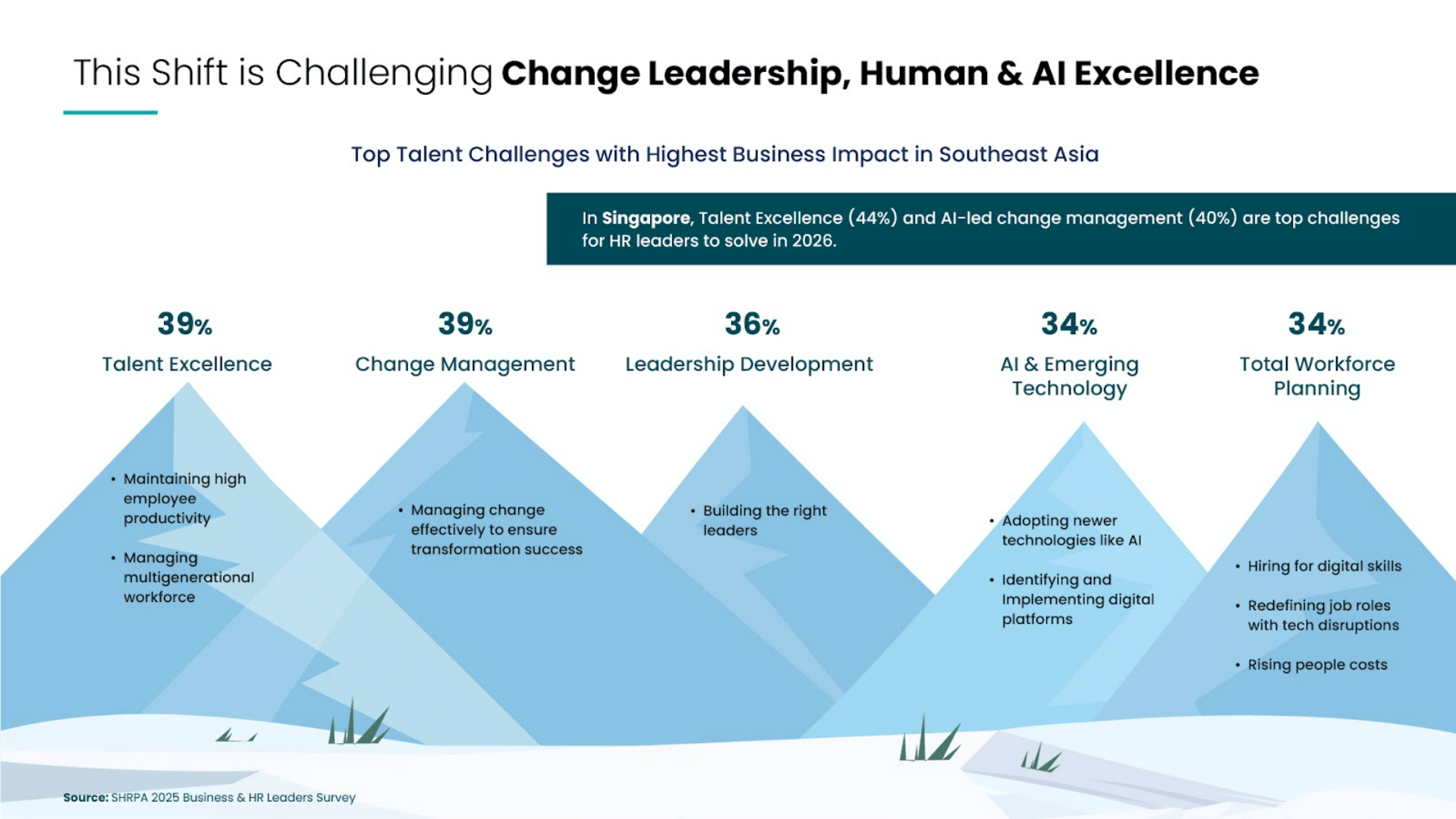
Insights from SHPRA 2025 Business and HR Leaders survey
AI Adoption: Ambition vs Reality
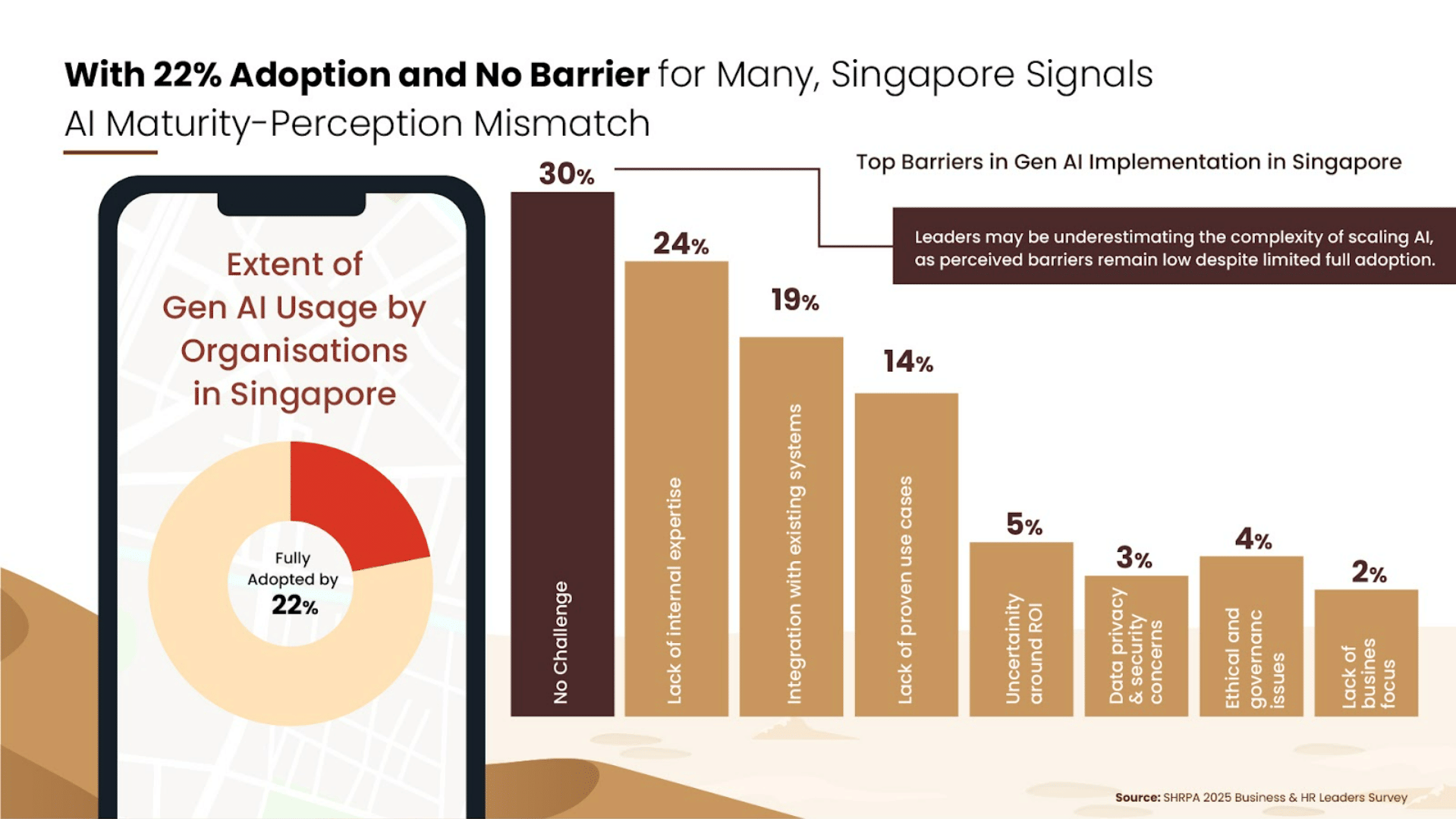
The region is moving fast on AI, but not always in the right way. “In Southeast Asia, 70% of organisations are truly trying to integrate the use of Gen AI,” Bidwai said.
However, intent does not equal readiness. “If you look at Singapore, the percentage increases… but the top barrier… in Southeast Asia, is lack of internal expertise,” he shared.
Even more striking is the disconnect: “So is there a sense that we are investing in AI activities, and that will translate into the outcomes… is there a false sense that we will build?” Bidwai said.
This “false sense” carries real consequences. “All of this translates into our businesses losing millions and billions of dollars,” he added.
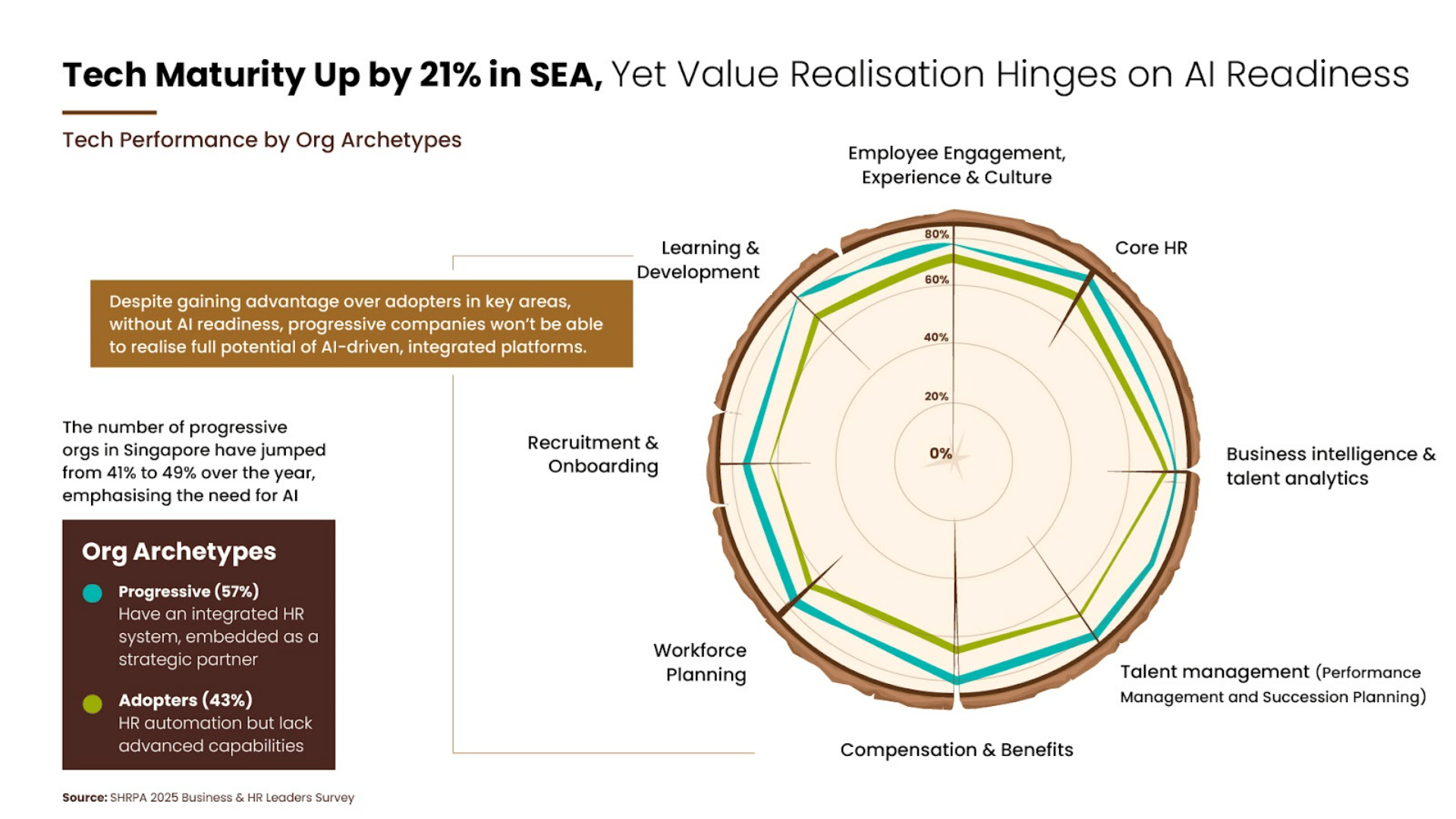
Insights from SHPRA 2025 Business and HR Leaders survey
The Human Edge Advantage
Bidwai introduced a critical differentiator: the human edge. “These are areas where there is a very clear gap between these two sets of organisations,” Bidwai shared, referring to learning and development, recruitment, onboarding, and workforce planning.
Yet, the broader ecosystem is struggling. “Across Southeast Asia, 57% of HR transformation projects… will not meet its goals,” Bidwai said.
The reason? A fundamental mismatch.
“If our change readiness is not equal to AI readiness… we need to beat this change,” he emphasized.
 Insights from SHPRA 2025 Business and HR Leaders survey
Maverick vs Incremental Leadership
At the heart of the session was a powerful leadership dichotomy. “I sum it up Maverick versus incremental… today's time needs Maverick leadership,” Bidwai said.
Who are maverick leaders? Bidwai described them as leaders who:
- Experiment boldly
- Build new playbooks
- Challenge legacy thinking
And Incremental leaders, by contrast, optimise within existing boundaries—an approach that falls short in today’s pace of disruption.
A Case Study in Transformation: ‘We Will Not Leave Anyone Behind’
One of the most compelling moments came through a real-world transformation story.
“We will not leave anyone behind… we will give everyone the same opportunity with the same kind of AI… the same kind of learning across the organisation,” Bidwai shared.
Instead of hiring new talent, the organisation doubled down on its existing workforce:
“They gave up the hiring roles… we will deeply invest in capability… one of the most mass upskilling initiatives,” he said.
The philosophy was clear – “You can’t buy yourself out… if you can’t buy yourself out of a crisis, then you need to orchestrate the human edge,” Bidwai added.
The results were dramatic:
Revenue drop of ~38% (2023–24)
Followed by ~40% growth in 2025
Nearly $50 billion market cap impact
“This is HR leading front and center to make that happen,” Bidwai said.
The Rise of the CHRO as Transformation Leader
A key shift highlighted was the evolving role of HR. “I believe the majority of the change around AI is happening, which is human led,” Bidwai said.
This positions CHROs not as support functions, but as central orchestrators of transformation.
“The CHRO will need to play a bigger role in leading this change,” he added.
HR Tech: Investment Without Value?
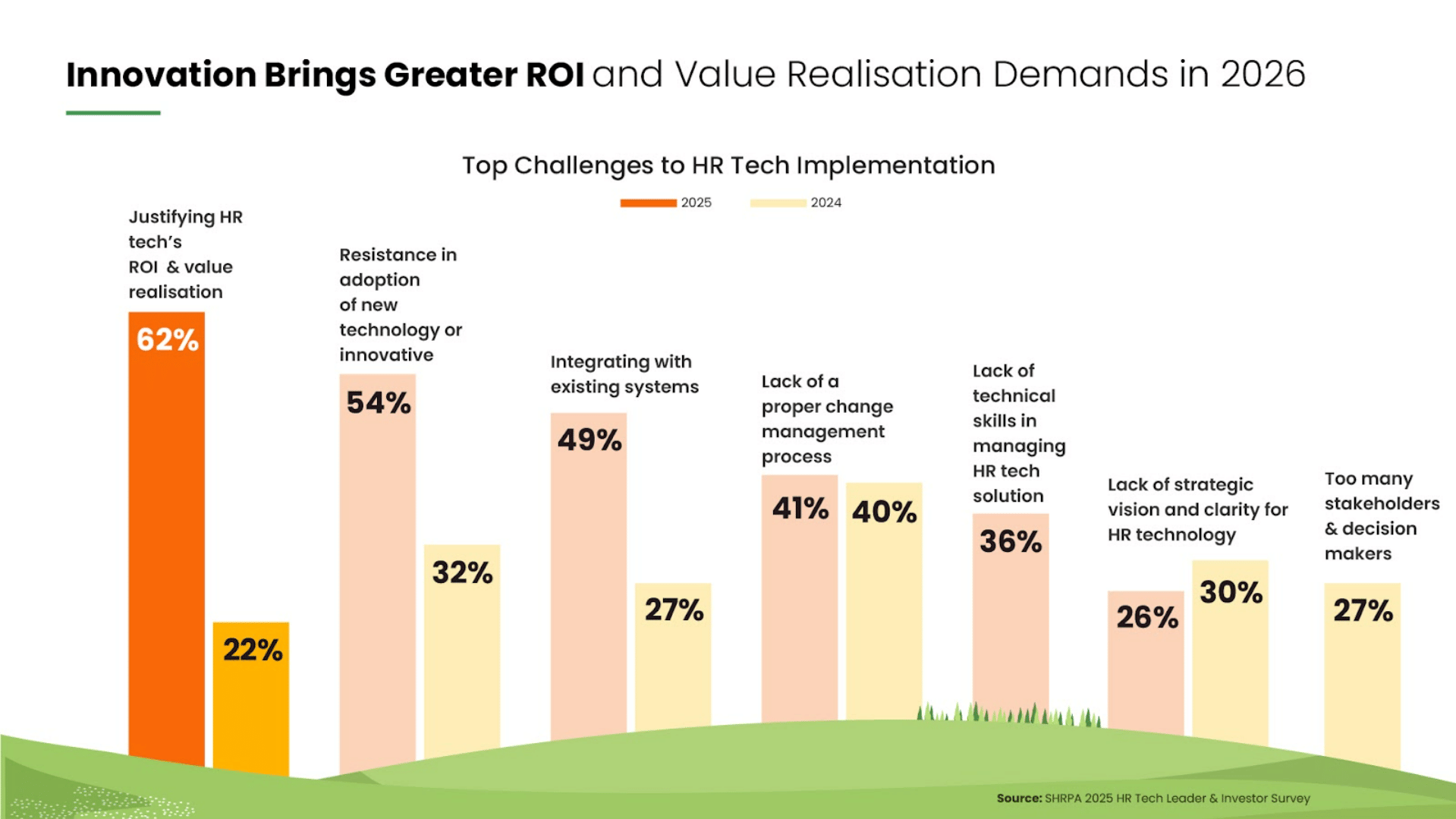
Organisations are investing heavily in HR technology, but returns remain uncertain. “The biggest one is justifying ROI… the value realisation piece is the biggest piece,” Bidwai shared.
Adoption, not deployment, is the real challenge: “We buy all these fancy tools, but if people are not using it, what are they for?” he said.
There is also a strategic shift underway: “58% of leaders are striving towards best of breed as a strategy,” Bidwai noted.
Insights from SHPRA 2025 HR Tech Leaders and Investors survey
Three Critical Gaps
Bidwai summarised the HR tech transformation critical challenges, which are also underlined in SHPRA 2025 Business and HR Leaders survey :
AI Readiness Gap – “It’s the culture of AI readiness… not skills,” Bidwai said
Value Realisation Gap – Difficulty in proving ROI and business impact
Effectiveness Gap – Capability gaps in leadership and execution
The 2026 Leadership Agenda
Looking ahead, the roadmap is clear. “The whole participation and augmentation of the world is only possible if you have the right skill strategy,” Bidwai said.
“Shift from deployment implementation to adoption,” he added, speaking on technology strategy.
On leadership, he emphasized purpose: “Every decision I take, which is purpose-led, will show the path,” Bidwai shared.
Rehumanizing Work in the Age of AI
The session also introduced a forward-looking idea: rehumanizing organisations. “How do we re-humanize organisations in the age of AI… that’s one of the core differentiating factors,” Bidwai said.
With questions like – Could CXOs be bots? Or could boardrooms include AI participants?
The future is not just digital, it is deeply philosophical and human. Bidwai left a final thought with a powerful reflection: “Lead the legacy… that we can be proud of… I was the one who was able to lead and drive that change,” he said.
TechHR Singapore 2026 set the tone for leaders that the future of work will not be won by those who adopt AI fastest—but by those who align human capability, culture, and execution with it.
And as Bidwai emphasized, the choice is simple, ‘Be incremental. Or be maverick’ not just a statement, but as a challenge.
Topics
Author
Loading...