








Leadership
From AI ambition to workforce impact: Meet the leaders shaping TechHR Pulse Philippines 2026





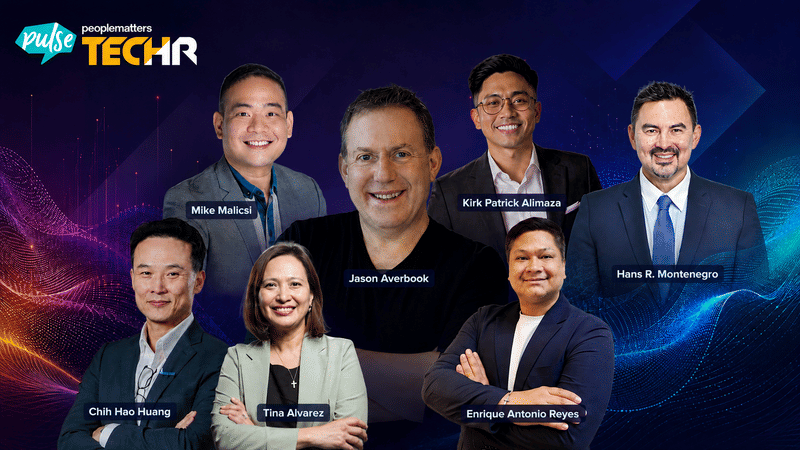
From making AI deliver measurable value to building skills, culture and leadership capacity, seven leaders at TechHR Pulse Philippines 2026 will bring perspectives shaped by transformation on the ground.
The real test of AI in the Philippines will not be how many employees use it. It will be whether a bank can scale without losing its culture, an airline can remain agile without exhausting its frontline workforce, a utility can modernise without compromising reliability, and a digital infrastructure company can build capabilities as quickly as it expands.
AI has already found its way into daily work. A 2026 study of 3,516 Filipino employees found that 78% use AI in their jobs, but only 35% receive training tailored to their roles. Aon similarly reports that 72% of organisations in the Philippines have deployed AI or are piloting it, while 94% expect the technology to create new roles and reshape skill requirements.
These figures reveal the leadership challenge beneath the adoption story. Employees are experimenting with new tools faster than companies are redesigning roles around them. Organisations are investing in learning without always knowing whether it improves performance. Business leaders want greater agility, but managers and employees are frequently expected to carry transformation without sufficient clarity, authority or support.
Against this backdrop, People Matters TechHR Pulse Philippines 2026 will bring together leaders who are managing these tensions inside some of the region’s most consequential businesses. Spanning digital banking, aviation, energy, electronics, telecommunications and enterprise technology, their experience will move the discussion from what AI could change to what leaders must redesign now.
Here are the leaders bringing that conversation to Manila.
Jason Averbook: Moving AI from access to organisational impact
For many organisations, the first phase of AI adoption has been defined by access: giving employees tools, identifying use cases and launching pilots. The next phase will be harder because it requires companies to rethink how decisions are made, how work moves and where people create value.
Jason Averbook brings three decades of experience across digital HR, workforce technology, employee experience and organisational transformation. He previously co-founded Leapgen, which was acquired by Mercer in 2023, and now works through Now to Next to help organisations close the gap between technological possibility and organisational readiness.
His perspective will place work redesign at the centre of the AI conversation. Instead of automating every existing activity, leaders must examine what should be removed, what can be automated, where AI can augment human capability and which decisions must remain accountable to a person.
Averbook will also facilitate the two-hour Making AI Work at Work workshop, designed to help leaders assess their organisation’s readiness, reconsider an HR process and identify an action that can be implemented immediately. His presence will bring a practical challenge to the room: AI transformation cannot wait for perfect certainty, but it must begin with a clear understanding of the work and experience leaders are trying to improve.
Mike Malicsi: Building a culture that can keep pace with digital growth
Digital businesses often scale faster than their organisational practices. Teams expand, roles evolve and decisions accelerate, placing pressure on the culture that initially brought people together.
Mike Malicsi brings experience in building culture within the demanding environment of digital banking, where innovation must coexist with regulation, customer trust and operational discipline. Before becoming CHRO of UnionDigital Bank, he served as Head of Talent and Culture and worked across workforce planning, leadership development, HR governance and talent optimisation. He has also been associated with culture-building initiatives including UD Life and One UD.
Malicsi’s perspective will deepen the discussion around culture as an operating system rather than an engagement activity. In a business changing at digital speed, culture is visible in how decisions are made, how teams collaborate, how leaders respond to failure and whether employees can connect their work with the organisation’s purpose.
He will bring a particularly relevant question for high-growth Philippine organisations: how can companies preserve speed and entrepreneurial energy while introducing the structures, governance and leadership discipline required to scale responsibly?
Kirk Patrick Alimaza: Protecting the human experience in high-velocity operations
Few industries test workforce resilience as continuously as aviation. Employees work across airports, offices, customer-facing operations and regional networks, while the business must balance safety, efficiency, service quality and rapidly changing demand.
Kirk Patrick Alimaza brings nearly two decades of HR experience across recruitment, employee relations, compensation and training. His career spans manufacturing, hospitality and business process outsourcing, while his work with AirAsia has included HR leadership in both the Philippines and Indonesia, as well as involvement in group-level talent initiatives in Malaysia.
Alimaza will bring the frontline workforce into a conversation that can otherwise become dominated by technology. His experience highlights why flexibility cannot simply mean asking employees to absorb more change. Sustainable agility requires clear communication, responsive policies, culturally aware leadership and meaningful support for employee wellbeing.
His contribution will also offer lessons for organisations managing distributed or multicultural workforces. Regional policies may create consistency, but leaders must understand local expectations and operating realities if those policies are to work in practice.
Hans Montenegro: Modernising an established workforce without losing operational strength
Transformation carries a different weight inside an essential-services organisation. New systems and skills must be introduced without disrupting reliability, while institutional knowledge developed over decades must be retained even as established ways of working are reconsidered.
Hans Montenegro, Meralco’s CHRO and Head of Corporate Services, brings experience across human resources, operations, general management and digital project delivery. His career includes leadership roles at Kayana Solutions, Accenture Philippines and Manulife, giving him a perspective that connects people transformation with enterprise execution.
Montenegro will bring to the room the realities of transforming at scale. Established organisations cannot simply replace their existing capabilities with new ones; they must decide which knowledge remains critical, which processes must change and how leaders can prepare employees for a more technology-enabled operating environment.
His perspective will be particularly relevant to leaders confronting the tension between continuity and reinvention. The discussion is not about choosing one over the other, but about modernising the organisation while protecting the expertise, trust and operational discipline on which the business depends.
Chih-Hao Huang: Developing talent for industries still taking shape
Electric mobility, smart infrastructure, advanced electronics and sustainable technology are creating demand for capabilities that remain scarce across Southeast Asia. For businesses operating in these sectors, talent development has become inseparable from investment, innovation and regional growth.
As Southeast Asia Regional CHRO at Delta Electronics Thailand, Chih-Hao Huang brings experience in developing talent across countries, cultures and highly technical business environments. He has previously shared Delta’s talent-development approach for the electric-vehicle sector and its emphasis on connecting employees’ career aspirations with the organisation’s sustained objectives.
Huang will add a regional dimension to the Philippine skills conversation. As businesses compete for emerging capabilities, hiring from the external market will not be sufficient. Organisations will need to build stronger connections with educational institutions, create clearer technical career paths and make expertise more mobile across businesses and markets.
His experience will help leaders examine how talent systems can serve present business requirements while preparing employees for industries and roles that are still evolving.
Tina Alvarez: Bringing people, process and technology into one transformation agenda
Workforce transformation is frequently treated as HR’s responsibility, while digital transformation is assigned to technology teams. That division becomes difficult to sustain when AI changes workflows, decision-making, customer experiences and the capabilities required across the enterprise.
Tina Alvarez brings a business and technology perspective to the conference as Chief Digital and Information Officer of JG Summit Holdings. She is also President of Go Global Business Services, the group’s shared-services organisation, which is evolving from a back-office support function into an integrated digital organisation delivering scaled services and transformative solutions.
Alvarez will bring the discussion closer to the architecture of enterprise change. Technology may enable transformation, but value emerges only when processes are redesigned, business units adopt new ways of working and employees understand how their contribution is changing.
Her presence also strengthens the cross-functional nature of TechHR Pulse Philippines. Building an AI-ready organisation requires CHROs, CIOs and business leaders to agree on the outcomes they are pursuing, the work that must change and the human capability needed to make that change last.
Enrique Antonio Reyes: Connecting learning with capability and productivity
As Converge expands its digital infrastructure and business footprint, the speed at which it develops talent will influence the speed at which it can grow. The company must build capability across new services and locations while creating opportunities for employees whose roles may look very different in the years ahead.
Enrique Antonio Reyes brings a career spanning pharmaceuticals, construction, consumer appliances, digital business and organisational development. At Converge, his work covers organisational capability, talent management, leadership development and technology-enabled learning. The company’s learning approach combines on-the-job experience, social learning and formal development, supported by programmes for employees at different leadership stages.
Reyes will bring a sharp performance lens to the skilling conversation. Participation rates and learning hours reveal activity, but they do not establish whether employees can solve harder problems, move into emerging roles or contribute more strongly to business outcomes.
His perspective will help advance the discussion from providing learning to building organisational capability, particularly how companies decide whether to hire a new skill, develop it internally or redesign the work altogether.
Different industries, one shared transformation
Each of these leaders enters the conversation from a different operating reality. Averbook brings a global framework for redesigning work around AI. Malicsi offers lessons from building culture inside a digital bank. Alimaza brings the realities of frontline and cross-border workforce leadership. Montenegro connects people transformation with operational continuity. Huang contributes a regional perspective on advanced skills. Alvarez brings digital and enterprise architecture into the people agenda, while Reyes connects learning with capability and productivity.
Together, their expertise reflects the central challenge facing Philippine organisations: technology is advancing, but its value will depend on the systems of work, skills and leadership built around it.
The discussions at People Matters TechHR Pulse Philippines 2026 will therefore reach beyond AI adoption. They will explore how organisations can translate investment into productivity, prepare employees for higher-value work, strengthen trust during transformation and create the leadership capacity needed to sustain change.
Join these leaders on 8 September 2026 at the Manila Marriott Hotel and be part of the conversations powering the Philippines’ next chapter of growth through people, AI and leadership.
Author
Loading...