








Payroll Benefits Administration
TechHR Pulse PH ’26: Why smarter hiring begins with payroll intelligence






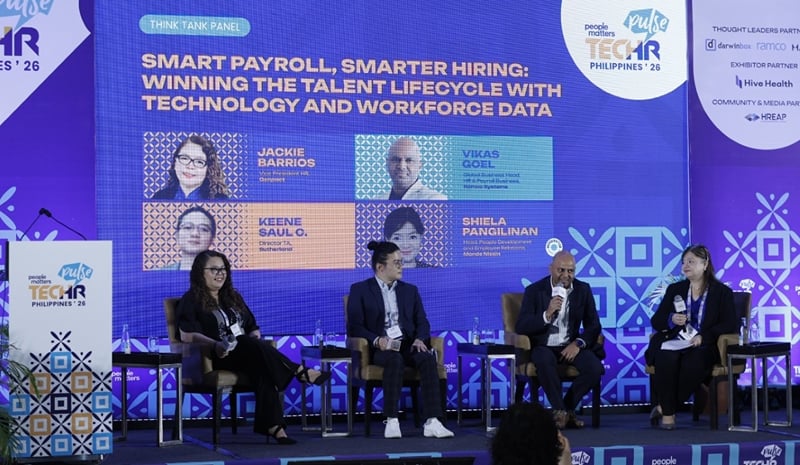
At TechHR Pulse Philippines 2026, Leaders from Genpact, Ramco Systems and Sutherland explored how connected payroll and workforce data can reduce friction across hiring, onboarding and pay, while strengthening employee trust and improving talent decisions.
The promise an organisation makes to a candidate does not end when the offer is accepted. It passes from recruitment to onboarding, HR operations and eventually payroll, where the employee discovers whether the organisation can deliver what was communicated.
If the compensation is incorrect, a joining bonus is delayed without explanation or the terms discussed during hiring do not match payroll reality, employees do not see an internal process gap. They see a broken promise.
This friction formed the central thread of the Think Tank Panel, “Smart Payroll, Smarter Hiring: Winning the Talent Lifecycle with Technology and Workforce Data,” at People Matters TechHR Pulse Philippines 2026.
The conversation brought together Jaquelyn Barrios, Vice President – HR, Genpact; Vikas Goel, Global Business Head – HR and Payroll Business, Ramco Systems; and Keene Saul C., Director – Talent Acquisition, Sutherland, with Sheila Pangilinan, Head – People Development and Employee Relations, Monde Nissin, moderating.
The discussion surfaced a critical weakness in traditional HR architecture: talent acquisition, onboarding, workforce operations and payroll may operate as separate functions, but employees experience them as one organisation.
Where the hiring promise begins to fracture
The most visible points of friction often emerge during handovers.
Barrios shared the example of a joining bonus promised during recruitment. The employee expects it in the first salary, only to discover that company policy schedules the payment for the second payroll. The policy may be legitimate, but the failure to communicate it creates a gap between expectation and experience.
The talent acquisition team may believe it communicated the offer correctly. The onboarding team may assume payroll will provide the details. Payroll may simply apply the policy recorded in its system. Each function completes its assigned task, yet the employee is left with an experience that feels inconsistent.
Keene brought the same issue into the wider candidate journey. A new employee interacts with recruiters, HR representatives, onboarding teams and payroll administrators, each carrying a different perspective and set of information.
For the employee, however, these are not separate touchpoints. They are different representations of the same employer.
Creating a consistent experience requires more than improving individual processes. Recruitment, onboarding and payroll need a shared understanding of what has been promised, what must be delivered and which team owns each communication.
Goel captured the commercial impact clearly: “The entity that faces the friction is the employee. But the entity that pays for that friction is the organisation.”
The cost can appear through payroll corrections, repeated employee queries, recruiter rework, employee-relations cases, negative employer reviews and early attrition. A small information gap can quickly become a trust and retention problem.
Payroll data belongs upstream in workforce decisions
Payroll has traditionally been positioned as a back-end utility responsible for processing salaries and maintaining compliance. Its data, however, can inform decisions much earlier in the talent lifecycle.
“Payroll is the richest data that the organisation has, but the most underutilised data the organisation has,” Goel said.
Payroll and timekeeping systems contain information on workforce costs, overtime, absence patterns, compliance exposure and attrition. When connected with hiring and operational data, these signals can help organisations determine where to recruit, which talent segments are becoming expensive and whether a workforce model is sustainable.
The value does not come from producing more reports. It comes from connecting information across the employee journey and translating it into decisions.
Barrios pointed towards timekeeping data as one example. Organisations frequently turn to exit interviews to understand attrition after an employee has already decided to leave. Attendance patterns may provide earlier signals that warrant closer attention.
Recurring absence or changes in attendance should not produce automatic conclusions about an employee. They can, however, prompt timely conversations and help leaders understand whether workload, management, engagement or personal circumstances require intervention.
This shifts workforce data from retrospective reporting towards earlier action. Instead of asking why employees left, organisations gain an opportunity to identify friction while there is still time to respond.
From correcting payroll errors to preventing them
The shift from payroll processing to payroll intelligence becomes more tangible when technology identifies exceptions before salaries are released.
Ramco’s Payce platform, for example, uses an AI and machine learning-based Anomaly and Reasoning Engine to examine payroll runs for unusual patterns and statistical variances. Detected anomalies are categorised by severity, with reasoning provided to help payroll teams understand which exceptions need attention before approval.
This changes the operating model from finding errors after employees have been paid to detecting potential issues before they affect the workforce.
Its Payroll Workspace provides a central view of active payroll runs, anomaly flags, approvals and Workday synchronisation. Payroll teams can review exceptions, resolve errors and monitor approval progress within the same operational environment.
The significance lies less in the dashboard itself and more in the visibility it creates. When payroll teams can see exceptions, dependencies and integration failures earlier, fewer problems travel downstream to employees.
Ramco has also introduced BInGO, an AI-powered payroll analytics capability that enables HR and finance teams to explore information through natural-language questions. Users can examine labour costs, headcount movements, payroll trends and country-level results without depending entirely on manual data extraction and specialised reporting cycles.
For senior leaders, this can reduce the distance between a payroll question and a workforce decision. Instead of waiting for data to be extracted, reconciled and formatted, decision-makers can explore trends and test follow-up questions more quickly.
These capabilities illustrate a broader change: payroll technology is moving from recording what happened to explaining what appears unusual, why it may have happened and where leaders should look next.
The first payroll is a test of organisational trust
Hiring creates an expectation. Onboarding begins the relationship. The first payroll demonstrates whether the organisation can deliver.
For employees, the fundamental expectations remain straightforward: pay them correctly, pay them on time and keep their data secure.
When any of these conditions fail, the damage can extend beyond the immediate error.
“The biggest risk is the loss of trust,” Goel said.
Trust begins with the job advertisement. The role description, workplace location, salary and benefits establish the candidate’s first understanding of the employment proposition. That expectation must remain consistent through interviews, the offer, onboarding and the first salary.
Keene connected this consistency with employer reputation. A salary or benefit that differs from what was originally communicated can quickly surface on social media and employee forums. The discrepancy may begin as an internal data or communication problem but become a public signal about the organisation’s credibility.
The consequences may also remain invisible.
Barrios described fragmented processes as a possible cause of “silent attrition”, where employees slowly disengage while questioning whether they joined the right organisation.
“You don’t raise a ticket for silent attrition,” she said.
The organisation may continue to see completed transactions and closed service requests while employee confidence is quietly deteriorating. By the time the issue appears in performance, absence or resignation data, the original process failure may be difficult to trace.
Self-service can remove friction without removing accountability
A connected payroll experience must also make information easier for employees to access.
Ramco Payce’s AI payroll assistant, Chia, allows employees to seek information on payslips, leave and other routine payroll matters through workplace channels including Microsoft Teams, WhatsApp and Slack.
This can reduce the time employees spend navigating portals, raising service requests or waiting for routine answers. It can also reduce the volume of repetitive enquiries handled manually by payroll teams.
The larger opportunity is to reserve human support for situations that genuinely require investigation, empathy or judgement. Automation can answer a standard question about a payslip; a complex discrepancy or sensitive employee concern may still require a person.
Employee self-service is therefore most valuable when it improves access without obscuring accountability. Employees must still know where to turn when an automated response does not resolve the issue.
For multinational organisations, accessibility must also sit alongside regulatory consistency. Ramco Payce supports native payroll across more than 60 countries, with wider payroll coverage across over 150 countries. Its architecture combines country-specific statutory requirements, automated compliance and integrations with enterprise systems such as Workday and Oracle.
Ramco also states that its in-memory engine can process 100 million payroll records in 30 minutes, addressing the scale required by large and geographically distributed employers.
These capabilities support operational consistency, but the quality of the experience still depends on accurate source data, clear governance and responsible exception handling.
AI can reduce administration, but people retain accountability
AI can help close process gaps and remove repetitive work across recruitment and HR operations. Its value depends on how well the organisation connects technology with human responsibility.
For recruiters, automation can support candidate-status updates, interview notes, referral tracking and routine communication. This creates more time for conversations that require context, judgement and relationship-building.
“AI is a tool that will help you do your job better. It can amplify your team’s potential,” Keene said.
The differentiator is not simply whether recruiters use AI, but how they use the time and information it provides. Human connection remains essential when assessing motivation, explaining the reality of a role and building confidence in the organisation.
The same principle applies to internal mobility. Barrios discussed how AI tools can surface candidate compatibility, performance information and possible career matches. These insights can support decisions, but they should not become the decision themselves.
“The tool is only as good as the user,” she said.
Employees using these systems need to understand their capabilities, recognise potential bias and refine the instructions that shape their output. Final responsibility must remain with the person interpreting the information.
The foundation is human in the loop: AI provides signals and recommendations, while people retain the last mile of thinking and accountability.
As Pangilinan summarised, people remain the pilots and AI acts as the co-pilot.
Connected data does not require one system
Removing friction does not mean placing every talent process inside one platform or combining every function.
Payroll requires specialist expertise because it operates as a compliance engine. It must deliver accurate and timely pay while meeting the legal and regulatory requirements of every market in which the organisation operates.
The goal is not to absorb payroll into talent acquisition. It is to connect the relevant data and maintain consistent information across specialist processes.
A single source of truth matters more than a single system.
Talent acquisition teams can use compensation and payroll intelligence to create greater salary transparency, set accurate candidate expectations and assess whether the organisation can attract the skills it needs in a particular market.
Keene also connected this information with business growth. Compensation data can help talent acquisition teams assess workforce availability, delivery locations and pricing when the organisation is evaluating a prospective client or launching a new operation.
This moves talent acquisition beyond filling approved positions. Recruitment data becomes part of decisions about where the business can grow and whether the required talent model is commercially viable.
One employee journey, one organisational promise
Employees do not distinguish between a recruitment promise, an onboarding process and a payroll transaction. Each interaction shapes their view of the employer.
Organisations may retain different functions, systems and areas of expertise, but they need shared data, clear ownership and consistent communication across the entire lifecycle.
Technology can surface anomalies, simplify analysis and answer routine employee questions. Its strategic value emerges when those capabilities prevent errors, enable earlier decisions and help the organisation deliver what it promised.
Smarter hiring begins with identifying the right candidate. It becomes credible when onboarding, payroll and workforce operations can deliver the same promise.
Author
Loading...