








Strategic HR
SHRPA 2026 Executive Insights SEA: From Quick Wins to Enterprise Transformation






SHRPA 2026 HR Tech and Transformation research SEA executive insights explore current trends and challenges in the Southeast Asia region.
AI is becoming central to enterprise strategy in Southeast Asia, increasing the focus on technology maturity, data readiness, workforce capability and organisational change. With dampened economic activity and cautious spending, HR leaders must support building the foundations for AI transformation to realise the potential of their investments in AI.
SHRPA 2026 HR tech and transformation research touches upon the key trends surfacing across the SEA region on AI transformation. These trends will be valuable for HR leaders and HR tech partners to identify opportunities for their organisations where AI can create the most impact.
How are HR leaders selecting and driving HR use cases?
SHRPA 2026 SEA Executive Insights findings suggest that the adoption levels for AI are highest in the hiring and hr operations use cases. There is twice as much gap between the adoption levels in hiring and hr operations as compared to the adoption levels in employee experience, L&D and performance management.
While adoption levels favour hiring and hr operations, HR leaders are also increasing their investments in talent development, acquiring the right talent and retaining top performers. Additionally, HR leaders also expect the highest impact of AI on HR use cases in hiring and hr operations.
This leaves other areas in HR underexplored, as neither do they have traction in usage nor are they getting the investments. HR leaders are prioritising investments and adoption based on feasibility of execution rather than strategic intent.
How is the HR tech landscape contributing to the widening maturity gap in organisations?
HR tech market in SEA is expected to grow at a strong 10-25% growth rate, with a similar growth in investments. This leaves some potential for HR leaders to test available AI-native solutions across HR functional areas.
The HR tech ecosystem is dominated by new emerging product categories, followed by a rise of AI-native challengers that are putting pressure on established platforms. However, in the absence of a clear use case shared by the organisations, these AI-native challengers struggle to deliver value to the organisations, further pushing down their AI maturity.
Another reason that contributes to the widening maturity gap is the misalignment of HR leaders and HR tech partners on capabilities to include in HR tech platforms. While HR leaders are seeking capabilities in HR data fabric, GenAI-powered learning and manager self-serving dashboards, HR tech partners are not aligned to offer these, creating a supply gap.
How can organisations build enterprise AI maturity?
One of the top challenges for HR leaders in SEA is not being able to move their AI transformation efforts from pilots to scale. HR leaders have to build six key foundational pillars in order to set up scalable AI transformation efforts.
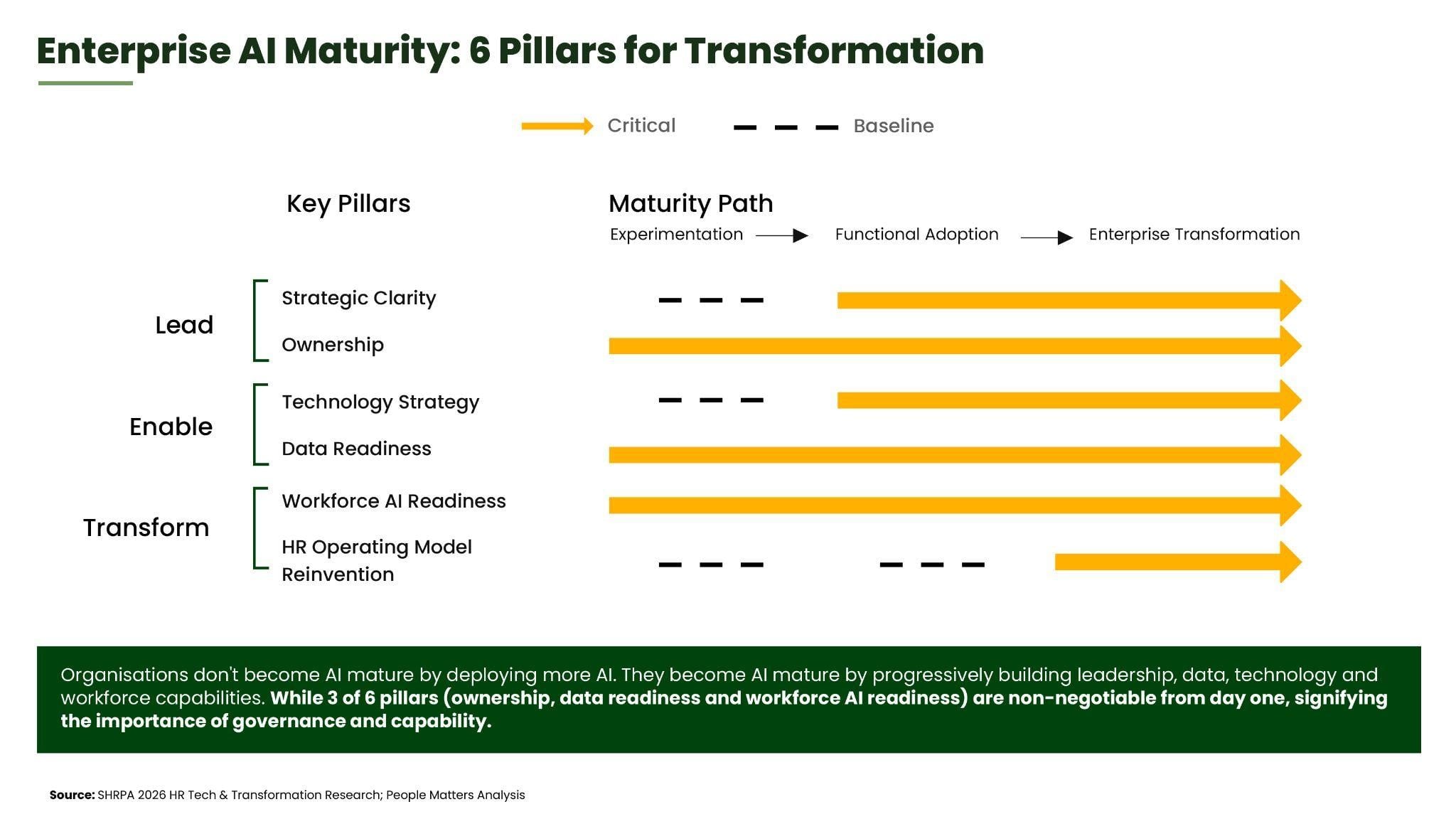
The six foundational pillars are:
Strategic clarity: 65% HR leaders in SEA believe that their understanding of AI and how it impacts their business is a key challenge for them and are not adequately supported by the HR on this. Leadership has a large role to play in AI transformation efforts, as they can sponsor the transformation and enable stickiness of the efforts.
Ownership: In the Southeast Asia region, most adoption efforts are led by HR leadership across maturity levels. However, clarity of ownership remains low during early maturity stages.
Tech Strategy: The HR tech has a growing number of large established platforms consolidating their share, while there are AI-native point-based solutions coming up as well. This can result in a procurement challenge for HR leaders who may have to acquire HR tech capabilities in a distributed portfolio of HR tech providers.
Data Readiness: AI transformation success depends heavily on the quality of data infrastructure. HR leaders in SEA struggle to get accurate data which can be integrated across multiple platforms. Above this, there are challenges with data privacy, which can further compromise data integrity.
Workforce AI Readiness: 80% of HR leaders in SEA expect leaders to acquire a combination of deep expertise and AI fluency in response to the introduction of AI. There is an increase in the demand for role-based segmentation for developing AI readiness.
HR Operating Model Reinvention: The HR function has to reinvent itself before it can enable enterprise AI maturity. However, a lack of internal capability to manage change and deploy AI becomes a prime obstacle in redesigning the HR function for AI.
While HR leaders in SEA are exploring making HR roles more strategic and creating more AI-focused roles, 51% of HR leaders are still planning structural changes in the next 12 months.
How can HR leaders measure the ROI on their AI investments?
HR leaders in SEA are still measuring their AI investments' ROI in the form of foundational markers like productivity gains, cost reduction, HR service delivery quality and operational speed. However, progressive organisations differentiate themselves by factoring the employee experience component as well. Employee experience, along with business outcomes, forms the key differentiators for organisations to measure success. The most sophisticated organisations are tracking the improvement in decision quality and time reinvestment from the productivity gains coming from AI adoption.
Most organisations are unable to realise the gains from AI transformation due to weak foundations. HR leaders must ensure strong ownership of AI adoption, followed by building the core of data and workforce readiness and keeping business and employee outcomes as the north star for their efforts.
Download the SHRPA 2026 HR Tech and Transformation Research SEA Executive Insights here.
Author
Loading...