








Talent Management
Building careers, not just jobs: Dr. Guruvayurappan PV on talent, education, and lifelong learning





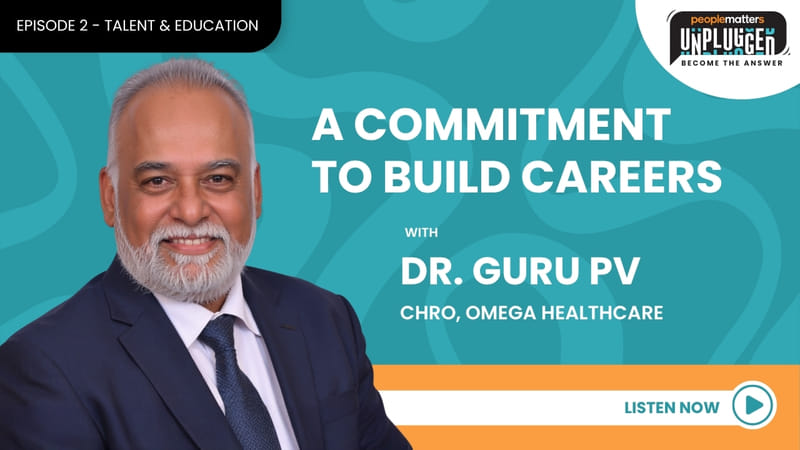
Dr. Guruvayurappan PV shares why HR must shift from job fulfilment to long-term career creation, embedding lifelong learning, holistic wellbeing, and a strong coaching culture for sustained growth.
In today’s fast-evolving world, where business, society, and environmental challenges are deeply interconnected, the role of HR has expanded far beyond the confines of office walls. Talent management is no longer limited to recruitment and retention—it now encompasses shaping future-ready workforces, fostering continuous learning, and enabling holistic employee well-being. In a recent episode of People Matters Unplugged, Dr. Guruvayurappan PV, CHRO, Omega Healthcare Management Services, shared his three-decade journey across industries and offered deep insights into building careers, nurturing talent, and bridging the growing gap between education and employability.
Dr. Guruvayurappan, affectionately called Guru, leads the people strategy for over 35,000 employees across four countries. An ICF-certified professional coach, fellow of the Institute of Directors, and Doctor of Excellence in Management, he has extensive expertise in organisational development, workforce planning, learning and development, and employee relations. His approach combines strategic thinking with a profound focus on human potential—a philosophy that has shaped Omega Healthcare’s culture of continuous learning and career growth.
A journey across industries
Guru began his career in manufacturing, where training was primarily focused on turning unskilled or semi-skilled employees into productive workforce members. “The training was about getting people to do their job effectively,” he explains. Over time, he witnessed the evolution of industries, from manual manufacturing to automation, aviation, and the business process outsourcing sector. This trajectory exposed him to a critical insight: learning must evolve from task-based training to a culture of lifelong learning.
“When I joined Omega, we had about 500 employees. Today, we are 35,000,” Guru notes. He emphasises that while hiring and training associates is important, creating a leadership pipeline and succession planning is paramount. In his view, a thriving workforce is built not just on skills but also on trust, opportunity, and the freedom to learn—even through mistakes. From blue-collar apprentices to knowledge professionals, Guru’s journey illustrates that the essence of HR lies in unlocking human potential, not merely fulfilling organisational needs.
Lifelong learning and coaching culture
Guru’s passion for education extends beyond professional obligations. After moving into corporate HR roles, he took charge of a training centre, overseeing programmes ranging from new hire induction to executive leadership development. It was during this period that he recognised the transformative power of creating a culture where employees can express their talents freely. Whether through sports, arts, or professional skills, employees thrive when given the space to explore and learn.
This philosophy led to the creation of Omega’s Coaching Center of Excellence, where leaders undergo extensive coaching training to facilitate meaningful conversations. Guru observes, “Our conversations have become coaching-oriented. People feel safe, and finger-pointing is rare. The environment is non-toxic, and this has translated into engagement and growth.” By embedding coaching into the organisational DNA, Omega ensures that learning and development are continuous, relevant, and deeply personalised.
Career-centric talent development
A key differentiator for Omega Healthcare is its commitment to building careers, not just jobs. In the competitive healthcare RCM (Revenue Cycle Management) sector, upskilling employees could be seen as a risk if competitors poach talent. However, Guru has taken a long-term, ecosystem-based view. “We never feared losing talent,” he says. “Upskilling benefits the employee, the organisation, and the broader ecosystem.”
Omega established the Medical Coding Academy in 2015, which trains employees comprehensively, enabling them to be certified professionals capable of serving both Omega and the wider market. The academy produces talent that benefits the industry at large, a testament to Guru’s belief in career creation over job fulfilment. Employees are trained across specialities, gaining broad skills rather than task-specific knowledge, which prepares them for long-term career growth.
This approach has tangible results: many employees who joined Omega decades ago as associates have risen to leadership roles, becoming vice presidents and heads of business. Guru emphasises that career progression is structured, intentional, and supported by continuous learning initiatives, ensuring high retention and organisational loyalty.
Holistic employee well-being
Today’s workforce seeks more than just career growth. Holistic development—including financial, social, and mental well-being—is increasingly critical. Recognising this, Omega Healthcare has introduced programmes like Parivartan, an Employee Assistance Program, and Roshni, focused on empowering women employees.
Parivartan provides employees with a neutral space to discuss personal and professional challenges, while Roshni supports women in navigating career interruptions, maternity leaves, and work-life integration. With over 50% of Omega’s workforce comprising women, these initiatives ensure that employees have both organisational and peer support, facilitating smooth transitions and sustained career engagement.
Financial wellness is another area of focus. Omega provides mechanisms such as earned salary advances to address short-term financial needs, reducing stress and promoting productivity. Guru notes that holistic support enhances employee engagement and loyalty, highlighting that well-being outside the workplace directly impacts well-being and performance at work.
Bridging the employability gap
Despite these initiatives, Guru acknowledges that graduate employability is declining, citing Mercer’s 2025 Graduate Skill Index, which shows that only 42.6% of Indian graduates are employable. He believes that employability is not solely the responsibility of academia or employers but requires a societal shift in how careers and education are approached.
“Organisations need to hire for attitude and then train for skills,” Guru asserts. He recommends apprenticeship models where students gain practical experience while learning. Such initiatives not only bridge skill gaps but also foster independence, critical thinking, and workplace readiness. Guru cites examples from the medical coding sector, where employees with diverse educational backgrounds—physiotherapists, pharmacists, or alternative medicine graduates—can be trained to become competent coders through structured learning programmes.
Future-ready metrics and AI-driven learning
While traditional training metrics often focus on hours completed or courses attended, Guru emphasises skill application and impact on job performance as critical measures of success. Furthermore, he sees AI-driven personalised learning as a key future initiative. By tailoring learning paths to individual employees, organisations can ensure that skill development aligns with both personal passions and business needs.
Rapid-fire reflections from Guru underscore his philosophy:
Boldest Bet: Embedding lifelong learning into the DNA of every employee.
Biggest Blind Spot: Underestimating how quickly AI will reshape human roles.
One Action for Leaders: Encourage 30 minutes of intentional learning per week, driven by personal curiosity rather than organisational mandates.
The systems thinking approach
Central to Guru’s vision is a systems thinking approach, which views talent, business, and societal challenges as interconnected. By leveraging HR to address workforce preparation, education gaps, and holistic development, organisations can create a positive ripple effect across industries and communities. “If employees are supported, engaged, and continuously learning, they will not only thrive professionally but also contribute meaningfully to society,” he says.
Takeaways for HR leaders
The conversation with Guru offers several actionable insights for HR leaders and business executives:
Shift from jobs to careers: Design learning programmes that enable broad skill development and long-term growth.
Embed coaching culture: Foster a safe, supportive environment where employees feel encouraged to learn and experiment.
Invest in holistic well-being: Address mental, financial, and social needs to enhance engagement and retention.
Collaborate with academia: Engage with educational institutions to prepare graduates for future workforce requirements.
Leverage technology: Explore AI-driven personalised learning to meet individual and organisational development goals.
Measure impact, not just participation: Evaluate training based on skill application and workplace performance, not just attendance.
Conclusion
Dr. Guruvayurappan PV’s insights underscore that HR today is not just a function of hiring, payroll, or compliance—it is a strategic lever for societal and organisational transformation. By focusing on continuous learning, holistic development, and career creation, organisations can prepare employees for both the challenges of today and the uncertainties of tomorrow.
As HR leaders and business strategists seek to navigate a rapidly evolving talent landscape, Guru’s experiences serve as a compelling reminder: invest in people, build ecosystems that enable growth, and approach talent through a systems thinking lens. Ultimately, the future of work is not just about filling positions—it’s about creating meaningful careers, nurturing human potential, and shaping a workforce ready to thrive in an interconnected world.
Topics


Loading...