








Leadership
It's not a generation gap. It's a readiness gap




The technology will keep changing, faster than any of us can fully keep up with. But the job of HR, and honestly the job of anyone leading people, hasn't changed all that much.
This article was first published in the latest edition of People Matters Perspectives.
A few honest thoughts on technology, generations, and why no single HR playbook works anymore.
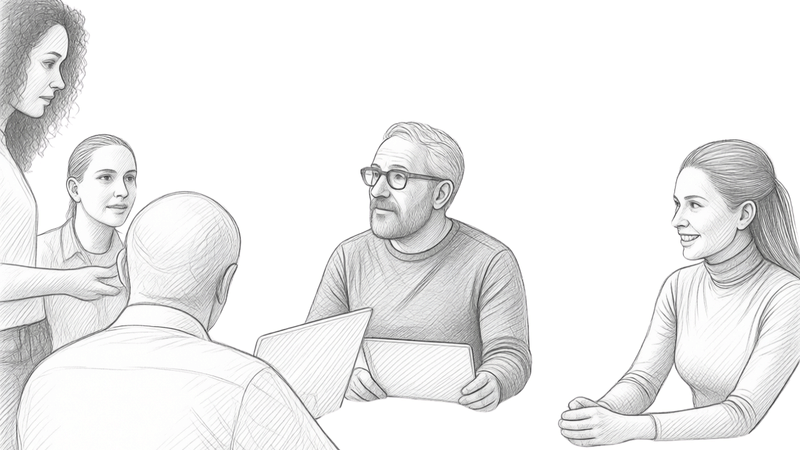
A few weeks ago, I was at a BFSI leaders conference. During one of the coffee breaks, I got talking to a senior banker who's been in the industry for almost three decades. A few tables away, a young analyst from his team was showing his colleagues something on his phone, probably an AI tool that had just summarised a 40-page credit report in under a minute.
Neither of them was doing anything wrong. They were just standing in two completely different relationships with technology, in the same room, on the same team, working toward the same goal.
I haven't stopped thinking about that moment since.
Why I think about this differently now
For over half a decade, I've been writing on the growth of companies covering founders and CXOs, trying to get to the heart of how they see they’ve evolved; though understood it better with business figures and data.
Also, I asked some version of the same question every week: how are you preparing for the next digital shift and are your people ready for the technology you're about to roll out? These days I sit on the other side of that exact same question, talking to people leaders instead of business leaders.
And here's what I've slowly come to believe. Technology adoption was never really a technology problem. It's a people problem wearing a tech costume.
The numbers are moving faster than I expected
Deloitte's newest Gen Z and Millennial survey found that close to three-quarters of both Gen Z and millennial employees are now using AI in their day-to-day work. A year ago, that number was barely above half. That's not a slow climb. That's a generation flipping a switch.
But adoption and readiness are two very different things. The same survey found nearly a third of these employees don't think their own organisation is actually prepared for the changes AI is bringing. So people are moving faster than the systems, training, and trust around them.
Closer home, BCG's latest AI at Work report had a number that genuinely made me sit up. Among Indian frontline employees who use AI, 96% said it has already changed what's expected of them in their role, and 70% said it saves them a full workday every single week, the highest of any country in the survey.
But the same report has a finding I think gets ignored too often. Two out of three regular AI users globally said the technology has made their job more satisfying. At the same time, around 40% also said it's made their job mentally heavier. BCG calls this the joy paradox. Work gets better and harder for the same person, at the same time.
And there's a Gartner number that keeps me honest. Only about 25% of workers, across every level of seniority, say they've actually used a GenAI tool to meaningfully cut down the effort needed for something that really mattered to their job. So even with adoption at an all-time high, real impact is still rare. Most of us are dabbling, not transforming.
‘Digital native’ is a label I think we should retire
We love to assume the under-30s in our office are naturally ready for whatever comes next, just because they grew up with a phone in their hand. And we assume the over-50s are somehow behind, just because they didn't.
Both assumptions are wrong more often than they're right.
Knowing how to use Instagram doesn't mean you know how to use an AI tool responsibly inside a regulated industry. And not growing up with the internet doesn't mean you can't out-adopt half your office once someone shows you why a tool actually matters to your job.
If anything, the most underrated group in this conversation is the one in the middle. People in their forties and early fifties who remember a world before smartphones and have also fully lived through the world after. They often make the best translators in the room, the ones who can explain new technology to someone twice their age, while also asking the right uncomfortable questions to someone half their age who's moving fast without checking the basics.
There's no single playbook, and I don't think there ever will be
I follow cricket closely, and I keep coming back to one simple idea from it. A good captain doesn't train a 19-year-old fast bowler the same way he handles a senior batter who's played 150 matches. One needs raw energy shaped with discipline.
The other needs his experience respected, not micromanaged. Same team, same goal, completely different handling.
I think HR has to think the same way.
A startup where most people are in their twenties has a completely different problem than a 50-year-old NBFC with decades of knowledge sitting inside a handful of senior employees. A product company scaling fast has different friction points than a services firm, where the relationship with the client is still the real product. None of them can run the same training module, the same townhall, or the same one-line AI policy and call it a strategy.
So what do I actually think HR should be doing
A few things, none of them flashy.
First, stop guessing who's "ready" based on age. Go find out, person by person, where people actually stand. I've met 55-year-olds who've automated half their job and 24-year-olds who've never used anything beyond Instagram for actual work.
Second, make space for the perspective that's already in the building. I interviewed a BFSI HR leader, a few days ago, and one thing he said has stuck with me. With younger employees, it's rarely a skills problem, it's that hierarchy filters their perspective out before it reaches the people making the real calls. So build the exchange deliberately, in both directions. Let the younger ones teach the tools. Let the experienced ones teach the judgement no tool will ever warn you about. And give both an actual seat at the table, not a once-a-quarter listening session for show.
Third, talk about the fear in the room honestly, instead of just rolling out another tool and hoping for the best. People aren't anxious because they're resistant to change. They're anxious because nobody's telling them clearly what their role looks like a year from now.
One last thought
I've always believed good storytelling in business isn't really about what's happening, it's about why it matters. I think the same is true for the future of work.
The technology will keep changing, faster than any of us can fully keep up with. But the job of HR, and honestly the job of anyone leading people, hasn't changed all that much.
It's still about seeing the person in front of you clearly, and helping them find their place in whatever comes next.
That banker and that young analyst at our summit weren't really divided by age. They just hadn't had the chance to learn from each other yet. I think that's the real work ahead of us.
Topics
Author
Loading...
Loading...