








AI & Emerging Tech
Indonesia launches first university-based AI centre to strengthen research and talent development






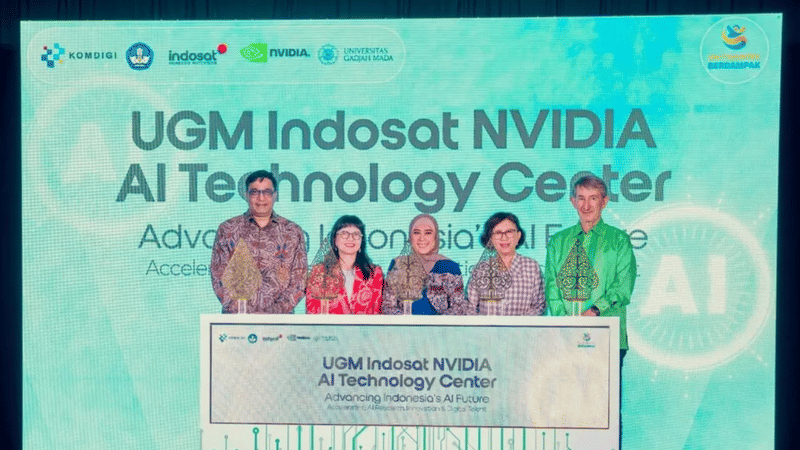
Researchers and students at UGM will have access to AI infrastructure, software tools and computing resources to develop solutions tailored to Indonesia's needs.
Indonesia has launched its first university-based artificial intelligence (AI) technology centre as the government accelerates efforts to develop domestic AI capabilities and strengthen collaboration between academia, industry and the public sector.
The UGM Indosat NVIDIA AI Technology Centre, launched in Yogyakarta, is a joint initiative involving the Ministry of Communication and Digital Affairs, Indosat, Nvidia and Universitas Gadjah Mada (UGM).
Established under the Indonesia AI Centre of Excellence programme, the facility aims to support research, talent development and the practical application of AI to address national challenges.
The centre will initially focus on three priority areas: healthcare, agriculture and disaster management. Researchers and students at UGM will have access to AI infrastructure, software tools and computing resources to develop solutions tailored to Indonesia's needs.
According to the Ministry of Communication and Digital Affairs, the initiative is intended to strengthen the country's technological independence and reduce its reliance on imported AI technologies.
Meutya Hafid, Indonesia's Minister of Communication and Digital Affairs, said the centre reflects the country's ambition to move beyond AI adoption and become a contributor to global AI innovation.
She said the initiative would help establish the foundations for Indonesia's AI sovereignty while supporting economic growth, national competitiveness and the development of solutions to the country's most pressing challenges.
The project combines Nvidia's AI software and models with GPU Merdeka, Indosat's sovereign GPU-as-a-service platform, providing local researchers with access to advanced computing infrastructure and development frameworks.
UGM said the centre would serve as a hub for education, research and innovation while expanding opportunities for AI development beyond Jakarta.
Professor Ova Emilia, rector of Universitas Gadjah Mada, said the initiative aligns with national priorities in higher education, research commercialisation and workforce development.
She added that accelerating AI adoption through education and research would help prepare future-ready talent while increasing the societal impact of academic innovation. Improving access to computing infrastructure is a central objective of the programme.
Although Indonesia has a large research community, limited access to advanced hardware, AI models and specialised software has historically constrained the development of locally focused AI solutions.
The centre aims to address these barriers by creating a broader ecosystem that connects researchers, students, entrepreneurs and technology innovators.
Vikram Sinha, president director and chief executive officer of Indosat Ooredoo Hutchison, said the company wants to ensure that AI opportunities are accessible to all Indonesians.
He said the initiative would help expand AI readiness across the country while supporting the government's vision of positioning Indonesia as both a developer and contributor to AI technologies.
Nvidia also emphasised the importance of strengthening local expertise through global collaboration.
Marc Hamilton, vice president of solutions architecture and engineering at Nvidia, said Indonesia's growing community of researchers and developers has significant potential to shape the future of AI.
The centre's first projects focus on addressing some of Indonesia's most urgent public policy challenges.
In healthcare, researchers at UGM's Faculty of Medicine, Public Health and Nursing are developing eNose-TB, an AI-powered screening system that analyses breath samples to identify potential tuberculosis cases.
Indonesia records more than one million new tuberculosis cases annually, and researchers hope the technology will improve screening in rural and underserved communities.
Agriculture will be another key area of research through the SmartAgri project, which combines satellite imagery, sensor data and local farming knowledge to generate recommendations on irrigation and crop management.
The initiative is expected to support small-scale farmers in a sector that employs nearly 30% of Indonesia's workforce.
The third project, known as Tech4Disaster, is developing a geospatial AI platform designed to improve emergency preparedness by processing satellite and sensor data more efficiently.
Given Indonesia's location along the Pacific Ring of Fire, researchers hope the technology will strengthen disaster monitoring and accelerate response efforts during earthquakes, volcanic eruptions and other natural disasters.
The launch reflects a broader trend in emerging economies, where universities are increasingly becoming integral to national AI strategies by serving as centres for talent development, applied research and innovation linked to public services and economic growth.
Topics
Author
Loading...