








AI & Emerging Tech
Industrial relations must evolve with AI, says Indonesia’s manpower minister






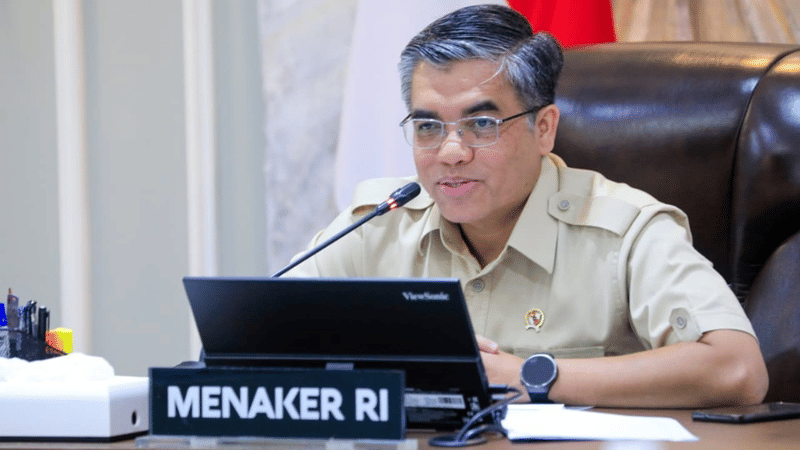
Manpower Minister Yassierli urges labor unions to champion fair work while embracing innovation, highlighting transformative industrial relations as key to a future-ready workforce and achieving Golden Indonesia.
As artificial intelligence and automation rapidly reshape the global workforce, Indonesia’s Minister of Manpower, Yassierli, has called for a fundamental shift in industrial relations, one that moves beyond harmony toward transformation.
Speaking at the opening of the 2026 National Conference of FSP FARKES KSPSI in Jakarta, Yassierli underscored the urgency of rethinking how workers and employers engage in an era defined by digital disruption.
“Industrial relations must upgrade. Not only harmonious, but also transformative, where workers and companies become strategic partners who grow together,” he said.
Beyond stability to collaboration
According to the minister, traditional models of industrial relations, focused primarily on maintaining stability and minimizing disputes, are no longer sufficient. Instead, he advocated for a collaborative framework where workers and businesses jointly drive productivity and long-term welfare.
The call comes as industries, including healthcare and pharmaceuticals, undergo rapid transformation fueled by digitalization, automation, and AI. Yassierli warned that innovation without inclusion risks leaving segments of the workforce behind.
“When the world talks about IT, automation, and AI, we must ensure that no worker is left behind. Innovation and productivity must go hand in hand with worker protection,” he emphasized.
A roadmap to maturity
Yassierli outlined a progression model for industrial relations maturity. It begins with compliance with labor regulations, evolves through transparent communication and consultation, and advances toward cooperation in resolving workplace issues.
The final stage, he noted, is true collaboration, where workers are recognized not merely as factors of production but as strategic assets.
At this level, industrial relations become a lever for both competitiveness and sustainable welfare, rather than just a mechanism to prevent disputes.
“My dream is for all companies to upgrade their industrial relations maturity,” he said, adding that this includes broader union representation, stronger collective labor agreements, and more balanced, win-win outcomes.
Trust, dialogue, and shared solutions
Central to this transformation is a cultural shift. Yassierli stressed that healthy industrial relations must be built on mutual trust, open listening, and shared problem-solving, not adversarial positioning.
He encouraged workers to channel their aspirations through constructive social dialogue grounded in cooperation and consensus-building.
Leveraging Indonesia’s cultural strengths of mutual cooperation and deliberation, he said, can help resolve workplace issues more effectively and sustainably.
Preparing for a “Golden Indonesia”
Looking ahead, Yassierli urged labor unions to continue advocating for fair and decent work while also embracing innovation and modern work practices.
Transformative industrial relations, he concluded, will be key to preparing Indonesia’s workforce for the future and achieving the nation’s vision of a “Golden Indonesia.”
As the nature of work continues to evolve, the minister’s message is clear: the future of industrial relations lies not in avoiding conflict, but in building resilient, forward-looking partnerships that ensure no worker is left behind.
Author
Loading...