








AI & Emerging Tech
Mira Murati, Fei-Fei Li and Minna Song among four women leaders on Forbes' list of 50 top AI companies





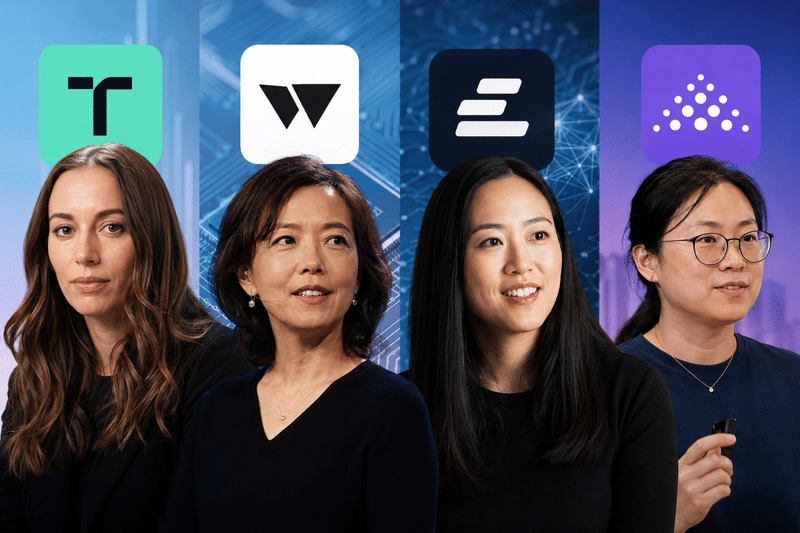
Forbes' annual ranking of the world's most promising private AI companies highlights the continued dominance of OpenAI and Anthropic, but only four female-led firms secured a place on the 2026 list.
Artificial intelligence may be attracting record levels of investment and producing some of the world's most valuable startups, but women remain significantly underrepresented among the sector's top founders and chief executives.
That reality is reflected in Forbes' 2026 ranking of the world's 50 most promising privately held artificial intelligence companies, where just four female-led businesses secured a place on the list. Among them are Mira Murati's Thinking Machines Lab, Fei-Fei Li's World Labs, Minna Song's EliseAI, and Fireworks AI, led by chief executive Lin Qiao.
The annual Forbes ranking arrives at a time when AI has moved from an emerging technology trend to a central force shaping business operations, software development, healthcare, finance, education and creative industries. According to Forbes, companies featured on this year's list have collectively raised $305.6 billion in funding, underscoring the scale of investor interest in the sector.
Women remain a small minority among AI's most prominent startups
While the AI industry has produced a growing number of high-profile founders, female representation at the top remains limited.
According to Forbes, only four female-led companies featured among the 50 firms selected for the 2026 ranking:
Thinking Machines Lab, founded by former OpenAI Chief Technology Officer Mira Murati
World Labs, founded by renowned AI researcher and Stanford professor Fei-Fei Li
EliseAI, led by founder and CEO Minna Song
Fireworks AI, led by CEO Lin Qiao
The inclusion of these companies comes amid continued discussion across the technology sector about leadership diversity in artificial intelligence, particularly as funding increasingly concentrates among a small number of founders and firms.
OpenAI and Anthropic continue to dominate the AI landscape
Forbes reported that industry leaders OpenAI and Anthropic remain the largest companies on the list by funding raised.
Together, the two companies have accumulated $242.6 billion in funding, representing approximately 80% of the total capital raised by all companies featured in this year's ranking.
According to Forbes:
OpenAI has raised $182.6 billion
Anthropic has raised $60 billion
The combined total accounts for roughly four-fifths of all funding represented on the list
The publication noted that strong adoption of generative AI tools has helped both companies achieve substantial revenue growth. Forbes reported that OpenAI had surpassed $25 billion in annualised revenue by the end of February, while Anthropic said its revenue run rate had exceeded $30 billion in early April.
Female founders are building AI companies across diverse sectors
The four women-led companies featured on the list represent very different approaches to artificial intelligence.
Thinking Machines Lab, launched by Mira Murati after her departure from OpenAI, has already raised $2 billion according to Forbes.
World Labs, founded by Fei-Fei Li, focuses on spatial intelligence and has secured more than $1 billion in funding. Li is widely recognised as one of the most influential figures in modern AI research.
Meanwhile, New York-based EliseAI has built AI-powered tools for housing and healthcare sectors. Forbes reported that more than 80% of the largest property management firms in the United States use the company's technology for administrative and customer service tasks.
Fireworks AI focuses on helping developers access and deploy AI models without managing complex infrastructure requirements. Forbes valued the company at approximately $4 billion.
New challengers emerge across the AI economy
Beyond the industry's biggest names, the 2026 list highlights a rapidly expanding ecosystem of AI startups targeting specialised industries and use cases.
The ranking includes companies operating in:
Software engineering and coding
Healthcare and medical research
Robotics
Legal technology
Financial services
Enterprise productivity
Data infrastructure
Voice and video generation
Drug discovery
Among the notable newcomers cited by Forbes are Reflection, an open-source AI startup valued at $8 billion; Gamma, an AI presentation platform valued at $2.1 billion; and Chai Discovery, which applies AI to drug development.
The list also features well-known names such as Databricks, Perplexity, Cursor, Harvey, Mistral AI, Cohere, Runway, Synthesia, ElevenLabs, Safe Superintelligence, Physical Intelligence, and OpenEvidence.
Competition intensifies as AI matures
The 2026 ranking reflects a market that is becoming increasingly competitive even as investment remains heavily concentrated among a handful of firms.
Forbes noted that several companies featured in previous editions have since been acquired or absorbed by larger technology players, highlighting the rapid consolidation taking place across the AI industry.
At the same time, hundreds of startups applied for inclusion in this year's ranking, demonstrating the continued pace of innovation and investment across the sector.
While OpenAI and Anthropic continue to dominate funding and market attention, the inclusion of leaders such as Mira Murati, Fei-Fei Li, Minna Song and Lin Qiao signals that new voices are still emerging in the race to define the future of artificial intelligence. As AI adoption expands across industries, the companies shaping the next phase of growth are likely to face increasing scrutiny not only for their technology, but also for who gets to lead it.
Topics
Author
Loading...