








AI & Emerging Tech
Salesforce claims Slack AI tools saved employees 3.8 million work hours annually






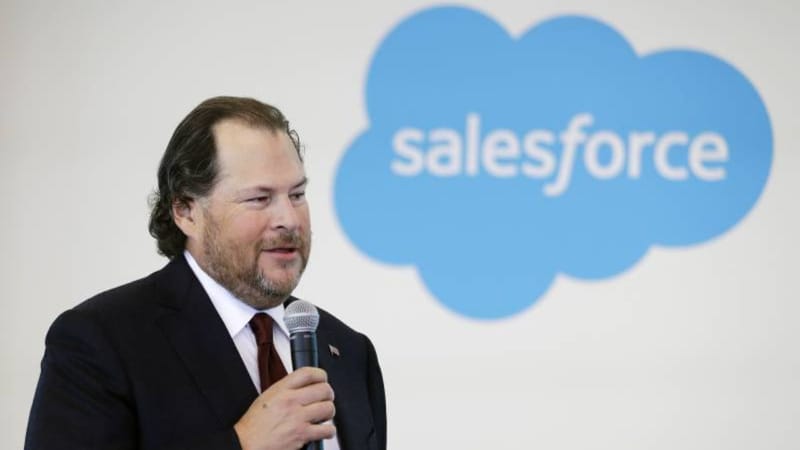
Salesforce says rapid adoption of AI tools across Slack and Agentforce is reshaping workplace productivity, software development and enterprise operations.
Salesforce says artificial intelligence tools integrated into its workplace collaboration platform Slack have generated the equivalent of 3.8 million hours in annual productivity gains for employees, as the software giant accelerates its broader push into enterprise AI.
The company disclosed the figure during its first-quarter fiscal 2027 earnings call, where executives outlined how AI adoption is beginning to influence everything from software engineering output to customer support operations and sales productivity.
The claim comes as major enterprise technology firms increasingly attempt to quantify the business impact of generative AI beyond experimentation and pilot deployments.
According to Salesforce executives, Slackbot has become the fastest adopted AI product in the company’s history across its workforce of more than 80,000 employees.
AI agents become central to workplace operations
During the earnings call, Salesforce CEO Marc Benioff described a future where AI agents become deeply embedded into workplace collaboration systems.
“In two years, there’ll be more agents using Slack than people,” Benioff said during the call.
Salesforce executives said Slack’s recently launched Model Context Protocol (MCP) crossed 1 million active users within six weeks of launch, highlighting growing enterprise interest in AI-driven workplace tools.
The company also revealed that it delivered 3.8 billion agentic work units across Slack and Agentforce during the quarter, more than double sequentially.
Salesforce defines an “agentic work unit” as a task completed by an AI system, including:
- Updating records
- Triggering workflows
- Making operational decisions
- Managing service interactions
Slack-related AI work units increased roughly fourfold quarter-on-quarter, according to the company.
Engineering teams expand output without workforce growth
Salesforce also used the earnings update to demonstrate how AI tools are reshaping internal workforce structures and productivity expectations.
Benioff said the company has maintained a largely flat engineering workforce of around 15,000 employees for nearly two years while continuing to increase software output.
According to company executives:
- AI coding tools helped double the amount of software features shipped year-on-year
- AI systems reduced engineering defects and operational incidents
- Internal AI tools improved productivity by approximately 3%
Benioff said AI efficiencies have become an important part of Salesforce’s margin strategy because the company is no longer scaling engineering hiring at previous rates.
However, the company said it continues hiring sales employees, noting that AI agents still complement rather than fully replace customer-facing human roles.
AI products drive revenue growth
Salesforce’s broader AI business also showed rapid growth during the quarter.
The company reported that:
- Agentforce annual recurring revenue reached $1.2 billion
- Combined Agentforce and Data 360 recurring revenue approached $3.4 billion
- Informatica Cloud ARR reached $1.1 billion
- The company processed 28.6 trillion AI tokens during the quarter
- Salesforce handled nearly 1 trillion API calls across core products
Executives also said the company’s top 10 customers using AI work units increased their Salesforce spending by an average of 1.5 times over the past year.
The company attributed part of its quarterly outperformance to the integration of recently acquired Informatica, which contributed approximately $444 million in quarterly revenue.
Overall first-quarter revenue rose to $11.1 billion, up 12% year-on-year excluding foreign exchange impact.
Enterprise AI race shifts from pilots to deployment
The results highlight how enterprise software vendors are increasingly competing on operational AI adoption rather than simply model development.
Salesforce executives repeatedly emphasised usage metrics, deployment scale and workflow integration as key indicators of progress.
The company said its AI systems have already processed:
- More than 4 million autonomous customer service transactions
- 52 trillion records through Data 360
- 12 terabytes of unstructured enterprise data
Salesforce President and Chief Revenue Officer Miguel Milano said the company expects continued momentum across Slack, Agentforce and Data 360 through the rest of the fiscal year.
At the same time, the company warned of ongoing softness in some traditional software categories including Tableau, Commerce Cloud and parts of its marketing business.
AI productivity becomes the new enterprise benchmark
Salesforce’s latest disclosures reflect a broader shift underway across the technology industry, where companies are increasingly measuring AI success through productivity gains, operational efficiency and revenue expansion rather than experimentation alone.
The company’s comments also underline how workplace collaboration platforms such as Slack are evolving from communication tools into AI operating environments where agents, workflows and enterprise data interact continuously.
As businesses attempt to scale AI adoption across everyday operations, vendors are now competing to prove not only that AI works, but that it can materially change how organisations manage work, staffing and productivity.
Topics
Author
Loading...